



 Whitman Expo




Outside of the direct trading of coins, our industry has seen some shake up recently on the data and information front.
Thank you to our sponsors!
Go check them out!







Collectors were keenly aware of the aftermarket price increases for the Proof sets of 1936, and sales of Proof coins in 1940 showed a notable increase from the year before. Prosperity was returning to the United States after a decade of economic depression, and this undoubtedly encouraged sales, too.
Once again, the quarter dollar registered the lowest sales, though time has rendered these slight differences meaningless. Most of the 1936 to 1942 Proofs have long since been removed from their original envelopes, so their subsequent handling weighs more heavily on their survival rate than does the respective numbers coined.
Like the nickels of 1939, those dated 1940 are transitional. The majority feature the sharper steps of Monticello introduced in 1939, yet a few were coined with dies that were impressed from the old hub having the wavy steps typical of 1938 nickels and most of the 1939 nickels. Collectors eagerly seek the 1938 Reverse nickel among the 1940 Proofs.
The Mint’s achieving of a fully brilliant finish after 1936 often came at a price in terms of design detail. Its die polishing was very harsh, and this tended to soften some of the details rather than enhance them. In addition, the dies wore quickly, and this further eroded some details. Wear was evident as shallow flow lines radiating outward from the center of the die. These lines were transferred to the coins struck from such dies, a phenomenon that a later generation of Mint employees described as “starburst.”
Instead of quickly retiring Proof dies as they became worn, Mint personnel repolished them to a full brilliance. This further eroded the details, and it even wiped out some shallow features altogether. An example is the lapel of Lincoln’s coat on the cent. Where it meets the coin’s field, this feature is in very low relief, and repeated polishing of the dies removed enough metal to diminish it significantly. Another example of overzealous polishing of the dies is seen on the Mercury dime, where the band that secures the rods of the fasces is left hanging at the bottom. Being a fairly shallow feature, one that is near the coin’s border, it was particularly vulnerable to abrasive polishing of the die. On this and other dates of Proof dimes, it may appear very thin or even partially obliterated.
Source: Whitman
Catalog Information
GSID:
10902
Fineness:
0.9
Precious Metal Weight:
0.6148 oz
Strike Type:
Proof
Edge:
Reeded
Variety:
Proof Set
Variety 2:
Reverse of 1940 Nickel, 5 Coins
Coin Date:
1940
Denomination:
1c-50c
Designation:
PR
Mint Location:
Philadelphia
Mintage:
11,246
Coinage Type:
Proof Set
Coinage Years:
1936-
Composition:
Silver
PCGS #:
904754
Send Catalog Feedback
To: editor@greysheet.com
Subject: I would like to contribute catalog info to CDN for 1940 1c-50c Proof Set, Reverse of 1940 Nickel, 5 Coins PR
Body: Referring page: http://beta.greysheet.com/prices/item/1940-united-states-proof-set/gsid/10902 GSID: 10902 Title: 1940 1c-50c Proof Set, Reverse of 1940 Nickel, 5 Coins PR
Subscribe to View
View more data, info, and visualizations. Get access to retail and wholesale pricing as well as auction data.
Coin Value History
1940 1c-50c Proof Set, Reverse of 1940 Nickel, 5 Coins PR
Currency
Grade Range
Sort by
Pricing
Values
Greysheet & CPG® Values
1936 1c-50c Proof Set, Brilliant Finish, 5 Coins PR

Worth: $5,600 – $5,600
1936 1c-50c Proof Set, Satin Finish, 5 Coins PR

Worth: $5,200 – $5,200
1937 1c-50c Proof Set, 5 Coins PR

Worth: $2,365 – $2,365
1938 1c-50c Proof Set, 5 Coins PR

Worth: $980 – $980
1939 1c-50c Proof Set, Reverse of 1938 Nickel, 5 Coins PR

Worth: $920 – $920
1939 1c-50c Proof Set, Reverse of 1940 Nickel, 5 Coins PR

1940 1c-50c Proof Set, Reverse of 1938 Nickel, 5 Coins PR
1941 1c-50c Proof Set, 5 Coins PR

Worth: $735 – $735
1942 1c-50c Proof Set, 5 Coins PR

Worth: $700 – $700
1942 1c-50c Proof Set, 6 Coins PR

Worth: $800 – $800
1950 1c-50c Proof Set, 5 Coins PR

Worth: $625 – $625
1951 1c-50c Proof Set, 5 Coins PR

Worth: $500 – $500
1952 1c-50c Proof Set, 5 Coins PR

Worth: $235 – $235
1953 1c-50c Proof Set, 5 Coins PR

Worth: $195 – $195
1954 1c-50c Proof Set, 5 Coins PR

Worth: $110 – $110
1940 Proof Set 1c-50c PCGS Proof 63-66 (5 Coins)

$925
Five-Piece 1940 Proof Set PR63 to PR66 PCGS. The coins are individually housed in holders bearing consecutive certification ... (Total: 5 coins)

$720
Five-Piece 1940 Proof Set PR65 to PR67 NGC. The coins are individually housed in holders from the same grading submission. T... (Total: 5 coins)

$1,020
Five-Piece 1940 Proof Set PR65 to PR66 NGC. The coins are individually housed in holders from the same grading submission. T... (Total: 5 coins)

$840

$1,600
Five-Piece 1940 Proof Set PR64 to PR66 NGC. The coins are individually housed in holders from the same grading submission. T... (Total: 5 coins)

$720
Five-Piece 1940 Proof Set PR65 to PR66 PCGS. The coins are individually housed in holders bearing consecutive certification ... (Total: 5 coins)

$1,110
1940 1c-50c Proof Set PCGS/CAC Proof 65-66

$1,101
Five-Piece 1940 Proof Set PR64 to PR66 PCGS. The coins are individually housed in holders. The set includes: Cent PR64 Red... (Total: 5 coins)

$840
Five-Piece 1940 Proof Set PR64 to PR67 PCGS Gold Shield. The coins are separately housed in holders with consecutive certifi... (Total: 5 coins)

$810
1940 1c-50c Proof Set: All PCGS/CAC Proof 64-66 (5 Coins)

$1,150
Five-Piece 1940 Proof Set PR64 to PR66 PCGS. The coins are individually housed in holders bearing consecutive certification ... (Total: 5 coins)

$900
1940 Proof Set 1c -- 50c PCGS Proof 65-66+ (5 coins 4 CAC)

$1,150
1940 Proof Set 1c-50c PCGS/CAC Proof 65-66 RD (5 Coins)

$1,400
Five-Piece 1940 Proof Set PR64 to PR66 PCGS. The coins are individually housed in holders bearing consecutive certification ... (Total: 5 coins)

$1,320
Five-Piece 1940 Proof Set PR64 to PR66 PCGS. The coins are separately housed in holders bearing consecutive certification nu... (Total: 5 coins)

$840
1940 Proof Set 1c-50c PCGS/CAC PR65RD PR66 PR66 PR65 PR65 (5 Coins)

$1,250
Five-Piece 1940 Proof Set PR64 to PR66 PCGS. The coins are separately housed in holders bearing consecutive certification nu... (Total: 5 coins)

$720
1940 Proof Set NGC/CAC Proof 64-66 (5 Coins)

$975
1940 1c-50c Proof Set: All NGC/CAC Proof 63-66 (5 Coins)

$1,025
Greysheet News
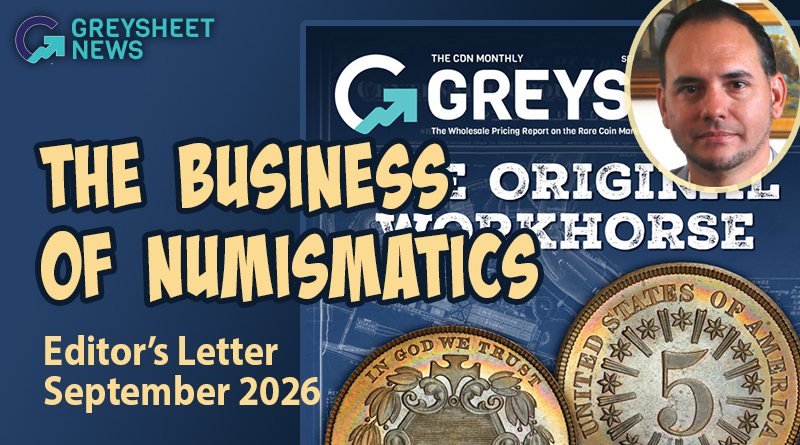
The Business of Numismatics: September 2026 Greysheet Editor's Letter
9/7/2026
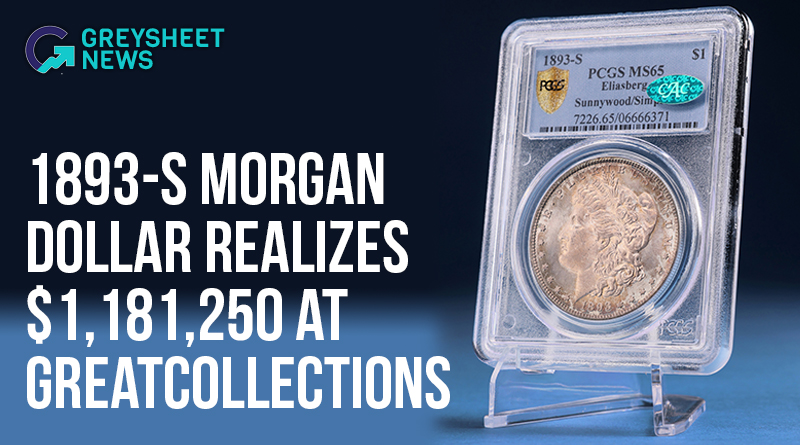
1893-S Morgan Dollar Realizes $1,181,250 at GreatCollections
Brings More Than 50% Over PCGS Price Guide — a Record for the Date in Gem Mint State.
9/4/2026
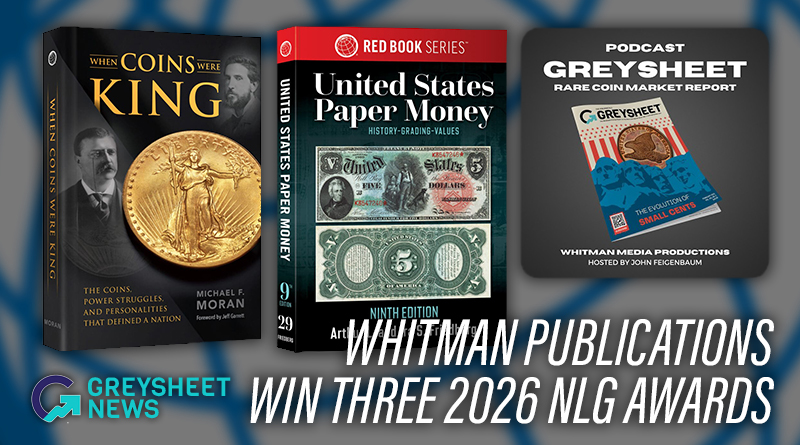
Whitman Publications Win Three 2026 NLG Awards
Whitman Brands walked away with a trio of honors during the annual Numismatic Literary Guild awards, held during the American Numismatic Association World's Fair of Money in Pittsburgh.
8/31/2026
Events
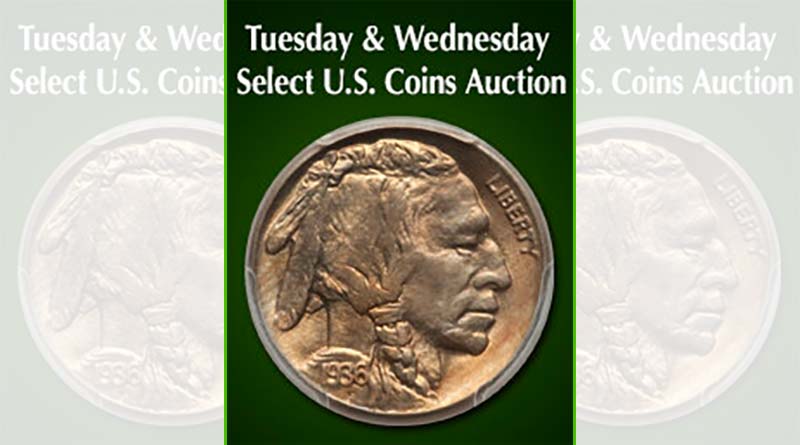
Heritage Auctions: US Coins Tuesday & Wednesday Select Auction
Location: Heritage Auctions
Wednesday, July 1, 2026
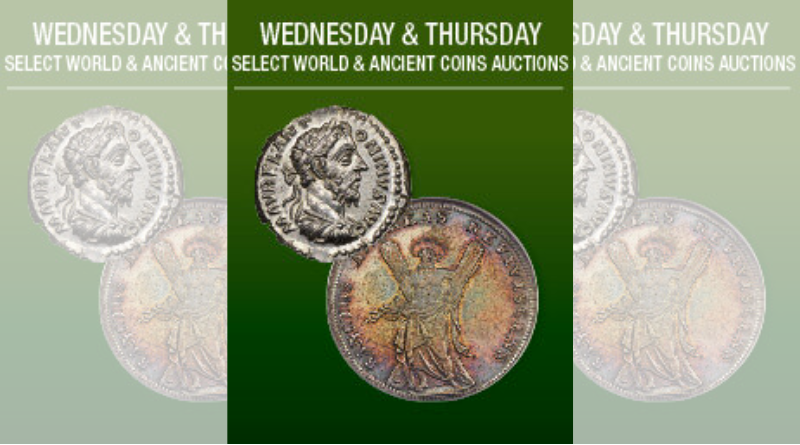
Heritage Auctions: World & Ancient Coins Wednesday & Thursday Select Auction
Location: Heritage Auctions
Thursday, July 2, 2026