



 Whitman Expo




Outside of the direct trading of coins, our industry has seen some shake up recently on the data and information front.
Thank you to our sponsors!
Go check them out!







The strain of producing a tremendous numbers of coins for circulation during the World War II years led to a suspension of Proof coin manufacture after 1942. As soon as the war ended, collectors began to plead for its resumption, but a spokesperson for the U.S. Mint claimed that the department was struggling with budget restraints imposed by the post-war recession and accumulated Federal debt. A bill to provide the funding for resumption of Proof production was not passed until 1950, being signed into law by President Harry S Truman on May 10.
Orders were accepted beginning July 17, by which time 10,000 sets had already been produced. The coin collecting hobby had experienced marked growth since 1942, and total sales of Proof sets were double those of the last pre-war issue. The popularity of this year’s set was undoubtedly increased by the fact that it included the first Proofs made for both the Roosevelt dime and Franklin half dollar.
The Mint had to once again relearn the art of polishing Proof dies and planchets. Many of the 1950 Proof coins have a finish more satiny than brilliant, much like the early sets of 1936. While the Satin Finish Proofs have a certain unique charm, collectors clearly prefer brilliant fields. When such coins also possess frosty white lettering and devices, for the all-too-rare cameo quality, they are better still.
Cameo Proofs, while available for all denominations of 1950, are very scarce. Deep or ultra cameo pieces are extremely rare and may be expected to bring substantial premiums.
The Proof coins of 1950 are very scarce in grades exceeding PF-66. The harshness of the cellophane envelopes, combined with the coins’ freedom to slide around within them, led to some pieces acquiring hairline scratches that diminish their grades. Many of the Proofs produced before the 1955 introduction of pliofilm packaging suffer from such hairlines, as well as cloudy toning. Collectors’ inexpert attempts at cleaning these coins often led to further and much more severe hairlining.
Source: Whitman
Catalog Information
GSID:
10908
Fineness:
0.9
Precious Metal Weight:
0.6148 oz
Strike Type:
Proof
Edge:
Reeded
Variety:
Proof Set
Variety 2:
5 Coins
Coin Date:
1950
Denomination:
1c-50c
Designation:
PR
Mint Location:
Philadelphia
Mintage:
51,386
Coinage Type:
Proof Set
Coinage Years:
1936-
Composition:
Silver
PCGS #:
904758
Send Catalog Feedback
To: editor@greysheet.com
Subject: I would like to contribute catalog info to CDN for 1950 1c-50c Proof Set, 5 Coins PR
Body: Referring page: http://beta.greysheet.com/prices/item/1950-united-states-proof-set/gsid/10908 GSID: 10908 Title: 1950 1c-50c Proof Set, 5 Coins PR
Subscribe to View
View more data, info, and visualizations. Get access to retail and wholesale pricing as well as auction data.
Coin Value History
1950 1c-50c Proof Set, 5 Coins PR
Currency
Grade Range
Sort by
Pricing
Values
Greysheet & CPG® Values
1936 1c-50c Proof Set, Brilliant Finish, 5 Coins PR

Worth: $5,600 – $5,600
1936 1c-50c Proof Set, Satin Finish, 5 Coins PR

Worth: $5,200 – $5,200
1937 1c-50c Proof Set, 5 Coins PR

Worth: $2,365 – $2,365
1938 1c-50c Proof Set, 5 Coins PR

Worth: $980 – $980
1939 1c-50c Proof Set, Reverse of 1938 Nickel, 5 Coins PR

Worth: $920 – $920
1939 1c-50c Proof Set, Reverse of 1940 Nickel, 5 Coins PR

1940 1c-50c Proof Set, Reverse of 1940 Nickel, 5 Coins PR

Worth: $770 – $770
1940 1c-50c Proof Set, Reverse of 1938 Nickel, 5 Coins PR
1941 1c-50c Proof Set, 5 Coins PR

Worth: $735 – $735
1942 1c-50c Proof Set, 5 Coins PR

Worth: $700 – $700
1942 1c-50c Proof Set, 6 Coins PR

Worth: $800 – $800
1951 1c-50c Proof Set, 5 Coins PR

Worth: $500 – $500
1952 1c-50c Proof Set, 5 Coins PR

Worth: $235 – $235
1953 1c-50c Proof Set, 5 Coins PR

Worth: $195 – $195
1954 1c-50c Proof Set, 5 Coins PR

Worth: $110 – $110
1950 Proof Set 1c-50c NGC Proof 64-67 (5 Coins)

$485
Five-Piece 1950 Proof Set, PR64 to PR68 NGC. The coins are individually housed in holders bearing consecutive certification ... (Total: 5 coins)

$1,080
Five-Piece 1950 Proof Set, PR65 to PR67 NGC. The coins are individually housed in holders bearing consecutive certification ... (Total: 5 coins)

$660
1950 Five-Piece Proof Set PR66 to PR68 NGC. ... (Total: 5 coins)

$1,680
1950 Proof Set 1c-50c PCGS/CAC PR65-67 (5 Coins)

$1,000
Five-Piece 1950 Proof Set PCGS. The set includes: Cent PCGS Genuine, the PCGS number ending in .91 suggests Questionable... (Total: 5 coins)

$960
1950 Proof Set NGC Proof 65-67 (5 Coins)

$600
Five-Piece 1950 Proof Set PR64 to PR67 NGC. The coins are separately housed in holders bearing consecutive certification num... (Total: 5 coins)

$1,320
Five-Piece 1950 Proof Set PR64 to PR67 NGC. Individually Housed. This set will include the following: Cent PR64 Red; Nic... (Total: 5 item)

$457
Five-Piece 1950 Proof Set, PR65 to PR67 PCGS. The coins are individually housed in holders bearing consecutive certification... (Total: 5 coins)

$840
Five-Piece 1950 Proof Set PR64 to PR66 NGC. The coins are separately housed in holders bearing consecutive certification num... (Total: 5 coins)

$1,680
1950 Five-Piece Proof Set, PR66 to PR67. ... (Total: 5 coins)

$1,560
Five-Piece 1950 Proof Set, PR63 - PR66 NGC. The set includes: cent PR65 Red, nickel PR65, dime PR66, quarter PR66, and ... (Total: 5 coins)

$432
1950 Proof Set PCGS Proof 64-67

$725
1950 1c -- 50c Proof Set PCGS Proof 66

$1,006
Greysheet News
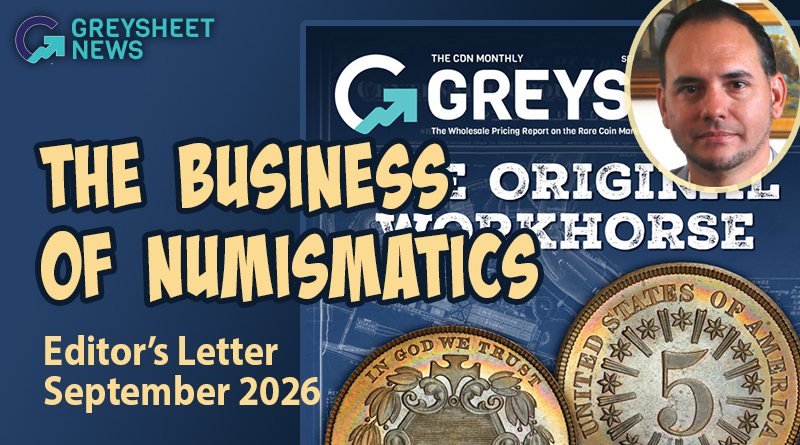
The Business of Numismatics: September 2026 Greysheet Editor's Letter
9/7/2026
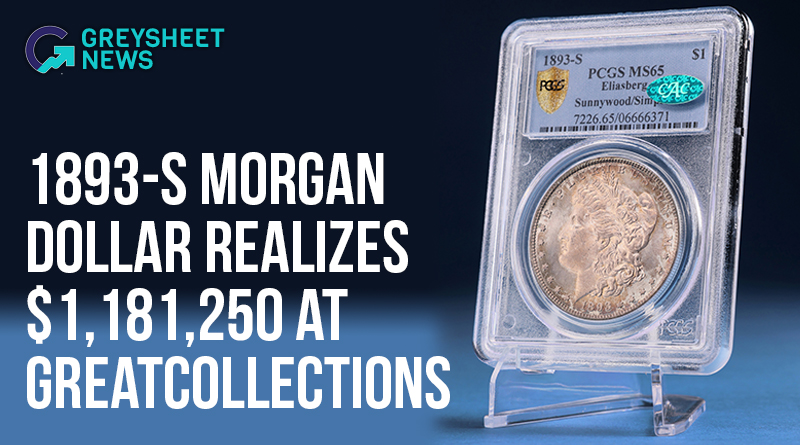
1893-S Morgan Dollar Realizes $1,181,250 at GreatCollections
Brings More Than 50% Over PCGS Price Guide — a Record for the Date in Gem Mint State.
9/4/2026
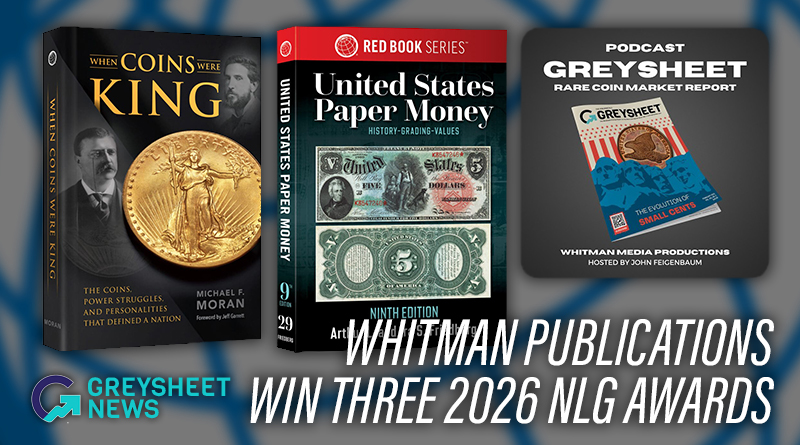
Whitman Publications Win Three 2026 NLG Awards
Whitman Brands walked away with a trio of honors during the annual Numismatic Literary Guild awards, held during the American Numismatic Association World's Fair of Money in Pittsburgh.
8/31/2026
Events
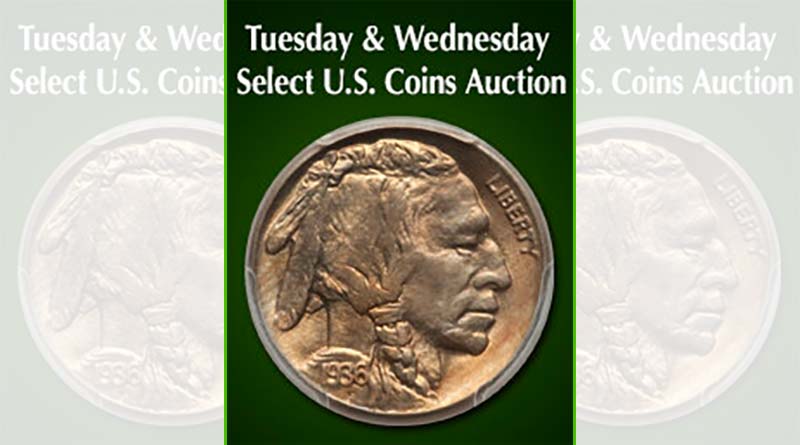
Heritage Auctions: US Coins Tuesday & Wednesday Select Auction
Location: Heritage Auctions
Wednesday, July 1, 2026
Heritage Auctions: World & Ancient Coins Wednesday & Thursday Select Auction
Location: Heritage Auctions
Thursday, July 2, 2026