




 Whitman Expo
Fear Meets Physics: The Forces Reshaping the Silver Market
On the morning of December 12, 2025, amidst a sea of red on global financial exchanges, one ticker screen flickers with a defiant green: silver, $64.09 per ounce.
by CDN Publishing |
Published on March 2, 2026


Download the Greysheet app for access to pricing, news, events and your subscriptions.
Subscribe to The Greysheet for the industry's most respected pricing and to read more articles just like this.
Advertisement
By Tom G. Ahern, Contributor
For the layperson, this is merely a commodity spike, a footnote on the evening news. But for historians who have traced this metal’s turbulent, tortured trajectory, the true spectacle is not the number itself, but the psychological fortress it has just shattered. Silver has breached $50, a legendary barrier etched on the market for over forty-five years—a line that represented both the tombstone of fortunes and the zenith of manias. Today, it is a fading line in the rearview mirror.
If gold’s epic price explosion is a straightforward chronicle of the decay of fiat currency, silver's story is far more complex. It is a dramatic, decades-long clash between its ancient roots as a store of value and its indispensable future as the lifeblood of 21st-century technology.
To understand why $64.09 is the beginning rather than the end, we must dissect the road that brought us here.
The Hunt Brothers' Corner (1971–1980)
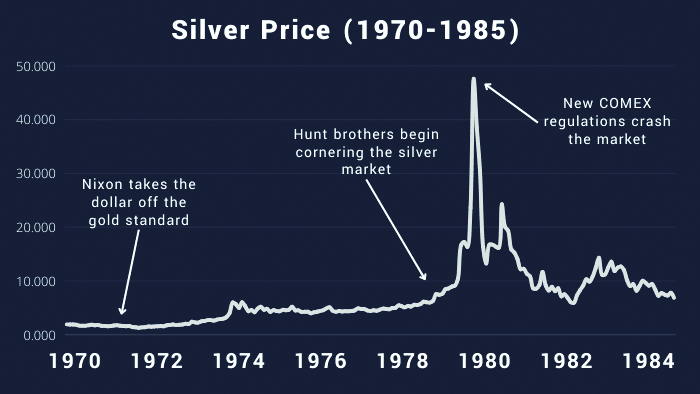
Like gold, silver’s modern odyssey begins with President Nixon’s fateful decision in August 1971 to sever the U.S. dollar's convertibility to precious metals. In one stroke, the world moved from hard money to a pure fiat system backed only by government decree. When the gold window slammed shut, silver was simultaneously unleashed from its Treasury-mandated peg of roughly $1.29 per ounce.
For years, it drifted—a monetary asset unemployed. But as the 1970s bled into 1980, the geopolitical and economic world became unmoored. Stagflation savaged the purchasing power of the dollar, Soviet tanks rolled into Afghanistan, and hostages languished in Tehran. The palpable scent of fear hung over the markets.
Enter Nelson Bunker Hunt and William Herbert Hunt
These two Texas oil tycoons viewed the chaos not with fear, but with predatory precision. Convinced the unbacked dollar was mathematically doomed, they initiated a methodical, audacious campaign to corner the global silver market.
It was a move of incredible conviction. Unlike the paper traders of today, the Hunts did not merely speculate with futures contracts; they demanded physical delivery. They commandeered airplanes to fly bullion across the Atlantic, storing mountains of 1,000-ounce bars in Swiss and American vaults.
By January 1980, the Hunts and their partners controlled an estimated 250 million ounces of physical silver and futures—a hoard equivalent to more than a third of the world's entire private supply. They had achieved a squeeze that Wall Street deemed impossible.
Their buying pressure, combined with runaway global inflation, ignited a nationwide firestorm. The price of silver, which had languished below $2 for years, exploded from $6 to a breathtaking intraday peak of $50 in January 1980. A full-blown public mania ensued. Americans scrambled to cash in, forming lines around the block at local coin shops to melt down sterling silver tea sets, family flatware, and heirloom candlesticks. In percentage terms, the surge eclipsed even gold's historic run.
But the Hunts forgot the cardinal rule of finance: you cannot corner a market the establishment needs to control.
The Comex Exchange, the major bullion banks, and the Federal Reserve viewed the $50 price not as a win for capitalism, but as a systemic threat to the banking sector. In a concerted, ruthless maneuver that forever altered the market, the exchange changed the rules in the middle of the game. They instituted "Silver Rule 7," a liquidation-only trading policy, and restricted leverage in the commodities futures market. The Hunts could now only sell; their ability to buy was severed.
The trap was sprung. Their leverage, once their greatest weapon, became a death sentence. The margin calls began—a relentless, billion-dollar drumbeat.
On March 27, 1980, known to history as "Silver Thursday," the Hunts capitulated. The price cratered by over 50% in days. A multi-billion-dollar fortune evaporated, and the $50 mark transformed from a peak into a tombstone—a ceiling of extreme psychological resistance that would haunt the market for generations. The Hunts had bet the ranch on hard money, only to be crushed by the very paper system they so deeply distrusted.
The Industrial Metal’s Slumber (1980–2001)
Just as it did for gold, the Volcker Shock in the early 1980s proved lethal to silver's monetary appeal. As Federal Reserve Chairman Paul Volcker raised interest rates to an unprecedented 20%, the opportunity cost of holding a zero-yield metal became impossibly high. Why own silver when a U.S. Treasury bond paid a handsome, risk-free return?
During the subsequent twenty-year bear market, silver was demoted. It was stripped of its monetary prestige and viewed almost exclusively as an industrial commodity, its price action more closely resembling that of copper or zinc. The price plummeted from its manic peak, eventually bottoming out below $4.
Yet, even in the darkness of this bear market, the smart money saw value. In 1997, stealthily and without fanfare, the Oracle of Omaha himself, Warren Buffett, began accumulating silver. Berkshire Hathaway purchased 129 million ounces—a significant part of the world’s known supply at the time—because Buffett recognized that supply and demand were out of balance.
Compounding the decline for the rest of the market, however, the rise of digital photography began the slow, inexorable decay of silver's then-primary industrial use: photographic film. For an entire generation of traders, the idea of silver as money was not just forgotten; it was absurd.
The Monetary Echo (2001–2011)
Silver’s reawakening came alongside gold’s in the wake of the dot-com bust and the geopolitical uncertainty following 9/11. As a much smaller, less liquid market, silver’s price movements began to display their characteristic leverage. A modest flow of investment capital could send its price soaring with far more velocity than gold.
The true catalyst, however, was the 2008 Global Financial Crisis. The policy response of Quantitative Easing (QE)—trillions of newly created dollars flooding the system—fully reignited silver's dormant monetary appeal. It became the "poor man's gold," an accessible haven for those who felt priced out of gold but were desperate for protection from currency debasement. Investment demand, particularly through new silver ETFs, flooded back into the market.
This wave of buying powered the second great assault on the $50 fortress. From a low of around $9 during the depths of the 2008 crisis, the price surged, reaching a dramatic peak of nearly $49.50 in April 2011. It was a near-perfect, agonizing echo of its 1980 high. Once again it fell just short, reinforcing the legacy of the Hunts and the profound psychological power of that $50 mark.
The War of Paper vs. Physical (2011–2019)
The years following the 2011 peak were brutal. As central bank liquidity flowed into a historic stock market rally, silver, like gold, was left behind. The consolidation that followed was no mere market cycle. It was a war. While investors nursed their wounds, two opposing, immense forces began to build—one in the shadows of the paper market, the other in the blazing light of industrial reality.
On one side, the paper price was being deliberately and systematically suppressed. This was a documented crime. While the public saw a boring, range-bound metal, a game was being played in the futures market. For nearly a decade, traders on the precious metals desk at JPMorgan Chase, among other banks, engaged in a massive, criminal spoofing campaign. They placed enormous, fake sell orders for silver futures, creating the illusion of massive supply to drive the price down, only to cancel them before they were filled. In 2020, the bank was forced to pay a record $920 million fine to settle U.S. government charges for this manipulation. For years, the paper price of silver was a fiction.
But while paper prices were being smothered in New York and London, a silent, tectonic shift was happening in the physical world. While investors scorned it, the technological revolution embraced it.
Silver’s unmatched electrical and thermal conductivity, combined with its durability, made it irreplaceable. The engines of this new demand were relentless. Silver paste, sintered onto photovoltaic cells, became essential for the solar revolution. Every circuit board, battery connection, and sensor in the burgeoning electric vehicle (EV) market required it. The rollout of 5G and advancements in medical technology further cemented its role as an irreplaceable industrial component.
Crucially, this industrial demand is almost entirely price-inelastic. A solar panel or an EV manufacturer must have physical silver to build its products. The cost of silver is such a tiny fraction of the final product's price that they will pay whatever is necessary to secure it.
During these lean years, this ravenous industrial consumption created a structural supply deficit. More silver was being consumed by industry than was being produced by miners. The world’s vast above-ground stockpiles were being relentlessly drawn down. The spring was coiling tighter.
The Great Awakening (2019–December 2025)
The monetary tsunami unleashed in response to the 2020 pandemic was the final catalyst. As trillions more in stimulus were printed worldwide, silver awoke from its slump.
But this time was different. This was the collision of silver's two worlds. Two immense, unstoppable forces began to hit the market simultaneously:
- Resurgent Monetary Demand: Investors, watching gold break to new all-time highs and terrified of permanent currency devaluation, poured back into silver as the ultimate leveraged alternative.
- Inelastic Industrial Demand: The global Green Transition and the relentless march of technology meant that industries now had to acquire physical silver, not as an option, but as a necessity for their very function.
It was the perfect storm: a speculative rush from investors hitting a physical supply squeeze from industry. The price surge that followed was not just a rally; it was a re-evaluation. The breakout past the $50 resistance was decisive, a shattering of the four-decade psychological barrier. The run to our present price has confirmed that a new secular bull market is here.
Conclusion: The Inevitable Repricing
The move to $50 is likely only the beginning of an extraordinary ascent, not the peak. Silver’s bull market is a formidable force, propelled by two powerful engines: the same financial fear that drives gold and a simultaneous, unavoidable industrial supply crisis. If one engine falters, the other will continue to drive prices higher. The next phase of this journey will be marked by public panic as the market faces a shrinking physical supply, with the potential to push prices to unimaginable levels—$100, then $200, and beyond—as silver’s dual destiny unfolds in a spectacular and unprecedented manner.

Related Stories (powered by Greysheet News)
View all news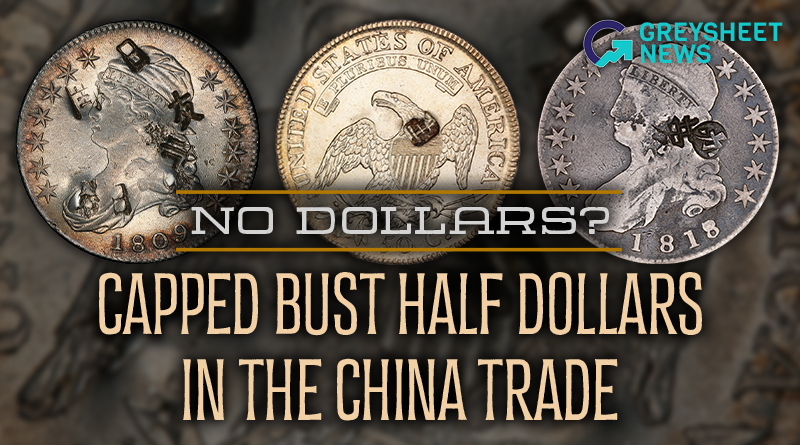
According to Representative Campbell P. White, in his congressional report of 1832, the exportation of half dollars carried on steadily after 1804 and was extensive from 1811–1821.


The launch marks the fulfillment of several years of research, listening to collectors and dealers, and developing a first class product with first class professionals.
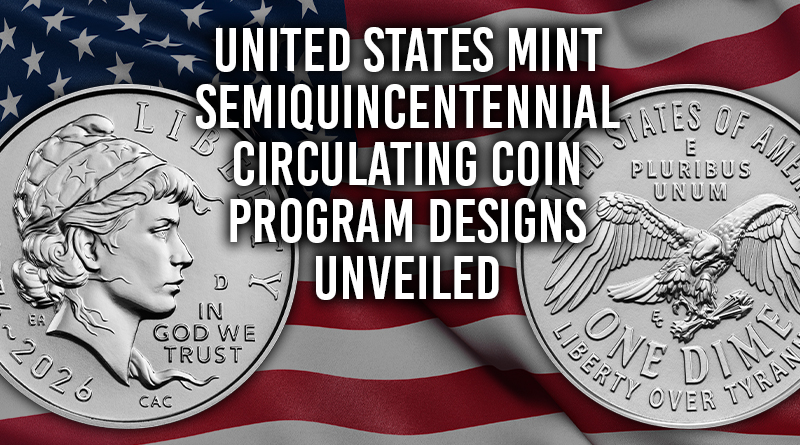
Semiquincentennial circulating coins featuring the new designs and dual dates will be released into circulation in 2026.
Please sign in or register to leave a comment.
Your identity will be restricted to first name/last initial, or a user ID you create.
Comment
Comments