




 Whitman Expo
-
Patterns (1853) Values
Greysheet & Red Book® PRICE GUIDE


Sort by
Sponsor

Sponsor

Sponsor

Sponsor

Sponsor

Legal Disclaimer
The prices listed in our database are intended to be used as an indication only. Users are strongly encouraged to seek multiple sources of pricing before making a final determination of value. CDN Publishing is not responsible for typographical or database-related errors. Your use of this site indicates full acceptance of these terms.
The Greysheet Catalog (GSID) of the Patterns (1853) series of Pattern Coinage in the U.S. Coins contains 11 distinct entries with CPG® values between $700.00 and $19,200.00.
History and Overview
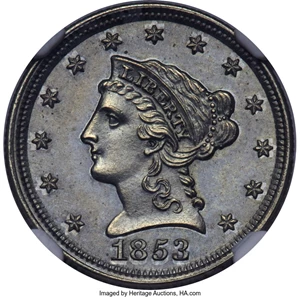
The Mint continued producing a new format of one-cent piece to replace the cumbersome copper “large” cents that had been the standard for many years. To test various metal concepts, an existing quarter eagle die of 1853 was employed in combination with a possibly newly created reverse die, the latter featuring an open wreath enclosing the words ONE CENT, spaced too widely apart with an open space at the center, and obviously made in haste.7 Pieces were struck in various alloys, generally known as “German silver,” this being a term for an alloy of silvery color, with nickel, copper, and other metals, but lacking precious silver. J-149 was struck with a content of 40% nickel, 40% copper, and 20% zinc; J-150 was made of 30% nickel, 60% copper, and 10% zinc; and J-151 was struck in 40% nickel, 60% copper. Apparently, some were made in “60% nickel, the remainder copper.”8 Elemental analysis of the cent patterns of this year suggests that at best the stated metal percentages were approximate.
For collectors, mules were created by combining the obverse of the 1850 perforated cent die (J-119) with the reverse of the 1853 (J-149).9 These are now listed under 1850, as J-124a to J-124e.
A curious pattern trime or three-cent piece was described by W. Elliot Woodward in his catalog of the Joseph J. Mickley Collection (sold from October 28 to November 2, 1867). The location of this piece is not known today.
Also listed under patterns of 1853 are copper impressions from Proof dies of the Liberty Seated dollar dated 1853. These have an interesting background inasmuch as years later it seems to have been realized by collectors that no original Proof impressions were struck in 1853. To fill sets, the Mint produced restrikes from Proof dies, 12 said to have been made in silver and an unknown number in copper. The copper pieces are listed here as J-154.
Collecting Perspective
The German-silver-pattern cents of 1853 seem to have been made in fairly large quantities and can be obtained readily today. The surfaces, not mirrorlike, are properly described as being Mint State. Although J-149 through J-153 were made in different metal compositions, in the absence of elemental analysis, these are impossible to determine today. Accordingly, certain attributions in past market offerings have been speculative. The varieties under J-152 in the seventh edition of Judd, made from an 1850-dated die, were produced for collectors and might best be collected along with other pieces bearing the 1850 date. They have been reassigned to that year’s section under the numbers J-124a to J-124e.
See More See Less




 Loading more ...
Legal Disclaimer
The prices listed in our database are intended to be used as an indication only. Users are strongly encouraged to seek multiple sources of pricing before making a final determination of value. CDN Publishing is not responsible for typographical or database-related errors. Your use of this site indicates full acceptance of these terms.
Available on Greysheet Marketplace
View All
Auction Ends: 9/2/2026
Auction Ends: 9/2/2026
Auction Ends: 9/2/2026
Auction Ends: 9/2/2026
Dealer Directory
View All Dealers



Greysheet News
View All News
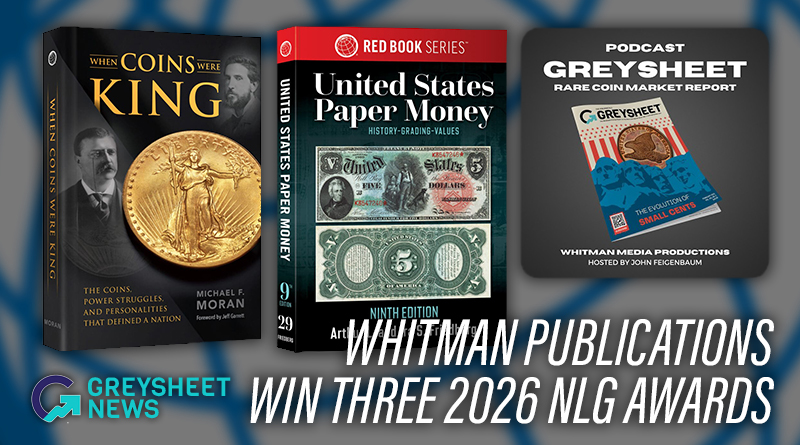
Whitman Brands walked away with a trio of honors during the annual Numismatic Literary Guild awards, held during the American Numismatic Association World's Fair of Money in Pittsburgh.

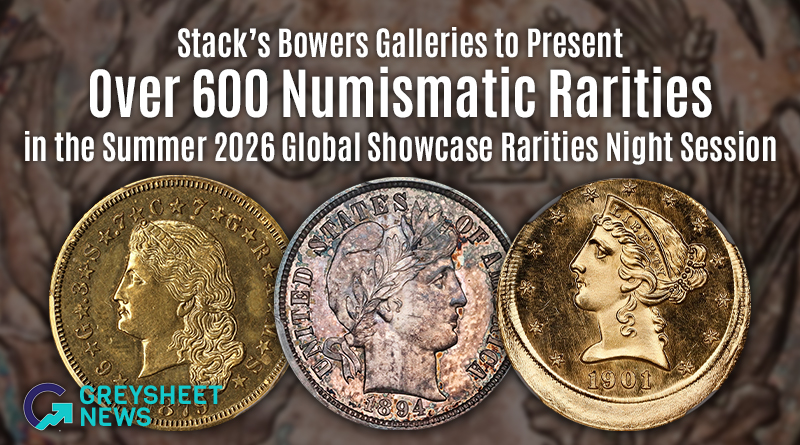
Rarities across the spectrum of American coinage are set to cross the auction block.
eBay, one of the world's largest marketplaces for unique and historic coins, today announced the expansion of Authenticity Guarantee in the U.S. to a new category: collectible coins.
Events
View All Events

Heritage Auctions

Wednesday, July 1, 2026
Thursday, July 2, 2026

DAVID LAWRENCE RARE COINS
Sunday, July 5, 2026