



 Whitman Expo



The United States Mint marked the nation's Semiquincentennial on July 4 with a special striking.
Thank you to our sponsors!
Go check them out!









Original Packaging: A transparent plastic casing with frosted borders surrounded a black plastic insert containing the coins. This was inserted into a blue cardboard box upon which the words “UNITED STATES PROOF SET • 1983” were printed in silver script.
The holder used from 1968 through 1972 was revived for 1983, the only difference being that the coins were mounted so that they faced what was formerly the back of the holder. This placed the embossed eagle above the half dollar’s reverse instead of its obverse. The inscriptions “United States Mint Proof Set” and packaged by u.s. mint thus moved from the back of the holder to its front.
Commentary: After the suspension of Susan B. Anthony dollar coinage, the U.S. Mint’s Proof sets entered a period of repetition, in which each year’s set looked much like the one before it. This had a steadily erosive effect on sales, with the nadir coming in the mid-1990s. The 1983-S Proof set was one of many that was purchased routinely each year by long-time customers on the Mint’s mailing list.
The 1983-S Proof set included the new copper-plated zinc cents, which had become standard issue for circulation. Since the multiple strikings required for Proof coin production tended to break through the copper plating, exposing the underlying zinc, the Proof cents received a double coating of their copper plating. This remains standard practice to the present day for all Proof cents.
Once again, an obverse dime die was shipped to San Francisco without its S mintmark. The number of S-less Proof dimes distributed is unknown, but this variety appears to be more readily available than earlier Proof varieties for which the intended S mintmark was accidentally omitted.
The quarter dollar became the latest denomination to receive a reworking by the Mint’s engraving department. This is most noticeable on the obverse, where the portrait was reduced slightly in relief as well as in overall size, with the lettering sharpened and moved inward from the borders.
To expand its sales and offer something distinctive to collectors, the U.S. Mint began marketing Prestige Proof sets in 1983. This year’s set featured special packaging that enclosed not only the five regular Proofs but also the 1983-S Olympic silver dollar commemorative. Priced at a whopping $59, only 140,361 sets were sold.
Source: Whitman
Catalog Information
GSID:
10998
Strike Type:
Proof
Edge:
Reeded
Variety:
Clad Proof Set
Variety 2:
5 Coins
Coin Date:
1983-S
Denomination:
1c-50c
Designation:
PR
Mint Location:
San Francisco
Mint Mark:
S
Mintage:
3,138,765
Coinage Type:
Proof Set
Coinage Years:
1936-
PCGS #:
904798
Send Catalog Feedback
To: editor@greysheet.com
Subject: I would like to contribute catalog info to CDN for 1983-S 1c-50c Clad Proof Set, 5 Coins PR
Body: Referring page: http://beta.greysheet.com/prices/item/1983-s-united-states-proof-set/gsid/10998 GSID: 10998 Title: 1983-S 1c-50c Clad Proof Set, 5 Coins PR
Subscribe to View
View more data, info, and visualizations. Get access to retail and wholesale pricing as well as auction data.
Coin Value History
1983-S 1c-50c Clad Proof Set, 5 Coins PR
Currency
Grade Range
Sort by
Pricing
Values
Greysheet & CPG® Values
1936 1c-50c Proof Set, Brilliant Finish, 5 Coins PR

Worth: $5,600 – $5,600
1936 1c-50c Proof Set, Satin Finish, 5 Coins PR

Worth: $5,200 – $5,200
1937 1c-50c Proof Set, 5 Coins PR

Worth: $2,365 – $2,365
1938 1c-50c Proof Set, 5 Coins PR

Worth: $980 – $980
1939 1c-50c Proof Set, Reverse of 1938 Nickel, 5 Coins PR

Worth: $920 – $920
1939 1c-50c Proof Set, Reverse of 1940 Nickel, 5 Coins PR

1940 1c-50c Proof Set, Reverse of 1940 Nickel, 5 Coins PR

Worth: $770 – $770
1940 1c-50c Proof Set, Reverse of 1938 Nickel, 5 Coins PR
1941 1c-50c Proof Set, 5 Coins PR

Worth: $735 – $735
1942 1c-50c Proof Set, 5 Coins PR

Worth: $700 – $700
1942 1c-50c Proof Set, 6 Coins PR

Worth: $800 – $800
1950 1c-50c Proof Set, 5 Coins PR

Worth: $625 – $625
1951 1c-50c Proof Set, 5 Coins PR

Worth: $500 – $500
1952 1c-50c Proof Set, 5 Coins PR

Worth: $235 – $235
1953 1c-50c Proof Set, 5 Coins PR

Worth: $195 – $195
Greysheet News
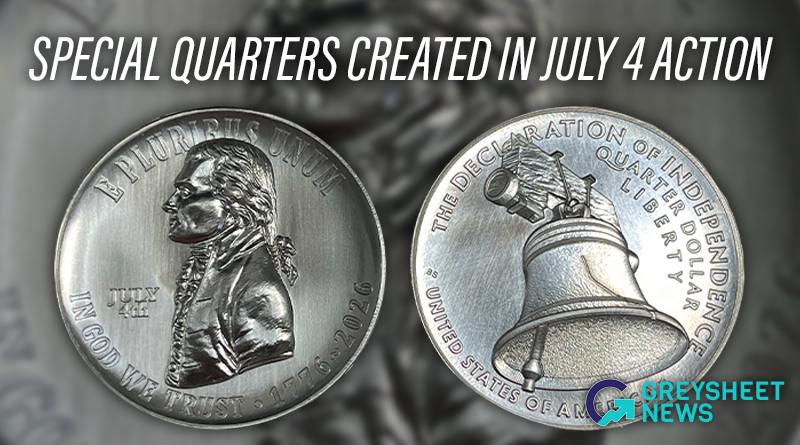
Special Quarters Created in July 4 Action
9/8/2026
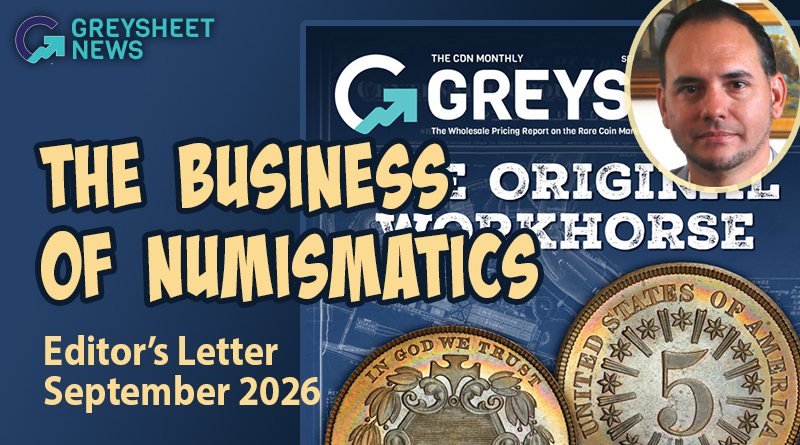
The Business of Numismatics: September 2026 Greysheet Editor's Letter
Outside of the direct trading of coins, our industry has seen some shake up recently on the data and information front.
9/7/2026
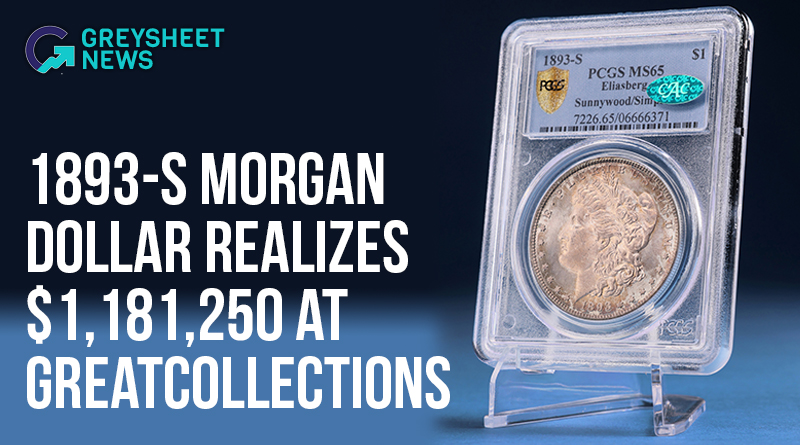
1893-S Morgan Dollar Realizes $1,181,250 at GreatCollections
Brings More Than 50% Over PCGS Price Guide — a Record for the Date in Gem Mint State.
9/4/2026
Events
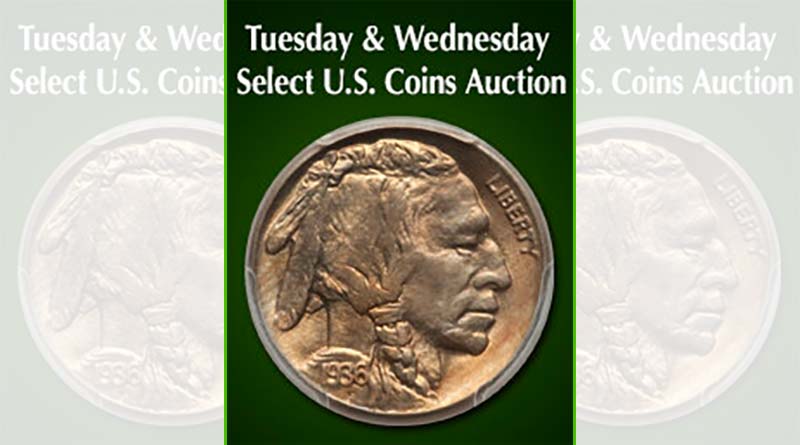
Heritage Auctions: US Coins Tuesday & Wednesday Select Auction
Location: Heritage Auctions
Wednesday, July 1, 2026
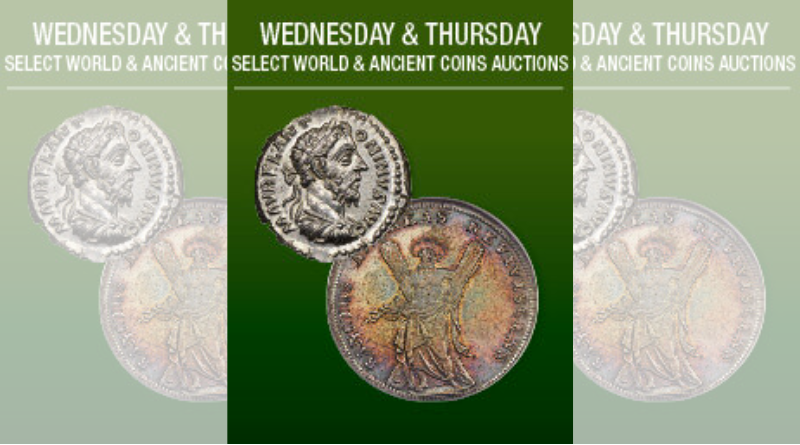
Heritage Auctions: World & Ancient Coins Wednesday & Thursday Select Auction
Location: Heritage Auctions
Thursday, July 2, 2026