



 Whitman Expo



Outside of the direct trading of coins, our industry has seen some shake up recently on the data and information front.
Thank you to our sponsors!
Go check them out!








Original Packaging: The coins were mounted in a red plastic insert that was fitted between an upper and lower casing of transparent plastic. These parts were set within a black plastic frame bearing on its lower border the words UNITED STATES PROOF SET in silver letters. The frame included a slot into which the transparent casing could be inserted for desktop display. A black cardboard box housed the assembled set, and the words “UNITED STATES PROOF SET • 1982” were printed on it in silver script.
When no dollar coins were struck in 1982, the Mint was left with a large remaining stock of Proof set holders designed to fit the Anthony dollar. Rather than discard them at a loss, the Mint filled the dollar coin’s hole with a bronze medal prepared from existing hubs. The obverse featured the familiar Treasury Department seal, while the reverse displayed the American eagle surrounded by the words UNITED STATES PROOF SET. Unique to 1982 Proof sets, this medal was itself coined in Proof.
Commentary: The high mintage of this year’s Proof set is something of a mystery, as 1982 offered nothing special to the collector, save for the curious Proof medal that filled a vacancy left by the now-suspended Anthony dollar. In any case, this high mintage took its toll on the value of uncertified Proofs. This set is seemingly a bargain at current prices.
The composition of the cent was changed drastically midway through 1982 to address the rising price of copper. Though the new cents of zinc with a copper plating were produced for circulation alongside those of the traditional composition, all Proof cents of this date are of the 95% copper, 5% zinc alloy used in previous years. Also changed during the course of the 1982 regular coinage was the obverse hub of the cent, the new obverse having a portrait of slightly reduced size and a distinctly smaller date. All of the Proof cents, however, have the older style obverse with its large date.
Yet another S mintmark appeared in 1982, but it was not transitional, as it was used for all the Proofs of this date and through 1984. This mintmark featured distinct serifs at top and bottom.
Note: The Proof sets of 1977 and later years have a uniform cameo quality to them, with even deep or ultra cameo pieces being commonplace. Though the certified population data published by the major grading services may include non-cameo pieces, these were likely certified before the current language was adopted. It may be assumed that all such Proofs are cameo at the very least.
Source: Whitman
Catalog Information
GSID:
10997
Strike Type:
Proof
Edge:
Reeded
Variety:
Proof Set
Variety 2:
5 Coins
Coin Date:
1982-S
Denomination:
1c-50c
Designation:
PR
Mint Location:
San Francisco
Mint Mark:
S
Mintage:
3,857,479
Coinage Type:
Proof Set
Coinage Years:
1936-
PCGS #:
904797
Send Catalog Feedback
To: editor@greysheet.com
Subject: I would like to contribute catalog info to CDN for 1982-S 1c-50c Proof Set, 5 Coins PR
Body: Referring page: http://beta.greysheet.com/prices/item/1982-s-united-states-proof-set/gsid/10997 GSID: 10997 Title: 1982-S 1c-50c Proof Set, 5 Coins PR
Subscribe to View
View more data, info, and visualizations. Get access to retail and wholesale pricing as well as auction data.
Coin Value History
1982-S 1c-50c Proof Set, 5 Coins PR
Currency
Grade Range
Sort by
Pricing
Values
Greysheet & CPG® Values
1936 1c-50c Proof Set, Brilliant Finish, 5 Coins PR

Worth: $5,600 – $5,600
1936 1c-50c Proof Set, Satin Finish, 5 Coins PR

Worth: $5,200 – $5,200
1937 1c-50c Proof Set, 5 Coins PR

Worth: $2,365 – $2,365
1938 1c-50c Proof Set, 5 Coins PR

Worth: $980 – $980
1939 1c-50c Proof Set, Reverse of 1938 Nickel, 5 Coins PR

Worth: $920 – $920
1939 1c-50c Proof Set, Reverse of 1940 Nickel, 5 Coins PR

1940 1c-50c Proof Set, Reverse of 1940 Nickel, 5 Coins PR

Worth: $770 – $770
1940 1c-50c Proof Set, Reverse of 1938 Nickel, 5 Coins PR
1941 1c-50c Proof Set, 5 Coins PR

Worth: $735 – $735
1942 1c-50c Proof Set, 5 Coins PR

Worth: $700 – $700
1942 1c-50c Proof Set, 6 Coins PR

Worth: $800 – $800
1950 1c-50c Proof Set, 5 Coins PR

Worth: $625 – $625
1951 1c-50c Proof Set, 5 Coins PR

Worth: $500 – $500
1952 1c-50c Proof Set, 5 Coins PR

Worth: $235 – $235
1953 1c-50c Proof Set, 5 Coins PR

Worth: $195 – $195
Greysheet News
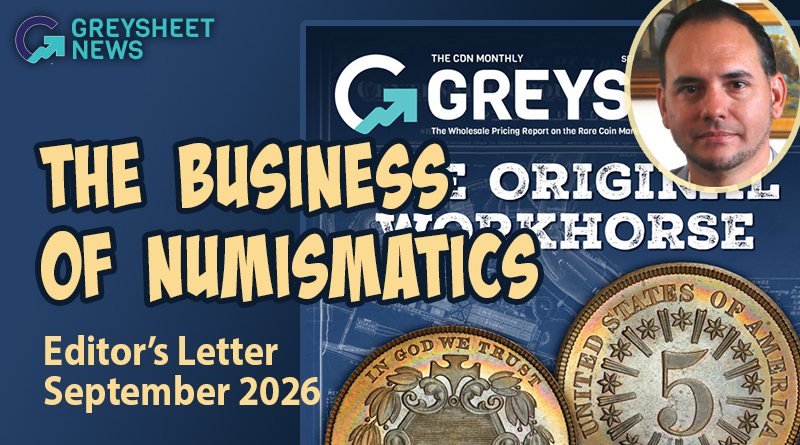
The Business of Numismatics: September 2026 Greysheet Editor's Letter
9/7/2026
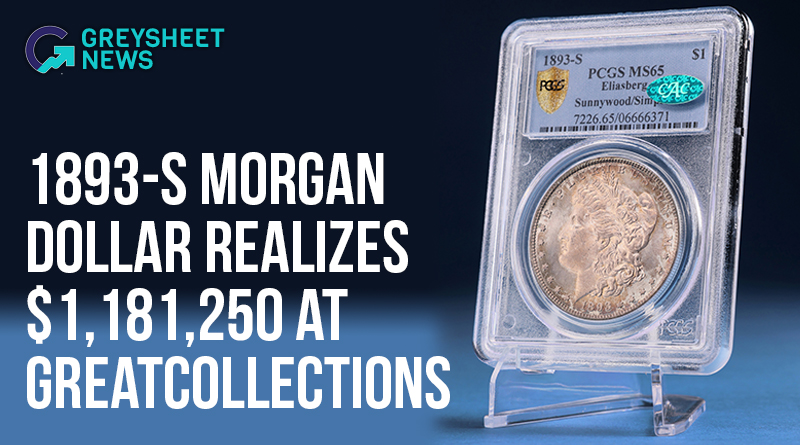
1893-S Morgan Dollar Realizes $1,181,250 at GreatCollections
Brings More Than 50% Over PCGS Price Guide — a Record for the Date in Gem Mint State.
9/4/2026
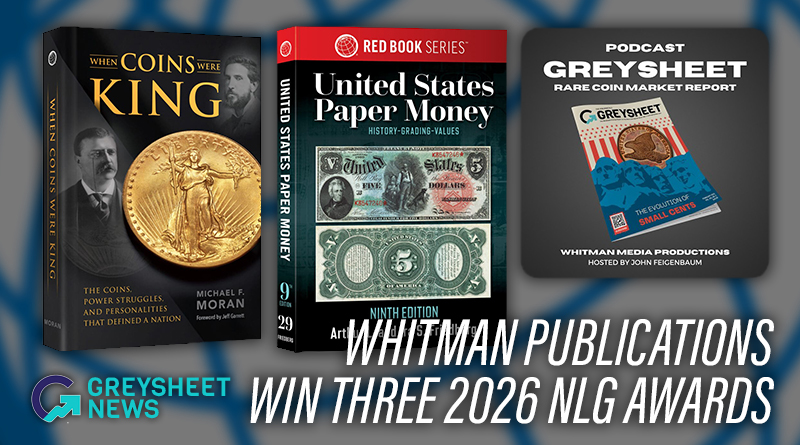
Whitman Publications Win Three 2026 NLG Awards
Whitman Brands walked away with a trio of honors during the annual Numismatic Literary Guild awards, held during the American Numismatic Association World's Fair of Money in Pittsburgh.
8/31/2026
Events
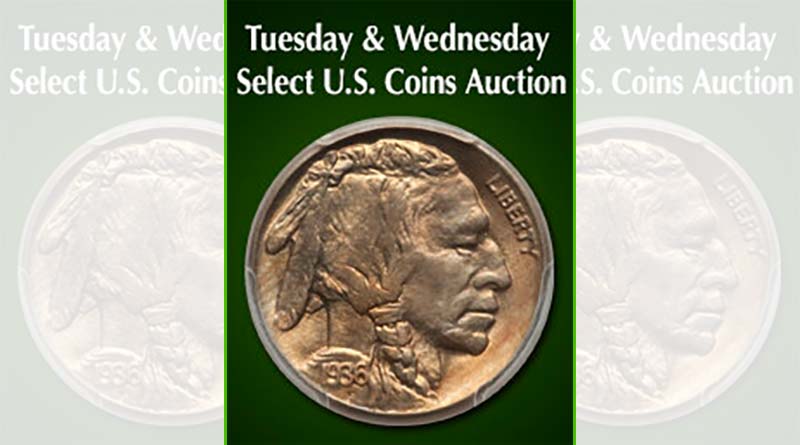
Heritage Auctions: US Coins Tuesday & Wednesday Select Auction
Location: Heritage Auctions
Wednesday, July 1, 2026
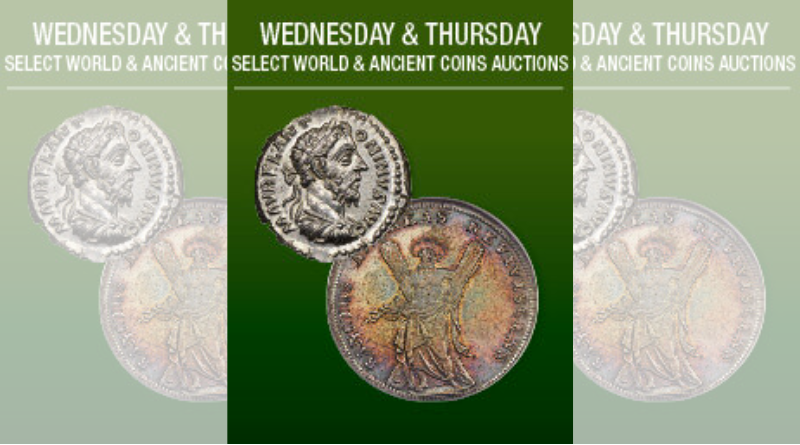
Heritage Auctions: World & Ancient Coins Wednesday & Thursday Select Auction
Location: Heritage Auctions
Thursday, July 2, 2026