




 Whitman Expo
-
Series of July 10, 1733
Greensheet & Friedberg® Price Guide

Sort by
Sponsor

Sponsor

Sponsor

Sponsor

Sponsor

Legal Disclaimer
The prices listed in our database are intended to be used as an indication only. Users are strongly encouraged to seek multiple sources of pricing before making a final determination of value. CDN Publishing is not responsible for typographical or database-related errors. Your use of this site indicates full acceptance of these terms.
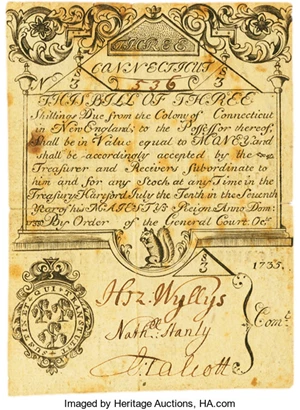
The Greysheet Catalog (GSID) of the Series of July 10, 1733 series of Connecticut Colonial Currency in the U.S. Currency contains 28 distinct entries with CPG® values between $6,000.00 and $17,000.00.
£30,000 in legal tender Bills of Credit issued pursuant to the Feb. 1732/33, May 1733, and Oct. 1733 Acts to exchange for “New London Society United for Trade and Commerce” circulating notes, to create new mortgage loans, and for public expenses. Redeemable by May 1, 1741. The faces were engraved on two copper plates (great and small) by Nathaniel Mors of Boston. The typeset backs contain the date. October was added to the face and back to distinguish the bills issued after the Oct. 1733 Act. Printed by Timothy Green. Signers were William Pitkin, Nathaniel Stanly, Joseph Tallcott, and Hezekiah Wyllys. Beginning at this time and continuing for over thirty years most paper money legislation was withheld from the public and not published in the printed Acts.
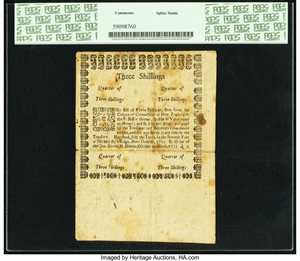
Since the 1709 emission the folding of bills had caused bills to tear, resulting in half or quarter sections. These parts circulated independently for proportional values. By a Jan. 1719/20 Act of Massachusetts Bay, the acceptance of sections of Connecticut bills in Boston was limited to half sections or more. In the May 1726 Connecticut Act the Connecticut Treasury was prohibited from receiving any sections of bills after May 1, 1727. The practice of deliberately sectioning bills for change developed, which in turn made sections of counterfeit bills easier to pass. By the May 1736 Act sectioning of bills of 5s and over was prohibited and after May 20, 1737 sections were to be unredeemable. The practice continued, nevertheless, in spite of newspaper warnings, etc. “Broken money” given to Christianize Native Americans was exchangeable by the May 1737 Act. By the Oct. 1737, May 1738, and May 1741 Acts redemption of sections was extended.
See More See Less




Sponsor

 Loading more ...
Legal Disclaimer
The prices listed in our database are intended to be used as an indication only. Users are strongly encouraged to seek multiple sources of pricing before making a final determination of value. CDN Publishing is not responsible for typographical or database-related errors. Your use of this site indicates full acceptance of these terms.
Available on Greysheet Marketplace
View All
Auction Ends: 9/1/2026
Auction Ends: 9/1/2026
Auction Ends: 9/1/2026
Auction Ends: 9/1/2026
Dealer Directory
View All Dealers


Greysheet News
View All News
New coins from the Netherlands, South Africa, and Vatican City.

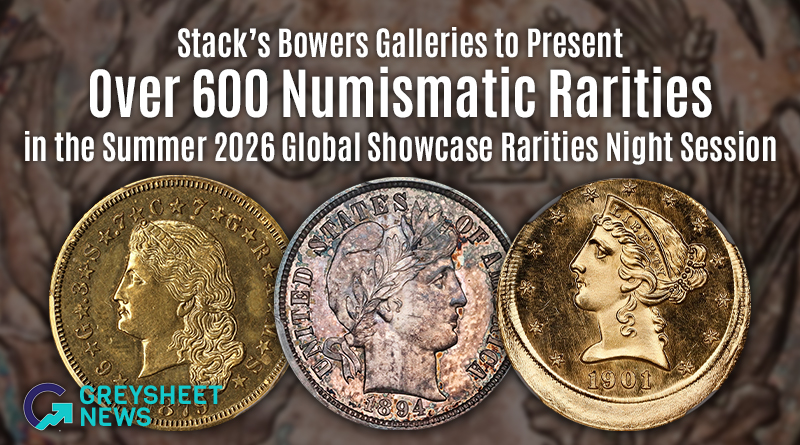
Rarities across the spectrum of American coinage are set to cross the auction block.
eBay, one of the world's largest marketplaces for unique and historic coins, today announced the expansion of Authenticity Guarantee in the U.S. to a new category: collectible coins.
Events
View All Events
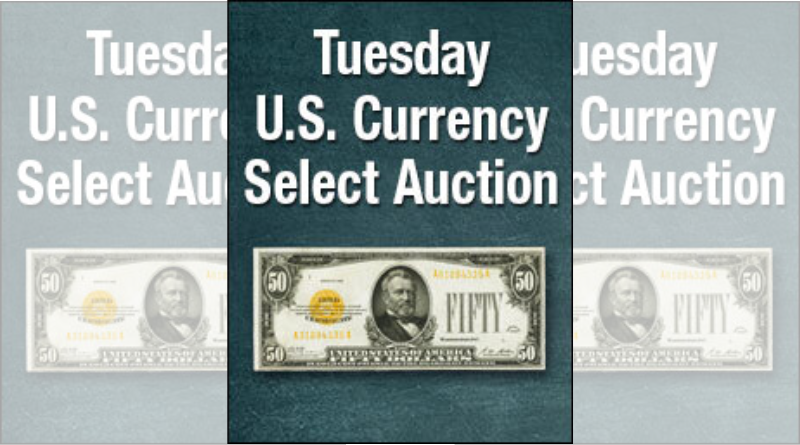

Heritage Auctions

Tuesday, June 2, 2026
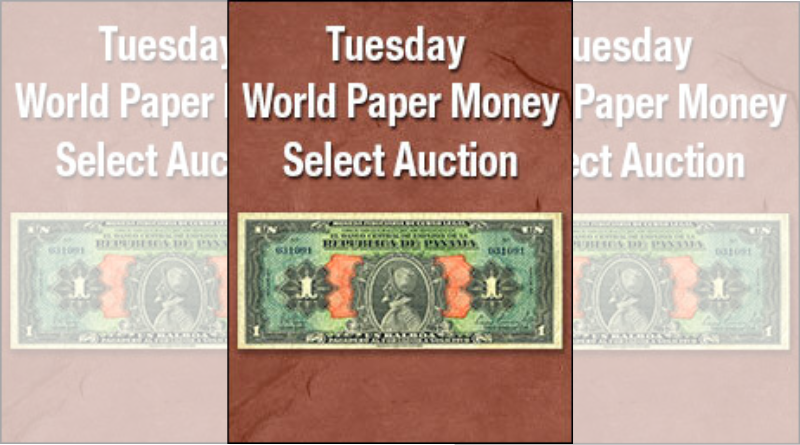
Heritage Auctions
Tuesday, June 2, 2026
Heritage Auctions
Wednesday, June 3, 2026