




 Whitman Expo
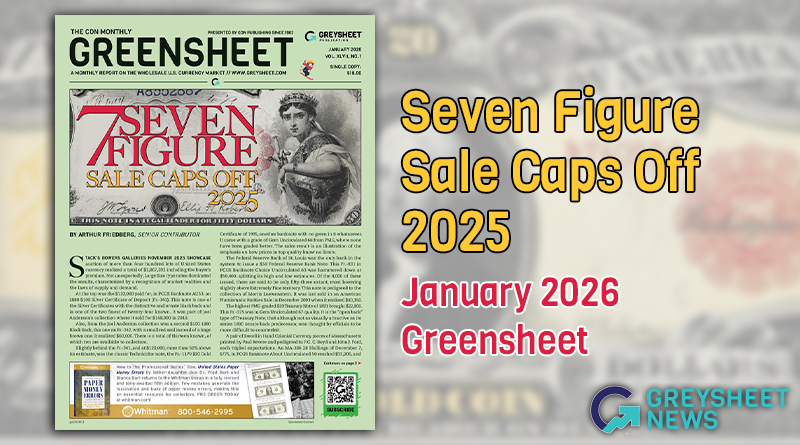
January 2026 Greensheet Market Analysis: Seven Figure Sale Caps Off 2025
Stack’s Bowers Galleries November 2025 showcase auction of more than four hundred lots of United States currency realized a total of $1,867,392 including the buyer’s premium.
by Arthur Friedberg |
Published on January 20, 2026

Download the Greysheet app for access to pricing, news, events and your subscriptions.
Subscribe to The Greensheet for the industry's most respected pricing and to read more articles just like this.

Not unexpectedly, Large Size type notes dominated the results, characterized by a recognition of market realities and the laws of supply and demand.
At the top was the $132,000 paid for, in PCGS Banknote AU53, an 1880 $100 Silver Certificate of Deposit (Fr.-341). This note is one of the Silver Certificates with the distinctive and ornate black back and is one of the two finest of twenty-four known. It was part of Joel Anderson’s collection where it sold for $168,000 in 2019.
Also, from the Joel Anderson collection was a second $100 1880 Black Back, this one an Fr.-342, with a small red seal instead of a large brown one. It realized $60,000. There is a total of thirteen known, of which ten are available to collectors.
Slightly behind the Fr.-341, and at $120,000, more than 50% above its estimate, was the classic Technicolor note, the Fr.-1179 $20 Gold Certificate of 1905, another banknote with no green in it whatsoever. It came with a grade of Gem Uncirculated 66 from PMG, where none have been graded better. The sales result is an illustration of the emphasis on how prices in top quality know no limits.
The Federal Reserve Bank of St. Louis was the only bank in the system to issue a $50 Federal Reserve Bank Note. This Fr.-831 in PCGS Banknote Choice Uncirculated 63 was hammered down at $50,400, splitting its high and low estimates. Of the 4,000 of these issued, there are said to be only fifty-three extant, most hovering slightly above Extremely Fine territory. This note is pedigreed to the collection of Morris Loewenstern. It was last sold in an American Numismatic Rarities Sale in December 2003 when it realized $10,350.
The highest PMG-graded $20 Treasury Note of 1891 brought $22,800. This Fr.-375 was in Gem Uncirculated 67 quality. It is the "open back" type of Treasury Note, that although not as visually attractive as its series 1890 ornate back predecessor, was thought by officials to be more difficult to counterfeit.
A pair of Sword in Hand Colonial Currency pieces of Massachusetts printed by Paul Revere and pedigreed to F.C. C. Boyd and John J. Ford, each tripled expectations. An MA-186 28 Shillings of December 7, 1775, in PCGS Banknote About Uncirculated 50 reached $13,200, and a MA-166 10 Shillings of August 18, 1775, in PCGS Banknote Choice Extremely Fine 45 settled at $12,600.
A $10 National Gold Bank Note of 1874 issued by the Farmers National Gold Bank of San Jose, California (Fr.-1148) in PMG Very Fine 20 led the National Bank category at $10,200. National Gold Bank notes are, as a class, underappreciated. They are not often found above Very Fine condition and almost always show signs of repair. The emphasis collectors place on perfection has been to their detriment.
Leading the Small Size results was a trio of high denomination Series 1928 Gold Certificates, each selling for $26,400. A Fr.-2405 1928 $100 Gold Certificate was graded by PCGS Banknote as Gem Uncirculated 65. The price paid was slightly below expectations. A PMG About Uncirculated 53 $500 Gold Certificate (Fr.-2407) was described as one of just over a hundred surviving examples, most of which are inferior in quality. Finally, an infrequently offered Fr.-2408 $1,000 Gold Certificate in PMG Extremely Fine 40 EPQ sold for slightly under its $30,000 estimate. The number known does not exceed double digits.
As the cataloger explained, any Gold Certificate available for sale today is essentially a "miracle of survival," because President Roosevelt’s Executive Order 6102 signed on April 5, 1933, forbade "the hoarding of gold coins, gold bullion, and gold certificates within the continental United States and required that all such instruments be turned for other currency. This was finally repealed in 1975, meaning that until then, possession of Gold Certificates and more than $100 worth of non-numismatic gold coins was illegal. Fortunately, the authorities usually had better things to do than enforce nonsense.
Joshua Abraham Norton was an odd character who emigrated from South Africa to San Francisco, where in 1859 he declared himself "Emperor of these United States," and in 1866 "Protector of Mexico." Estimated at $8,000 to $12,000 and finally selling for $21,600 was a PMG About Uncirculated 50 $5 bond certificate remainder issued by his Imperial Government in the 1870s. A simple online search will yield as much about the emperor as you care to read.
As of April 2025, the last time the Bureau of Engraving and Printing issued a monthly production report, series 2021 notes have been printed for all denominations, although not for all Federal Reserve districts and not at both production facilities. Following are the catalog numbers assigned for each denomination and production facility reported. The letter designation of the corresponding Federal Reserve district should be added to the number (with a star when it is a star note).

Related Stories (powered by Greysheet News)
View all news
Coins to help mark and promote the Swiss Federal Shooting Festival have been a tradition since the 19th century.


The final Greensheet issue of 2025 is already upon us!
While the BEP remains silent about new currency designs, the Heritage U.S. Currency Signature Auction was held from October 7 to 10.
Please sign in or register to leave a comment.
Your identity will be restricted to first name/last initial, or a user ID you create.
Comment