




 Whitman Expo
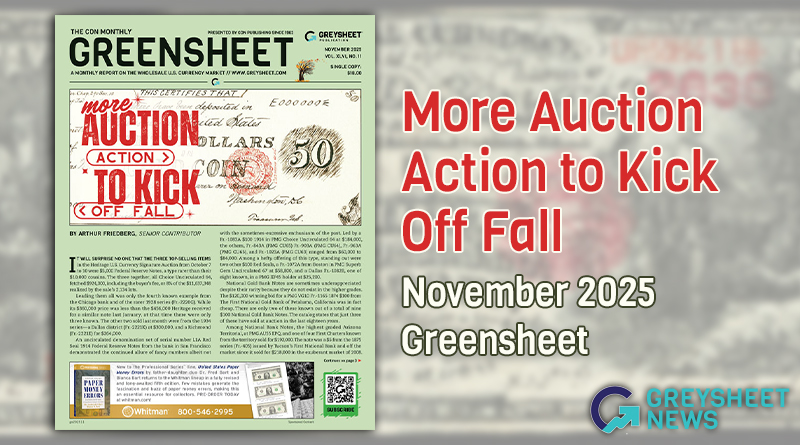
November 2025 Greensheet Market Analysis: More Auction Action to Kick Off Fall
While the BEP remains silent about new currency designs, the Heritage U.S. Currency Signature Auction was held from October 7 to 10.
by Arthur Friedberg |
Published on November 20, 2025

Download the Greysheet app for access to pricing, news, events and your subscriptions.
Subscribe to The Greensheet for the industry's most respected pricing and to read more articles just like this.

It will surprise no one that the three top-selling items in the Heritage U.S. Currency Signature Auction from October 7 to 10 were $5,000 Federal Reserve Notes, a type rarer than their $10,000 cousins. The three together, all Choice Uncirculated 64, fetched $924,000, including the buyer’s fee, or 8% of the $11,637,348 realized by the sale’s 2,134 lots.
Leading them all was only the fourth known example from the Chicago bank and of the rarer 1928 series (Fr.-2220G). While its $360,000 price was less than the $456,000 Heritage received for a similar note last January, at that time there were only three known. The other two sold last month were from the 1934 series—a Dallas district (Fr.-2221K) at $300,000, and a Richmond (Fr.-2221E) for $264,000.
An uncirculated denomination set of serial number L1A Red Seal 1914 Federal Reserve Notes from the bank in San Francisco demonstrated the continued allure of fancy numbers albeit not with the sometimes-excessive enthusiasm of the past. Led by a Fr.-1083A $100 1914 in PMG Choice Uncirculated 64 at $184,000, the others, Fr.-843A (PMG CU65) Fr.-903A (PMG CU64), Fr.-963A (PMG CU65), and Fr.-1023A (PMG CU63) ranged from $60,000 to $84,000. Among a hefty offering of this type, standing out were two other $100 Red Seals, a Fr.-1072A from Boston in PMG Superb Gem Uncirculated 67 at $58,800, and a Dallas Fr.-1082B, one of eight known, in a PMG XF45 holder at $25,200.
National Gold Bank Notes are sometimes underappreciated despite their rarity because they do not exist in the higher grades. The $120,000 winning bid for a PMG VG10 Fr.-1165 1874 $100 from The First National Gold Bank of Petaluma, California was in fact cheap. There are only two of these known out of a total of nine $100 National Gold Bank Notes. The catalog states that just three of these have sold at auction in the last eighteen years.
Among National Bank Notes, the highest graded Arizona Territorial, at PMG AU55 EPQ, and one of four First Charters known from the territory sold for $192,000. The note was a $5 from the 1875 series (Fr.-405) issued by Tucson’s First National Bank and off the market since it sold for $218,000 in the exuberant market of 2008.
This bank was the only one in the state to issue First Charter notes, and only of this denomination. 8,500 were printed. The three others remaining are thought to belong to descendants of bank family members.
Another premier Small Size note was a $500 Gold Certificate from 1928 (Fr.-2407) in PMG Choice Uncirculated 64 that went for $93,000 after last going for $58,750 in 2014. While not at the level of some comparable sales of the last few years, small size Gold Certificates are one of the currency categories that soared recently, so they are now reaching a level of equilibrium.
It has been fourteen months since the Bureau of Engraving and Printing (BEP) has issued a press release about anything. The last time a word was heard from them was an announcement about the availability of series 2021 $5 uncut sheets. They explained a few months ago that the BEP was concentrating on fulfilling its primary mission of satisfying currency orders from the Federal Reserve System. We do not know how that is going since no monthly production reports have been issued since last April.
Something else we have heard nothing about is the release of a new $10 bill, slated to be the first in the new “Catalyst” series of United States currency. The schedule was for the note to be ready for production in 2026, with a revelation of its design prior to that. This will be the first piece of American currency to have a raised tactile feature (RTF) applied with intaglio printing to enable identification by the visually impaired. The new feature is following a long-standing order and judgment by the United States District Court for the District of Columbia requiring meaningful access to United States paper currency. The RTF feature has been in development since 2022. The order was the result of a lawsuit brought decades ago by the American Council of the Blind and others.
One issue on which the BEP has been even quieter than usual for them is what the currency will look like. All references to the designs for the new series that were revealed during the Obama administration by then-Treasury Secretary Jack Lew have been wiped without a trace from government web sites. Most of the attention when Lew announced the proposed designs was on Harriet Tubman and the $20 bill in 2030. At that time, the plan was for Alexander Hamilton’s portrait to remain on the front of the $10 note with the reverse featuring members of the women’s suffrage movement, among them: Susan B. Anthony, Alice Paul, Sojourner Truth, Elizabeth Cady Stanton, and Lucretia Mott. It was also going to call attention to the Woman Suffrage Procession on March 3, 1913, in Washington, D.C.
Unlike coin design, a congressional prerogative, the design of banknotes is at the discretion of the Secretary of the Treasury. Perhaps a reason for the silence and delay is that the BEP has had to develop entirely new designs.

Related Stories (powered by Greysheet News)
View all news
Coins to help mark and promote the Swiss Federal Shooting Festival have been a tradition since the 19th century.

Stack's Bowers Galleries November 2025 showcase auction of more than four hundred lots of United States currency realized a total of $1,867,392 including the buyer's premium.

The final Greensheet issue of 2025 is already upon us!
Please sign in or register to leave a comment.
Your identity will be restricted to first name/last initial, or a user ID you create.
Comment