




 Whitman Expo
Eagles Soar in Latest Offering of James A. Stack Collection
A wide range of U.S. and pioneer gold coins from 1798 to 1933 proved to be highlights of the February 3 Stack’s Bowers sale of the second part of the James A. Stack Sr. Collection.
by Greg Reynolds |
Published on April 13, 2026

Download the Greysheet app for access to pricing, news, events and your subscriptions.
Subscribe to The Greysheet for the industry's most respected pricing and to read more articles just like this.
Advertisement
The group of Indian Head eagles ($10 gold coins) was particularly impressive and realized strong prices.
For a number of reasons, it is productive to refer to collection owner James A. Stack, Sr. by his initials without periods, i.e., ‘JAS.’ The main reason is that his last name continually deflects attention from his achievements as a collector and the greatness of the collection he formed. James A. Stack, Sr. (JAS) is unrelated to the family that founded the coin auction firm in New York in the 1930s. Even so, coin-minded people tend to think that he is related or are therefore distracted by his last name.
While Louis Eliasberg, John J. Pittman, Harry Bass and Emery May Holden Norweb were all known to collectors during their respective lifetimes, JAS was not publicly recognized until long after his death in 1951. Parts of his collection went to different children and grandchildren, who chose to sell at different times.
Stack’s conducted five JAS-related sales in New York City in March 1975, November 1989, January 1990, October 1994, and March 1995. Since the current Stack’s Bowers Galleries is an amalgamation of multiple auction firms, the Stack’s (New York) of the past should not be referred to as Stack’s Bowers Galleries in the present.
JAS was clearly a client of Stack’s (N.Y.), though he also purchased coins from other auction firms and dealers during the 1930s and 1940s. He had a huge collection of classic U.S. coins, which rivaled that of Louis Eliasberg and the Norweb Family in quantity, quality and depth.
Recent auctions by Stack’s Bowers in December 2025 and February 2026 came about as surprises when announced. Most interested collectors were unaware of the remaining portions of the JAS Collection. For example, the Flowing Hair and Draped Bust silver dollars that Stack’s Bowers auctioned in December from the collection would merit a thorough analysis, though those are a little too complicated for a medium-size review.
The focus here is on several Indian Head eagles that were auctioned by Stack’s Bowers in Costa Mesa, California, on February 3, 2026, which I personally viewed.
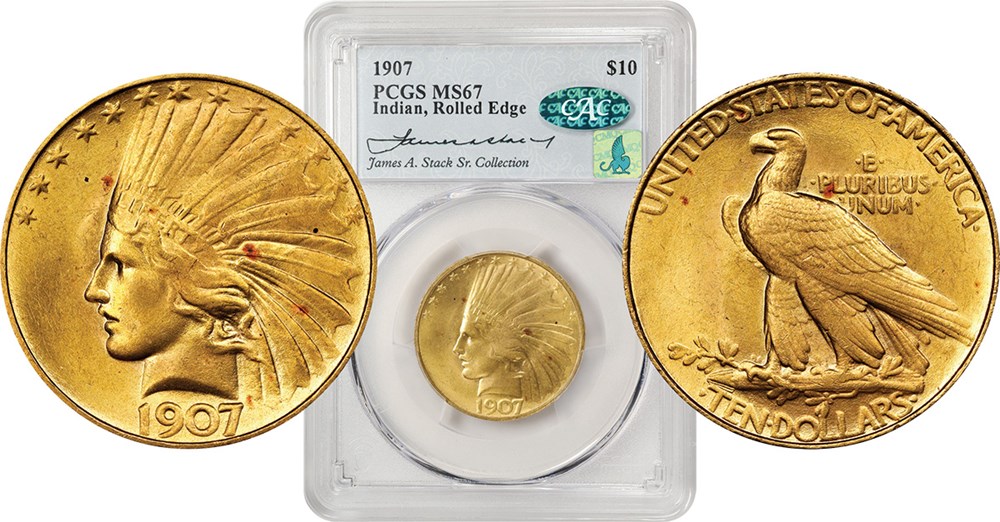
The 1907 "Rounded Rim" and the 1907 "Rolled Edge" eagle are the same thing, though there are differences of opinion among experts regarding the name and meaning of these. The JAS 1907 Rolled Edge eagle has a partial outer rim in the lower part and on the left side of the obverse. Neither ‘Rounded Rim’ nor ‘Rolled Edge’ is the best name for pieces of this type, yet traditional names often have traction. Indisputably, however, the JAS Collection Rolled Edge eagle brought a noteworthy price of $900,000.
For a CAC-approved MS67 grade Rolled Edge 1907 eagle, Greysheet-CAC bid is $1,008,000. Greysheet bids are estimates of upper-wholesale prices. There are often separate Greysheet bids for coins that have green stickers of approval from CAC or are in CACG holders. The coins in the recent offerings from the JAS Collection were encapsulated by PCGS and many of them received green stickers of approval from CAC.
It is possible that the editors of price guides were relying heavily upon the price of $1.14 million realized by a CAC-approved, PCGS graded MS67 Rolled Edge eagle in the Stack’s Bowers auction on April 5, 2022. In that particular auction, bidding often went crazy in my opinion, and many results were well above the market levels that prevailed at the time. Those were anomalies, not market prices.
Additionally, the Rolled Edge 1907 eagle that realized $1.14 million in April 2022 was notably superior to the JAS Collection Rolled Edge 1907 eagle that realized $900,000 in February 2026. I am almost certain that I am not the only one who thought as much.
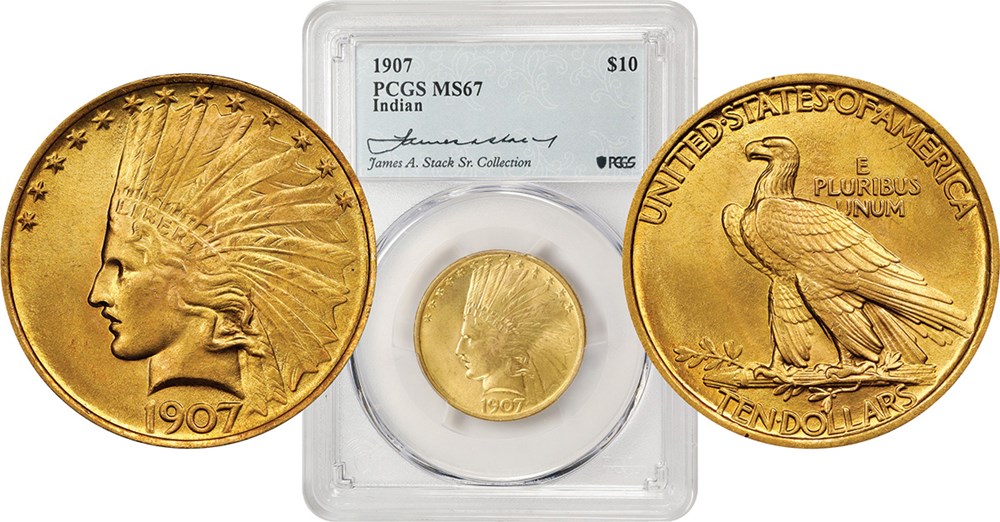
The No Periods coins of 1907–08 are regular issue Indian Head eagles. JAS had a PCGS graded MS67 1907 No Periods eagle, which realized $38,400, clearly a solid retail price.
The $57,600 realization for the 1909-S/S repunched mintmark eagle is fascinating. Greysheet-CAC bid for a PCGS graded MS65 1909-S with a regular mintmark is $28,000. A tenable explanation for the $57,600 result is that at least one leading bidder was willing to pay a tremendous premium because this coin is a variety. It could be the highest quality representative of this S/S variety that a particular bidder has been able to find. It is also a realistic possibility that some bidders thought that this coin might upgrade to MS66.
The JAS Collection, PCGS graded MS64+ 1910-D, with a CAC sticker, brought $6,600, a strong to very strong price that was very sensible. For its certified grade, this was a particularly appealing coin. It was much less costly than many of the other JAS Collection Indian Head eagles.
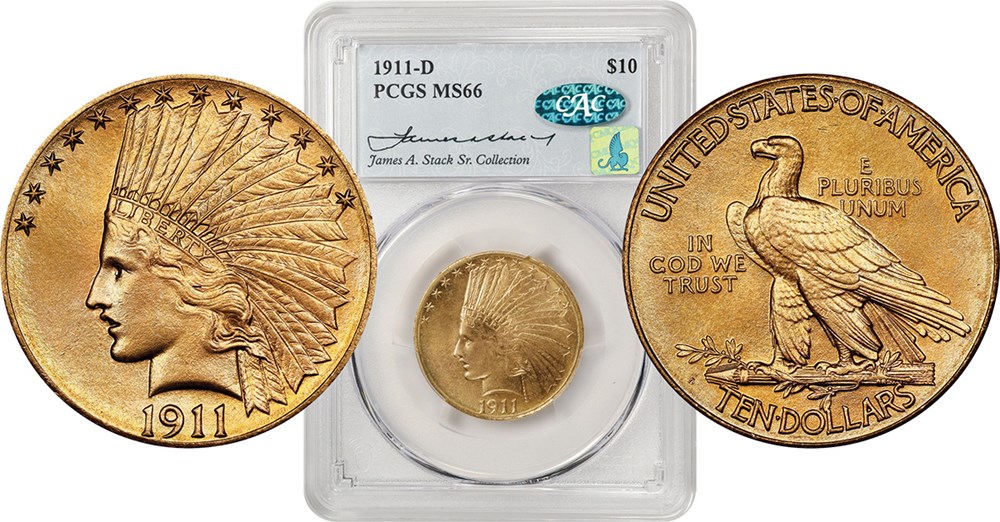
The PCGS graded MS66 JAS Collection 1911-D, with a CAC sticker, is a top pop coin. PCGS reports three graded as MS65 and just this coin as MS66. The NGC census does not include a 1911-D eagle as grading above MS64. Neither CAC nor PCGS has graded a 1911-D ten higher than MS66.
The only 1911-D eagle in MS65 and higher grades in the CAC pop report is this JAS 1911-D, which brought $1.8 million. This was a very strong price, possibly an auction record for a non-rare gold coin and an auction record for any Indian Head eagle minted after 1907. There are definitely more than five hundred 1911-D tens in existence, most likely more than one thousand.
Although I have never seen it, I have heard much about the 1911-D eagle that was formerly in the Norweb Family Collection, which Bowers & Merena auctioned during the 1980s. My impression is that the Norweb 1911-D has never been certified. To fairly express a judgment about whether the JAS 1911-D eagle is the finest, there would be a need to carefully examine the Norweb 1911-D.
The JAS 1912 eagle sold in this offering was PCGS graded MS66+ and received a sticker of approval from CAC. It realized $72,000, certainly a strong price.
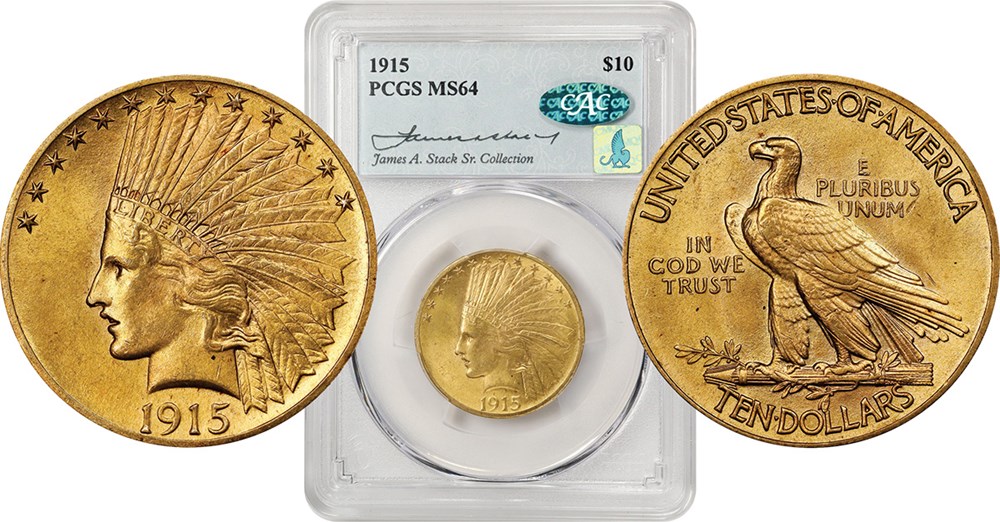
The JAS 1915 eagle was PCGS graded MS64, with a CAC sticker. It realized $8,400, an extremely strong price. It is likely that at least one serious bidder was figuring that this coin would upgrade to 64+ or become a non-CAC, NGC or PCGS graded MS65 grade 1915 eagle. Indeed, I would not be startled if it upgrades to MS65, though I am not making a prediction.
While I understand the $8,400 result for the CAC-approved, PCGS graded MS64 1915, I was surprised that a CAC-approved, PCGS graded AU58 1915-S realized that same price. The Greysheet-CAC bid for an AU58 grade 1915-S is $6,000, and Greysheet bid for an MS62 grade 1915-S is $8,400. This 1915-S does not appear to be a candidate to achieve MS62 level.
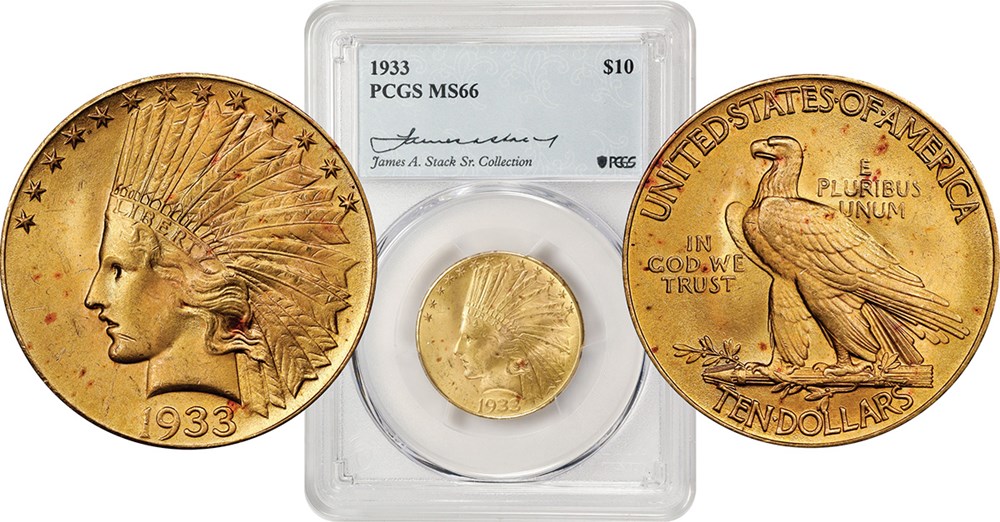
A discussion of Indian Head eagles from the JAS Collection must include mention of his 1933. It was PCGS graded MS66 and it brought $960,000. Greysheet bid before and after this auction was $800,000 and the CPG medium retail estimate is $960,000 for this coin.
It is important to keep in mind that the population of PCGS graded MS65 and MS66 1933 eagles has significantly increased over the last 25 years. The $960,000 price for the JAS 1933 was strong to very strong, given the population of certified MS65 to MS66 grade 1933 eagles overall and the physical characteristics of this specific coin.
The recent JAS sales are especially noteworthy events in the history of coin collecting.
©2026 Greg Reynolds, Insightful10@gmail.com
Images courtesy of Stack's Bowers Galleries.

Related Stories (powered by Greysheet News)
View all news
Highlights from the auction were on display at the recent New York International Coin Convention.

Numismatic researcher Greg Reynolds does a deep dive into the Alymaya set of Saint Gaudens double eagles sold by Heritage in August 2025.
In this article Greg Reynolds analyzes the 1814 Capped Bust Half Dollar.
Please sign in or register to leave a comment.
Your identity will be restricted to first name/last initial, or a user ID you create.
Comment
Comments