




 Whitman Expo
Stunning German Gold Coins Highlight Kuenker Auction in Berlin on January 28
Highlights from the auction were on display at the recent New York International Coin Convention.
by Greg Reynolds |
Published on January 22, 2026

Download the Greysheet app for access to pricing, news, events and your subscriptions.
Advertisement
The “World Money Fair” at the Estrel Hotel and convention center (ECC) in Berlin will be held from January 29 to 31, 2026. This is one of the leading coin conventions in the world. The firm of Künker (often spelled “Kuenker” in English) will conduct the official auction on January 28, at the Estrel hotel, their Auction No. 437. Hundreds of rare coins will be offered. It is not practical to discuss many of them here. I remark upon a few that I personally examined at the NYINC.
In North America, the largest and greatest event relating to world coins is the New York International Coin Convention (NYINC), which is held every January in Manhattan. This year, I attended all nine days, from Jan. 10 to Jan. 18, at the Barclay Inter-Continental Hotel on 48th Street near Grand Central Station. Six different firms conducted live auctions with ‘in person’ bidding at the NYINC.
Auction lot viewing began on Jan. 10. Dealer-to-dealer trading occurred on Jan. 15. The bourse floor was open from Jan. 16 to 18 to anyone who paid a $30 admission fee. There were educational programs as well.
On Jan. 17 and 18, I examined coins and medals at the Künker table on the bourse floor. They transported some of the greatest coins in this upcoming auction so that collectors and dealers in the United States could see them. The CEO and scion himself, Ulrich Künker, was personally present and talkative.
As I first glanced at the display case at the Künker table, I felt pulled in by a Regensburg 6 Ducat gold coin from the late 1700s. It does not have a date. It was minted during the reign of Emperor Joseph II, son of Empress Maria Theresa and Emperor Francis I.
For six to seven centuries, beginning in the late 1200s, Ducats and coins with other names minted in accordance with the ducat standard, such as zecchini, circulated widely in Europe, and were produced by many nations. A ducat amounted to both a coin denomination and a unit of measurement of gold. Ducats were currencies of the world.
By tradition, a ducat weighed 3.5 grams (0.1125 Troy ounce) and was 98.6% gold. Coins that closely approximated this specification tended to trade on par with ducats and multiple ducat denominations. Ducats and multiple-ducat coins were often manufactured with the idea that they would be slightly underweight to encourage businessmen around the world to spend them rather than have them melted.
This Joseph II Regensburg 6 Ducat coin is very important for multiple reasons. Regensburg is not the largest city in Bavaria and receives little attention in the twenty-first century. This city, however, played a major role in history.
The Congress of the Holy Roman Empire first met there in 1594 and was active continuously in Regensburg from 1663 to 1806. This Congress did not dissolve or ‘take a break’ during this period mostly because of the fear that an emperor at some point would not call an inactive congress back into session and thus passively disband it.
This Joseph II Regensburg 6 Ducat coin, lot #251 in the upcoming auction, is particularly impressive. The artistic merit of the design is exceptional. The ‘city-view’ on the obverse (front) is intricate and awe-striking. An heraldic, two-headed eagle is featured on the reverse (tail). Two-headed eagles are central symbols in German societies and emblems of some Eastern European nations.
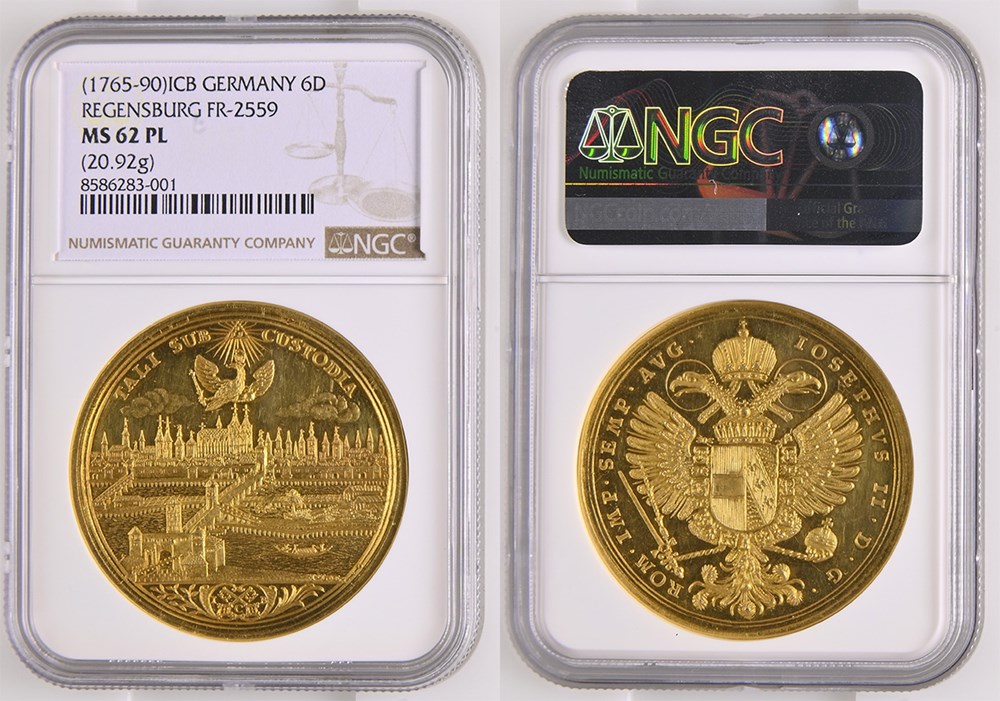
This Regensburg 6 Ducat coin is NGC certified as MS-62-Prooflike. There are some hairlines. No sensible expert, though, would argue that this coin is overgraded.
Right away, I noticed the natural toning and excellent color overall. On both sides, the central devices are of an orange-white color. Major design elements were definitely white after the coin was struck. The green fields are normal and appealing. There are some deep russet areas on the obverse. This coin was just lightly dipped or was never dipped. Like many of the coins from this auction on display in New York, this coin could be fairly described as ‘really cool’!
The cataloguer notes that this same Joseph II Regensburg 6 Ducat coin was in a Schulman-Kreisberg auction in New York in January 1963. Hans Schulman and Abner Kreisberg were among the most famous coin dealers during the middle of the twentieth century.
Another Regensburg 6 Ducat coin from the 1700s is not quite as impressive as the just mentioned coin, but it is cool nonetheless. The obverse also features the trademark Regensburg City-View. Holy Roman Emperor Francis I, also known as Franz I, is the main subject of the reverse. He was the father of Emperor Joseph II.
This Franz I 6 Ducat coin, offered as lot #250, is characterized by many hairlines and there is stuff in the fields. It was NGC graded AU-58. This coin is very rare, and it might be very difficult to find a better one. Certainly, it is a highlight of this auction.
A 1627 Regensburg 5 Ducat coin is especially noteworthy. It will be offered as lot #248.
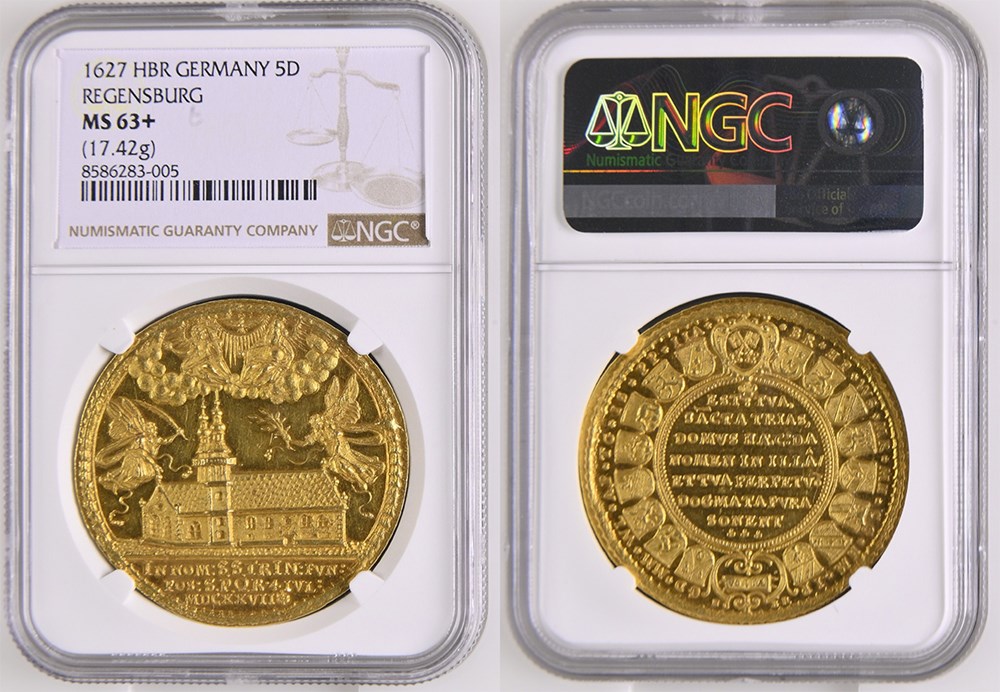
This 1627 Regensburg 5 Ducat coin certainly appears much cooler in actuality than it does in pictures. The contrasts of the toned whitish design elements and the rich glossy fields are not cameo, yet are more entertaining than most cameo contrasts. Indeed, the overall brown-tan-gold colors of this coin are curiously appealing. The outer symbols on the reverse probably were creamy white before toning tan. The inner fields in the reverse are energetically reflective.
The planchet was a little wavy. The dies were polished more so than the dies of most business strikes throughout the ages, yet this coin is clearly a business strike. It may have been unintentionally distinctive and more than attractive.
It was NGC graded as MS-63+. If it had much fewer hairlines, it would probably have graded MS-64+ or MS-65! This Regensburg 5 Ducat coin is memorable.
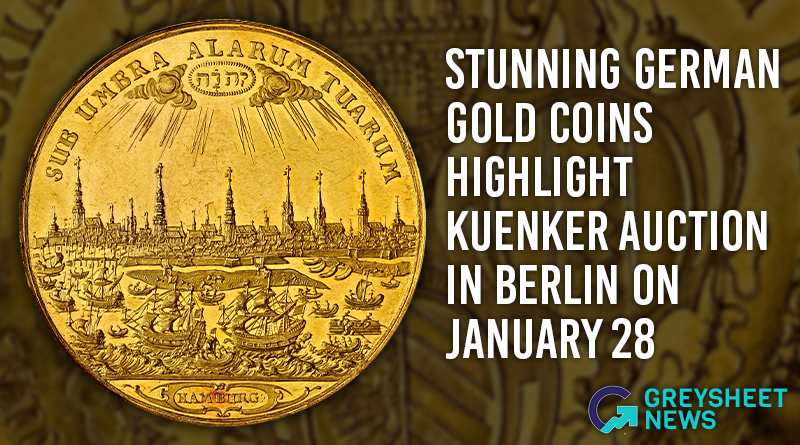
One of the most exciting coins in this auction is a Hamburg 1665 10 Ducat coin, which is being offered as lot #167. The 10 Ducat denomination was very important in the field of banking. In addition to a stunning city-view, this Hamburg 1665 coin features the coats of arms of Hamburg and three other major centers of international trade and finance.
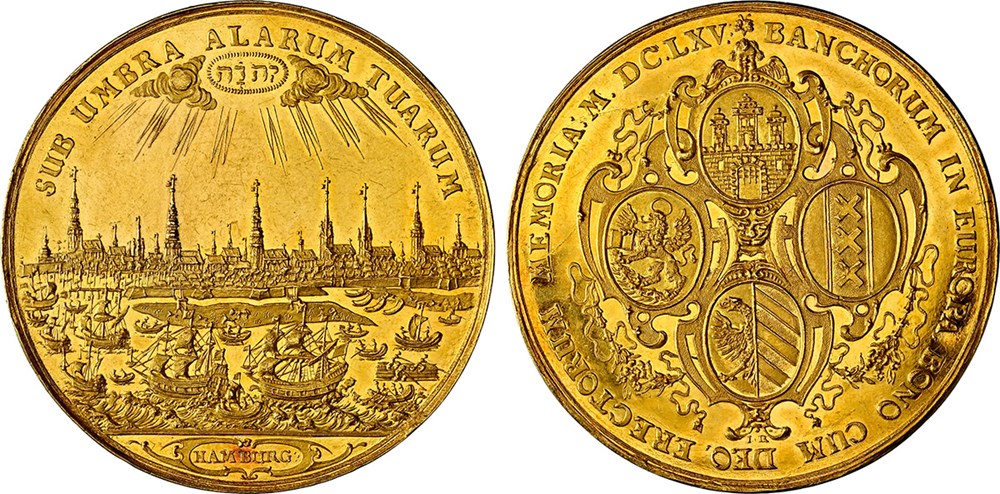
As one ducat is generally specified to weigh 3.5 grams, or a little less, it is unsurprising that this Hamburg 10 Ducat coin weighs 34.47 grams (1.108 Troy ounce). It was NGC certified as MS-61-Prooflike.
The term ‘prooflike’ is an understatement. I suggest that it is not a business strike. This coin is very glossy, notably well struck and really amazing. The crispness and relief of the design elements in combination with their relations to the fields may fulfill criteria for something much different from a business strike, though I would have to see this coin under stronger magnification and with better lighting to form an opinion about its status. For a very large gold coin from 1665, it is spellbinding. The presence of this coin was one of the highlights of the whole NYINC.
©2026 Greg Reynolds
Images are courtesy of NGC.

Related Stories (powered by Greysheet News)
View all news
A wide range of U.S. and pioneer gold coins from 1798 to 1933 proved to be highlights of the February 3 Stack's Bowers sale of the second part of the James A. Stack Sr. Collection.

Numismatic researcher Greg Reynolds does a deep dive into the Alymaya set of Saint Gaudens double eagles sold by Heritage in August 2025.
In this article Greg Reynolds analyzes the 1814 Capped Bust Half Dollar.
Please sign in or register to leave a comment.
Your identity will be restricted to first name/last initial, or a user ID you create.
Comment
Comments