




 Whitman Expo
-
Flowing Hair Dollar Flowing Hair Dollar Values
Greysheet & Red Book® PRICE GUIDE


Sort by
Sponsor

Sponsor

Sponsor

Sponsor

Sponsor

Legal Disclaimer
The prices listed in our database are intended to be used as an indication only. Users are strongly encouraged to seek multiple sources of pricing before making a final determination of value. CDN Publishing is not responsible for typographical or database-related errors. Your use of this site indicates full acceptance of these terms.
The Greysheet Catalog (GSID) of the Flowing Hair Dollars (1794–1795) series of Dollars in the U.S. Coins contains 1 distinct entries with CPG® values between $1,800.00 and $1,000,000.00.
Bust dollars, also otherwise known as early dollars, refer collectively to the Flowing Hair dollar struck in 1794 and 1795 as well as the Draped Bust dollar, which was produced from 1795 through 1804. Bust dollars are popular early American coins, and many collectors and dealers specialize in this area of the hobby. While they are usually collected only as type coins, there are some ambitious collectors who pursue entire date runs or specialize in collecting the many different varieties that enthusiasts have identified within the realm of Bust dollars.
The Flowing Hair dollar was America's first official silver dollar, with the first released in 1794. The coin was engraved by Robert Scot and features a visage of Miss Liberty with flowing hair on the obverse of the coin. The reverse showcases an eagle perched on a wreath. On the edge of the coin is the inscription HUNDRED CENTS ONE DOLLAR OR UNIT. The 1794 dollar is much scarcer than the 1795, though both dates are extremely scarce. Numismatists attribute several varieties to the 1795, and some collectors pursue these individually.
In 1795, Scot designed the Draped Bust obverse, which features a more voluptuous rendering of Miss Liberty with curlier locks. The eagle design from the Flowing Hair dollar remained on the silver dollar through 1797 and in 1798 was replaced by a heraldic eagle design. This change constitutes two sub-types for the Draped Bust silver dollar: the small eagle reverse (1795-1797) and large eagle reverse (1798-1804). Draped Bust silver dollars are scarce, though available for a price. The most common dates are the 1798 and 1799, though these are quite challenging to find with truly original, undamaged surfaces.
While United States Mint records indicates production of 19,570 Draped Bust silver dollars in 1804, there is no evidence that these coins bear the 1804 date. The famous 1804 silver dollar was struck in 1834 and included in special proof sets presented as diplomatic gifts to foreign heads of state. Along with a handful of pieces made as restrikes after 1857. In all, only 15 known examples of 1804 dollars exist and are now seven-figure rare coins.
See More See Less![Flowing Hair Dollar $1 1794-1795 MS [Type]](https://images.greysheet.com/ctc/catalog/1795-1-obv.jpeg?MaxWidth=180&Mode=Pad&Scale=UpscaleCanvas&format=webp)
 Loading more ...
Legal Disclaimer
The prices listed in our database are intended to be used as an indication only. Users are strongly encouraged to seek multiple sources of pricing before making a final determination of value. CDN Publishing is not responsible for typographical or database-related errors. Your use of this site indicates full acceptance of these terms.
Available on Greysheet Marketplace
View All

Buy Now: $69,000.00

Buy Now: $253,000.00
Auction Ends: 9/2/2026
Auction Ends: 9/2/2026
Dealer Directory
View All Dealers




Greysheet News
View All News
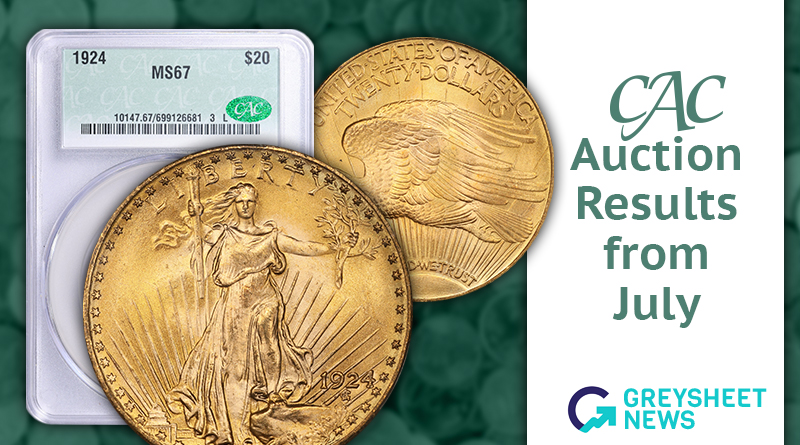
CAC approved and CACG encapsulated coins fared well in public sales during the month of July 2026.


Whitman Expos and Raleigh Coin Club Partner to Create the Carolinas' Premier Collecting Event and a New National Numismatic Destination.
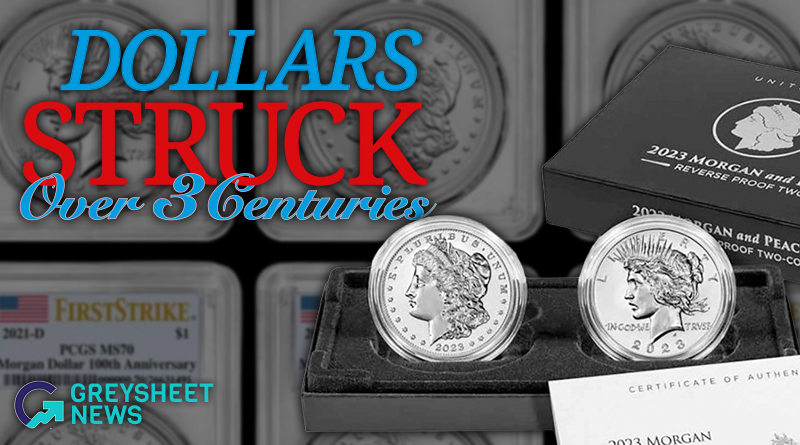
As dealers, collectors and investors all know, Morgan and Peace silver dollars are extremely popular American coins because of their history, legends, and silver content.
Events
View All Events

Heritage Auctions

Tuesday, June 2, 2026
Heritage Auctions
Tuesday, June 2, 2026
Heritage Auctions
Wednesday, June 3, 2026