




 Whitman Expo
Weekly World Mint Coinage: June 25, 2026
New coins from Italy, Poland, and the Philippines.
by Michael Alexander |
Published on June 25, 2026


Download the Greysheet app for access to pricing, news, events and your subscriptions.
Subscribe to RQ: Red Book Quarterly for the industry's most respected pricing and to read more articles just like this.
Advertisement
Italy – IPZS

Silver Coins Highlight Establishment of the Republic and Women's Suffrage
Silver coins from Istituto Poligrafico e Zecca dello Stato (IPZS) mark two important national anniversaries. It has been 80 years since women in Italy were accorded the legal right to vote, a change brought about by intense lobbying by women’s groups and female activists involved in the anti-fascist resistance. It would be an important step in a future decision.
Italian women first exercised their right to vote in local administrative elections starting in March 1946. On the 2nd June 1946, a referendum was held across the nation which would include the votes from Italy’s women for the first time. Such an historic event was taken very seriously that one of Italy’s national newspapers Corriere della Sera published an article entitled ‘Senza rossetto nella cabina elettorale’ (Without lipstick in the poll booth), which advised women not to wear any lipstick when voting to avoid the risk of leaving any stains on the ballot, therefore invalidating it.
The results were returned with 12,182,855 in favour of the establishment of a Republic and 10,362,709 in favour of retaining the monarchy. Additionally, votes were cast by all Italians to elect a Constituent Assembly to draft a new constitution which would go on to establish the new Republic. The volume of votes recorded a turnout of over 89%, reflecting immense civic engagement following the end of World War II.
Today, women’s participation in the 1946 referendum is remembered as a cornerstone in forging Italy's modern democracy. The anniversary of these milestones is celebrated annually on the 2nd June as Festa della Repubblica. In October 2022, Italy elected the first woman to hold the office of Prime Minister.
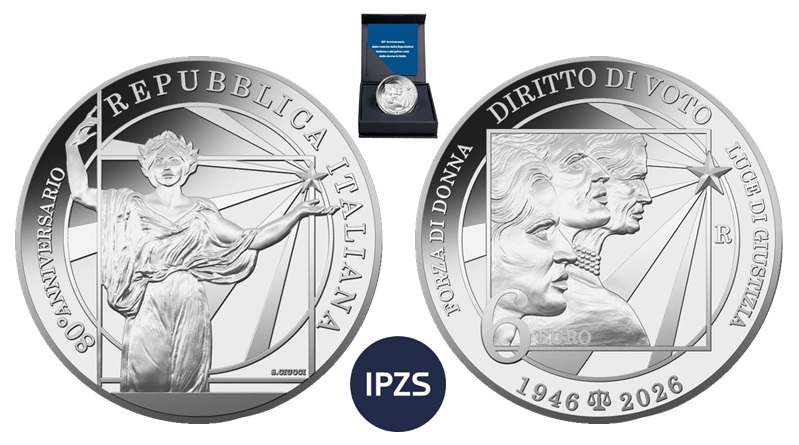
The silver BU quality coins are designed by Silvia Ciucci. The obverse features a traditional allegorical female figure representing the birth of the Republic, her arms outstretched. Above her left hand is the star from the emblem of the Italian Republic with rays of light emanating. The figure of Italy is depicted within a circle and a square, symbolising heaven and earth, stability and power. Along the rim and encircling the primary design is the commemorative text 80° ANNIVERSARIO” and REPUBBLICA ITALIANA (80th Anniversary and Italian Republic) At the bottom right is the designer's name S. CIUCCI. The reverse depicts the faces of three women from three different generations centred, with the star of the Italian Republic on the right, radiating rays of light. The inscriptions FORZA DI DONNA (strength of women) and LUCE DI GIUSTIZIA (light of justice) appear on the left and right sides along the rim. Above the primary design is the inscription DIRITTO DI VOTO (right to vote) while below along the lower rim are the commemorative years 1946 and 2026 separated by the image of a scale, a symbol of social justice. The face value 6 EURO is shown at the bottom left and the letter R identifying the Mint of Rome is placed at the right.
| Denomination | Metal | Weight | Diameter | Quality | Maximum Mintage |
| 6 Euro | .999 Silver | 31.1 g. | 38.6 mm. | BU | 5000 |
Each coin is encapsulated and presented in a heavy-gauge card case accompanied with a certificate of authenticity. For additional information, please visit the e-webshop of the IPZS.
Poland – Mint of Poland
Silver Proof and Colour Coins Mark Poignant National Anniversary
Collector coins from the Narodowy Bank Polski commemorate the 50th anniversary of the June 1976 protests. The action was brought about when Polish leader Edward Gierek’s so-called ‘economic miracle’ ran out of initiative and the political and the economic situation in Communist Poland began to deteriorate rapidly. On the 24th June 1976, the government announced a proposal for changes in the structure of prices, meaning drastic increases in prices of basic food products and in some cases, ushered in rationing.
Demonstrations took place across the country predominantly in factories and in 24 governing regions with over 80,000 people participating. A crowd gathered in front of the provincial Committee of the Polish United Workers’ Party demanding without success, to talk to the First Secretary of the Committee. As a result, some of the protesters forced their way into the building and began to ransack it, eventually settting the structure on fire. Many of the detainees, often random bystanders were subjected to run the gauntlet of rows of policemen who were beaten with batons, belt buckles and car tools until many lost consciousness.
The town of Ursus saw workers at the Tractor Factory down tools and move towards nearby railway tracks, stopping long distance train traffic. The protest was peaceful but, as the authorities feared the strikes might spread further across the country, announced they would withdraw the planned price increases later that evening.
According to the official data, a total of 239 people were arrested – 173 in Radom, 35 in Płock and 31 in Ursus. Some were eventually tried by a local misdemeanour tribunal but, 40 people were tried in criminal courts with some sentences handed down to protestors with up to 10 years of imprisonment in the town of Radom. Under an amnesty deal worked out between local and national prosecutors, the last of the incarcerated workers were released in July 1977.
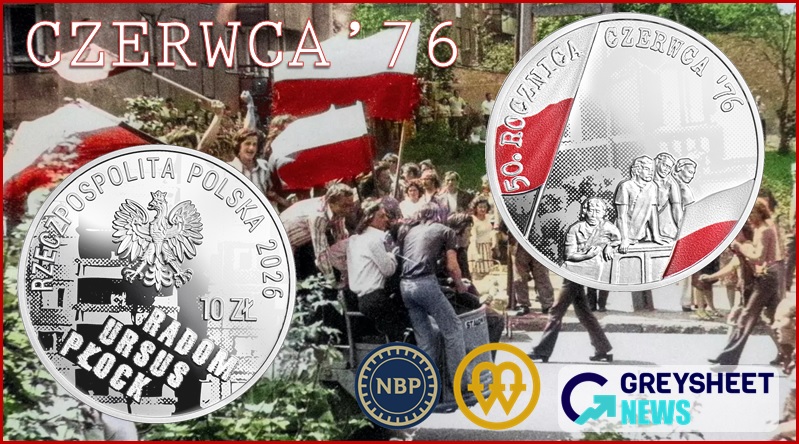
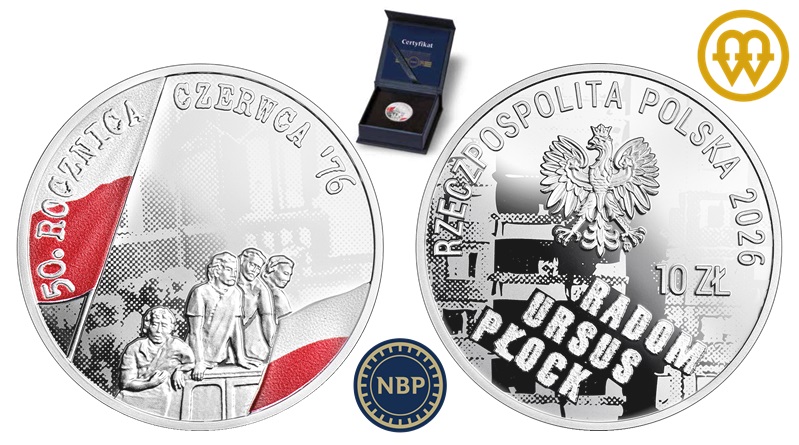
The Proof and colour coins are produced by the Mint of Poland in Warsaw on behalf of the National Bank and designed by Dobrochna Surajewska. The obverse features images of a collection of protesters which is inspired by original photographs taken during the protests. To the upper left and lower right are fragments of two flags in the colours of the Republic of Poland and which are shown in pad-print colour. Above and along the upper rim is the text 50. ROCZNICA CZERWCA ’76 (50th anniversary of June '76). The reverse features the names of the cities where the most dramatic protests of June 1976 took place – RADOM, URSUS, PŁOCK with the national emblem, the crowned eagle placed just above. In the background is a stylised image of apartment buildings. A stylised image of a block of flats is depicted in the background. Along the upper rim is the text RZECZPOSPOLITA POLSKA 2026 and to the lower right is the denomination 10 ZŁ.
| Denomination | Metal | Weight | Diameter | Quality | Maximum Mintage | |
| 10 Zlotych | .999 Silver | 14.1 g. | 32 mm. | Proof & Colour | 8000 | |
| Denomination | Metal | Weight | Diameter | Quality | Maximum Mintage |
| 10 Zlotych | .999 Silver | 14.1 g. | 32 mm. | Proof & Colour | 8000 |
Each coin is encapsulated and presented in a heavy gauge card custom case accompanied by a certificate of authenticity. For additional information, please visit the e-webshop of the National Bank of Poland.
Philippines - Bangko Sentral ng Pilipinas

Proof Coins Mark the 125th Anniversary of the Nation’s Highest Court
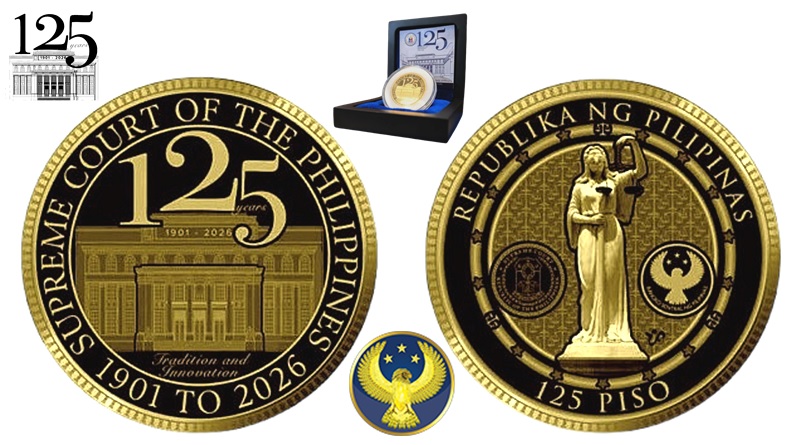
The Central Bank of the Philippines uses their latest commemorative coin t honor on the country’s judiciary branch. The Supreme Court of the Philippines traces its origins back to Act No. 136, which established the tribunal on the 11th June 1901 while still under American administration. This pivotal legislation marked the foundation of the country’s highest court, shaping the legal landscape and the future of the judiciary. This landmark legislation served as a critical step in the development of the Philippine legal system, providing a framework for the highest court to exercise its jurisdiction and fulfill its constitutional duties.
One of the primary functions of the Supreme Court of the Philippines exercises administrative supervision over all courts and court personnel in the country. By overseeing the implementation of rules and regulations, the Supreme Court maintains the integrity and efficiency of the courts. The Court can sit en banc, which means that all 15 members, including the Chief Justice and the Associate Justices, convene to collectively decide on cases.
The current location of the Supreme Court on Padre Faura Street in Manila houses the Supreme Court that was built between 1928 and 1930. Originally constructed to serve as the main library for the University of the Philippines, it was later renovated into the Supreme Court in 1991. Its neoclassical and art deco styles were recently recognised as an important national and historical cultural property and asset.
The Proof quality coins are produced at the Bangko Sentral ng Pilipinas – BSP Mint at their facilities in in Quezon City, Metro Manila. The coin’s reverse is designed by BSP artist Abigail Cutaran and its obverse by Rancho Arcilla. The obverse features the official logo of the Supreme Court’s 125th anniversary complete with an image of the present Court Building and the numerals 125. Around the design and along the rim is the commemorative text SUPREME COURT OF THE PHILIPPINES. Below the design are the commemorative years 1901 TO 2026. The reverse features a standing allegorical figure of Lady Justice together with the logos of the Supreme Court and Bangko Sentral ng Pilipinas encircled by 15 stars symbolising the members of sitting Justices of the Court. Above the primary design is the text REPUBLIKA NG PILIPINAS with the denomination 125 PISO placed below along the lower rim.
| Denomination | Metal | Weight | Diameter | Quality | Maximum Mintage |
| 125 Piso | Alum-Br | 28.2 g. | 34 mm. | Proof | n/a |
Each Proof coin is encapsulated and presented in a custom case accompanied by a certificate of authenticity. For additional information, please visit the e-webshop of the Bangko Sentral Pilipinas.
Related Stories (powered by Greysheet News)
View all news


New coins from New Zealand, Oman, and the United Kingdom.

New coins from Switzerland, France, and the United Kingdom.
Please sign in or register to leave a comment.
Your identity will be restricted to first name/last initial, or a user ID you create.
Comment
Comments