




 Whitman Expo
Vatican City. New Commemorative €2 coins Mark Transition of Election of New Pontiff
The Vatican Mint and Holy See Treasury release new coins continuing a centuries-old tradition.
by Michael Alexander |
Published on February 12, 2026

Download the Greysheet app for access to pricing, news, events and your subscriptions.
Subscribe to RQ Red Book Quarterly for the industry's most respected pricing and to read more articles just like this.

The issuance of coins marking the interregnum period between the death of one Pope and the election of his successor is a continuation of a tradition dating back to the 14th century. This interim period is known as Sede Vacante – which is a Latin phrase simply meaning ‘the see being vacant’ and in the context of the Catholic Church, it specifically refers to the period when the papacy is vacant. This period occurs either by the death or resignation of the pope, and before the election of a new one. On this occasion, it was brought upon with the death of His Holiness Pope Francis on the 21st April 2025.
During this time, the College of Cardinals governs the Church. It is the obligation of the Camerlengo of the Holy Roman Church and the head of the Camera Apostolica to formally proclaim the death of the pope. The Camerlengo, as the chief of the Roman Curia conducts normal business after the death of the pope, and also oversees the burial by presiding over the rite of ascertainment of death. Subsequently, the Camerlengo instructs preparation for the new election by calling all eligible Cardinals to assemble in Vatican City. With the death of Francis, this responsibility was fulfilled by Cardinal Kevin Farrell who was created a cardinal on the 9th October 2016 by Pope Francis and installed as Camerlengo on the 14th February 2019.
The most recent period of Sede Vacante began on the 21st April and concluded on the 8th May after sixteen days with the election of His Holiness of Pope Leo XIV. The longest period of Sede Vacante lasted nearly three years from the 29th November 1268 to the 1st September 1271 after the death of Pope Clement IV and the election of Pope Gregory X. The shortest time frame was 13 days after the death of Pope Pius IX and before the election of Pope Leo XIII.
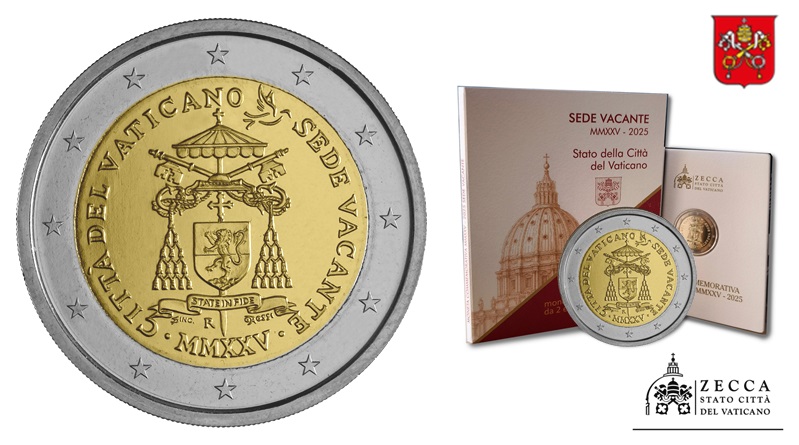
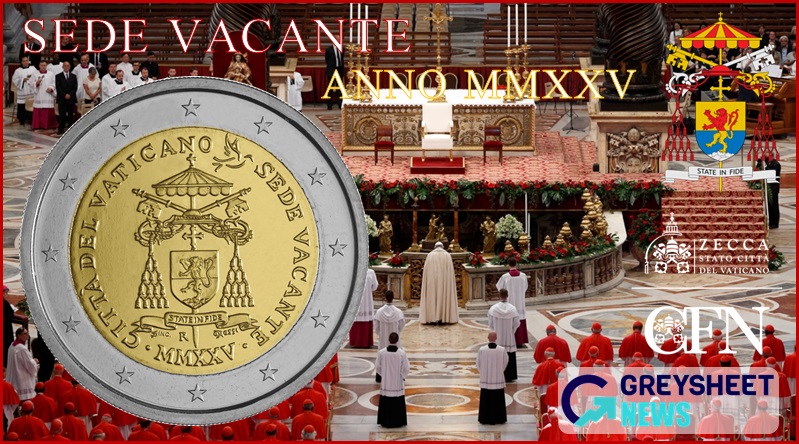
The €2 bi-metallic coins are produced by the Istituto Poligrafico e Zecca dello Stato Italiano – IPZS at their facilities in Rome on behalf of the Treasury department of the Vatican City State. Designed by Orietta Rossi, the obverse design depicts the coat of arms of Cardinal Kevin Farrell as the Cardinal Camerlengo featuring a red galero hat with 15 tassels on each side, signifying his cardinal status. The central part of the arms displays a *shield and design reflecting his personal history. Above the shield are two crossed keys of St. Peter in gold and silver and a canopy of red and yellow stripes, symbols of the Camerlengo's office and the vacant Holy See. The motto STATE IN FIDE is shown below the crest and translates to Stand Firm in the Faith. The inscription CITTA’ DEL VATICANO and SEDE VACANTE are placed along the edge and around the crest. An abstract representation of a dove – a symbol of the Holy Spirit appears between the two inscriptions. The year is shown in Roman numerals as MMXXV (2025) indicating the year of issue and is placed below the crest. The primary design is surrounded by twelve five-pointed stars, representing the European Union. The reverse side is that of the standard Euro-zone design for the 2 Euro coins, the numeral ‘2’ superimposed over a map depicting Europe created by artist Luc Luycx.
| Denomination | Metal | Weight | Diameter | Quality | Maximum mintage |
| 2 Euro | Bi-metallic | 8 g. | 25.7 mm. | FDC | 75,000 |
Available from the 4th February, the FDC version of the commemorative €2 coins are encapsulated and presented in a case with magnetic closure accompanied with information about the coin. The specifications are also included on the printed on the case. For additional information, please visit the e-webshop of the Vatican Treasury.
* In the upper portion of the shield, gold and the lion are derived from the arms of Cardinal Theodore Edgar McCarrick, whom Bishop Farrell assists as an auxiliary bishop. The lower portion of the lion in gold derives from the Irish clan of O’Farrell. In this instance, blue has been substituted for the green of the O’Farrell Arms, to honour Our Lady of Lourdes, upon whose feast Bishop Farrell received ordination in the episcopate at the hands of the Cardinal Archbishop of Washington. In the base of the shield is a silver mound of rock, symbolic of Bishop Farrell’s patron, Saint Kevin (died c. 618). After ordination Saint Kevin settled as a hermit at Glendalough, County Wicklow in a cave called ‘St. Kevin’s Bed’ formerly a Bronze Age rock tomb.
Related Stories (powered by Greysheet News)
View all news
The Monnaie de Paris release their first €2 commemorative coins remembering a beloved publication.

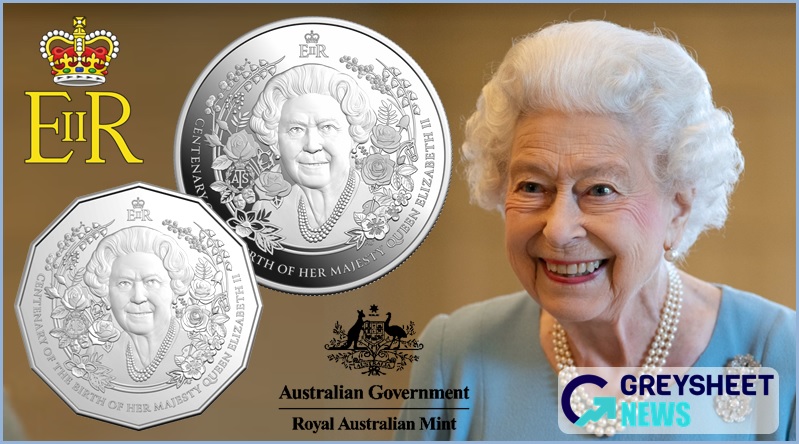
The Royal Australian Mint release new coins honouring the 100th anniversary of the Late Queen's birth.
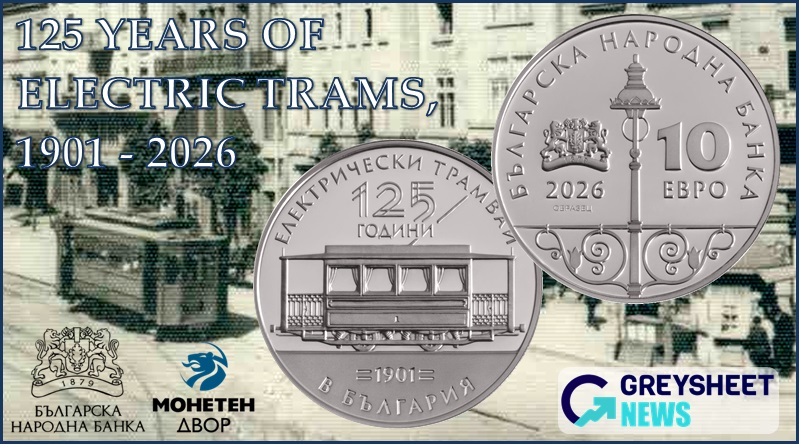
The Bulgarian National Bank release new silver proof coins highlighting an important transport milestone.
Please sign in or register to leave a comment.
Your identity will be restricted to first name/last initial, or a user ID you create.
Comment