




 Whitman Expo
The Business of Numismatics: June 2026 Greysheet Editor's Letter
The recently concluded Central States U.S. coin auction held by Heritage netted just a hair short of $27 million, an impressive result that yielded numerous price records.
by Patrick Ian Perez |
Published on June 3, 2026


Download the Greysheet app for access to pricing, news, events and your subscriptions.
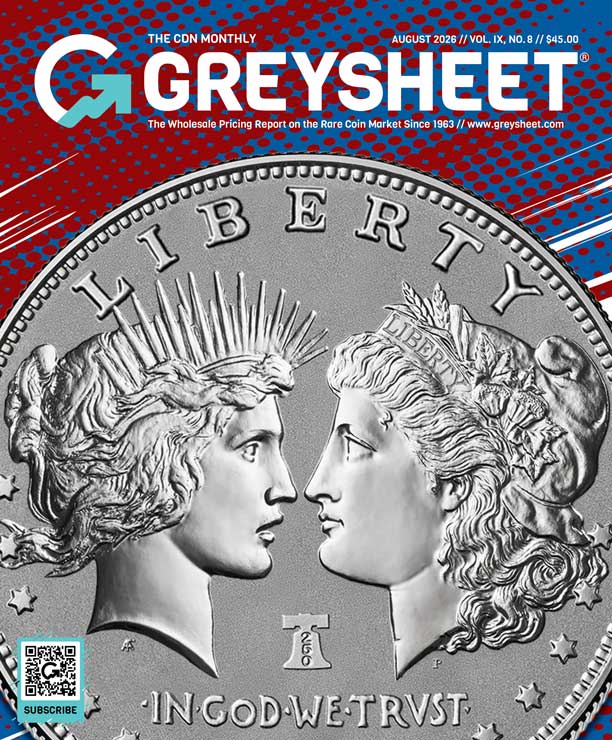
Subscribe to Greysheet for the industry's most respected pricing and to read more articles just like this.
The sale came on the heels of the show itself, which was well attended and featured above average dealer-to-dealer business. Transaction volume on the wholesale side had the potential to be greater but was limited by a general lack of supply of fresh material. I heard multiple comments from dealers regarding this. A significant amount of quality coins that have been purchased over the past few years are in strong hands, which is a very positive sign for the industry as a whole. It shows that the buyers are dedicated collectors who are building, not speculating, with their coins and that the base of buyers is widening as well. The other issue, at least on the wholesale side of the market that I heard being discussed at the Central States show, was how inventory was being priced. Some of the available material was priced unrealistically high in anticipation of another step up in prices, as if the market six months from now will automatically be 15% higher than today. Of course, it is every seller’s right to price their material as they wish, but speculative pricing could lead to market stagnation.
Back to the Heritage CSNS auction, I mentioned there were numerous price records set. Before diving into a few of them, it is interesting to think of how we interpret a “record price” today. Over the past 20-plus years there has been much excitement and awe when individual coins, especially those from widely collected series, set price records. Is there the same excitement today? When the gold spot price was $800 and silver stood at $15, it seemed that a million-dollar coin was somehow more impressive. Perhaps the entire populace has become accustomed to everything in general being more expensive. There has been significant erosion in the value of the US dollar, especially in the past six years, that has also reframed how we view a given price. Today, it seems a coin almost needs to get to the $3 million level to turn heads, and a $1 million coin is commonplace. Should it be cause for celebration that our market has become sophisticated enough that it regularly attracts this kind of capital investment, or do we chalk it up to the type of asset price inflation that many other collectible markets have experienced? A great example of all of these aspects is the top lot from the CSNS sale: an 1879 Coiled Hair $4 Stella graded NGC PR67 CAM. One of the finest known examples and fresh to the market, it sold for $2,135,000, beating the prior record by 46%. Remarkably, the record this coin beat was set just in January, when an example graded PCGS PR66 CAM sold for $1,464,000. In addition, last August saw a PCGS/CAC PR65 (non-Cameo) sold for $1,440,000. So just over the past nine months the record been reset three times for this coin. Did the first two results spur the owner of the present coin to sell? I think in this case it was very likely, and clearly there are multiple collectors who are chasing this type. While the majority of coin collectors are not buying million-dollar plus coins, this scenario has been replaying over and over at many levels, from $10,000 on up. Some coins that were previously in the $5,000 to $8,000 range are now bringing in the $10,000 to $12,000 range. I suspect this trend will continue throughout 2026.
Sincerely,
Patrick Ian Perez, patrickp@whitmanbrands.com

Related Stories (powered by Greysheet News)
View all news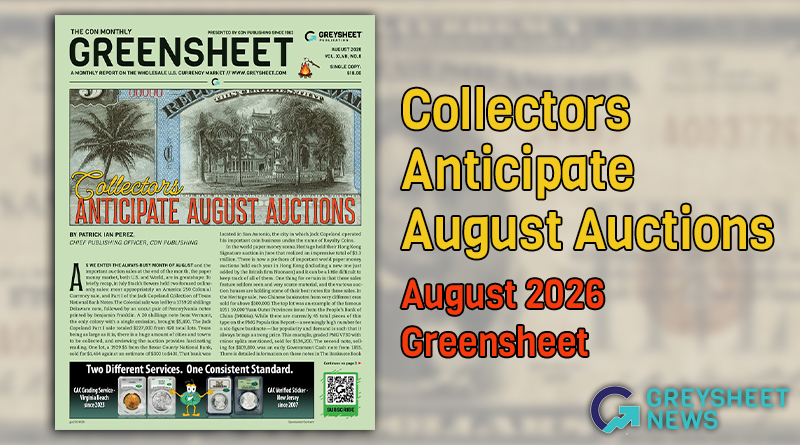
As we enter the always-busy month of August and the important auction sales at the end of the month, the paper money market, both U.S. and World, are in great shape.

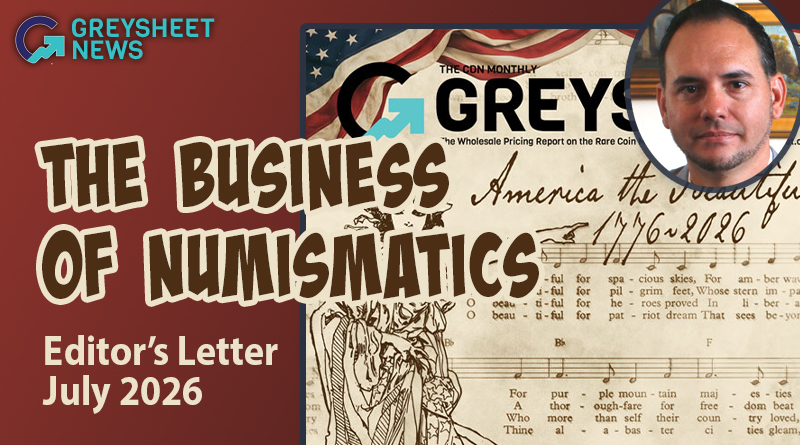
July is a special month on this year's calendar as we celebrate the 250th birthday of our nation.
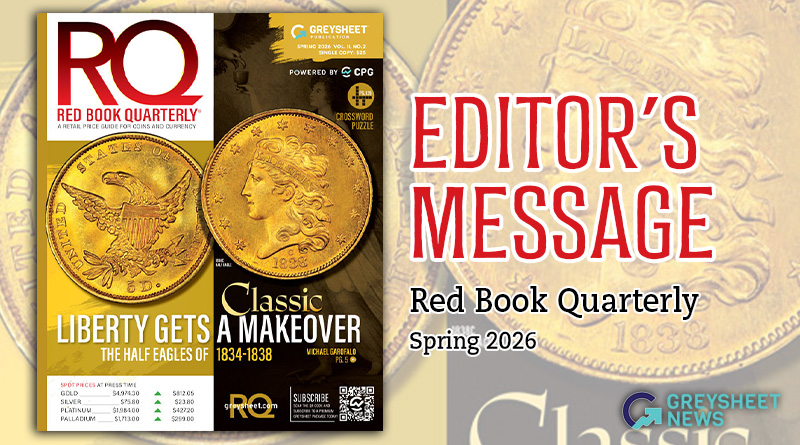
The concept of coin collecting is slowly, but steadily, moving further into the mainstream consciousness.
Please sign in or register to leave a comment.
Your identity will be restricted to first name/last initial, or a user ID you create.
Comment
Comments