




 Whitman Expo
Over $10 Million in Rare U.S. Gold Coins in James A. Stack, Sr. Collection, Part II
The auction will be held on Tuesday, February 3 in Griffin Studios in Stack’s Bowers Galleries international headquarters in Costa Mesa, CA.
Published on February 3, 2026

Download the Greysheet app for access to pricing, news, events and your subscriptions.
Subscribe to RQ Red Book Quarterly for the industry's most respected pricing and to read more articles just like this.
Advertisement
In less than one week, the James A. Stack, Sr. Collection, Part II will fall under the auctioneer’s hammer, allowing collectors the first chance in at least 75 years to acquire 128 U.S. gold coins valued at over $10 million. All the coins have been off the market since at least 1951, the year of Mr. Stack’s passing, and many were last seen at auction over a century ago. The auction will be held on Tuesday, February 3 in Griffin Studios in Stack’s Bowers Galleries international headquarters in Costa Mesa, CA beginning at 12:00 PM PT.
The auction introduces, or reintroduces, major U.S. gold coin rarities to the marketplace, with coins individually valued from many thousands into the millions of dollars. Mr. Stack began his coin collecting in the late 1930s with the goal of building as complete a collection of U.S. coins as time and resources would allow. His collections were quite advanced by the mid-1940s, including significant U.S. paper currency as well as ancient and world coins. The majority of his coin and paper money collections were sold in a series of auctions held by Stack’s Rare Coins (no relation to James A. Stack, Sr.) from 1975 to 1995. Unbeknownst to much of the numismatic world, a small but significant group of a few hundred coins was kept by Mr. Stack’s descendants, including a previously unrecorded Class III 1804 dollar that lay quietly in the Stack Collection since the 1940s. Revealed in Stack’s Bowers Galleries’ December 9, 2025 auction of Part I, that newly rediscovered rarity soared to $6 million, a significant portion of the $15 million in prices realized for that auction.
“The goal of the James A. Stack auctions is not only to find a new generation of buyers for Mr. Stack’s coins, but to also preserve, promote, and revivify his legacy in numismatics for generations to come,” commented Vicken Yegparian, Executive Vice President of Stack’s Bowers Galleries. He continued, “The market welcomed his early silver dollars and double eagles in Part I, breaking records just this past December. We are confident that the balance of his gold coins—gold dollars through $10 eagles as well as Territorial gold coins in Part II, will achieve new heights, with many pieces already bid to record levels one week before the live auction begins.”
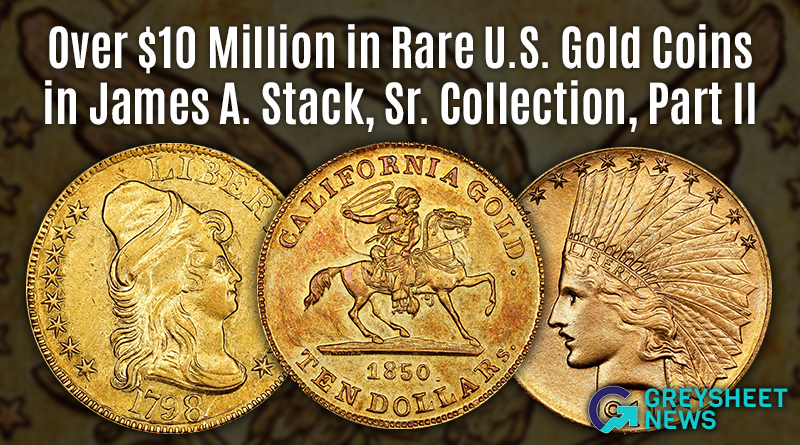
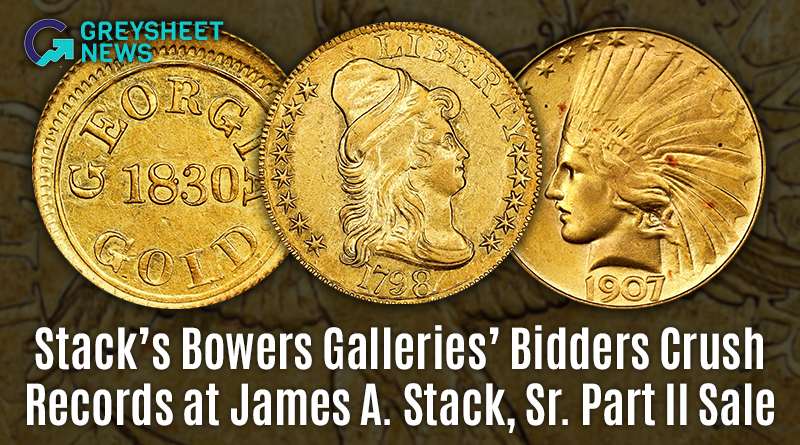
The cover lot of the auction is the long-lost Earle (1912)-Atwater (1946) example of the 1798 Small Eagle $5, one of just five known in private collections of this extremely rare early gold coin. Its long absence from the market and poor quality auction photos from the first half of the 20th century created confusion as to whether this example was the same as a coin discovered in the 1990s. Awakened from its 80-year slumber in the James A. Stack, Sr. Collection, this sole CAC-verified example graded AU-53 (PCGS) will achieve a seven figure price on auction day. It represents the fourth of the five privately held, and the fifth of the seven total known examples that Stack’s Bowers Galleries and its predecessors have had the pleasure to handle over the last century.
Collectors of Indian Head $10 eagles should take note of the Stack Collection’s treasures, beginning with one of just 50 examples of the 1907 Rounded Rims type not melted down—his example grades MS-67 (PCGS) CAC CMQ and is one of the few finest survivors of this vaunted Saint-Gaudens production. His key date 1911-D, graded MS-66 (PCGS) CAC CMQ, is the sole finest certified at either major grading service and is destined for a set of superb Gem $10 Indians. It was wholly unknown to modern numismatists before being discovered in the Stack Collection. His 1933 $10 Indian—the only generally ownable gold coin dated 1933—is one of just 50 to 60 pieces thought to survive, and at MS-66 (PCGS), it is among the few very finest certified by either major grading service.
The James A. Stack, Sr. Collection also includes the finest offering of fresh-to-market Territorial gold coins in recent memory. Many of the coins are from the collection of Hillyer Ryder, who acquired them at auction in the 1910s and 1920s before his passing in 1928. Best known today for his collections of and books on U.S. Colonial coinage, Ryder will now also be remembered as one of the most significant 20th century collectors of best-in-class and historic U.S. and Territorial gold coins. Mr. Stack’s 1830 Templeton Reid $2.50 graded AU-55 (PCGS) CAC tracks to Ryder, who acquired the coin in Henry’s Chapman’s 1924 sale of the Nygren Collection. Three of the Territorials trace to the collection of California coiner John Glover Kellogg via Ryder, including Kellogg’s own 1854 Kellogg $20, now graded AU-58+ (PCGS) CAC CMQ. Mr. Stack picked up his iconic “Horseman” type 1850 Baldwin $10 at B. Max Mehl’s sale of the Geiss Collection in 1947; it is the first Stack’s Bowers Galleries has offered since its record-setting $1.26 million auction sale of the specimen graded MS-63+ (PCGS) CAC CMQ in November 2024.
“The James A. Stack, Sr. Collection has provided us at Stack’s Bowers Galleries—and the entire marketplace—a wild and exciting ride since we announced the collection last summer,” mused Brian Kendrella, President of Stack’s Bowers Galleries. “With our deeply researched catalog, expert photography, worldwide marketing, and record prices, the James A. Stack, Sr. Collection will now be rightly remembered as one of the greatest U.S. coin collections built in the 20th century.”
Session 1 and Session 2 of the James A. Stack, Sr. Collection Part II are available for viewing and pre-sale bidding at StacksBowers.com. Live bidding begins at 12:00 PM PT on Tuesday, February 3, 2026.
Related Stories (powered by Greysheet News)
View all news
July 25-31 Costa Mesa, CA

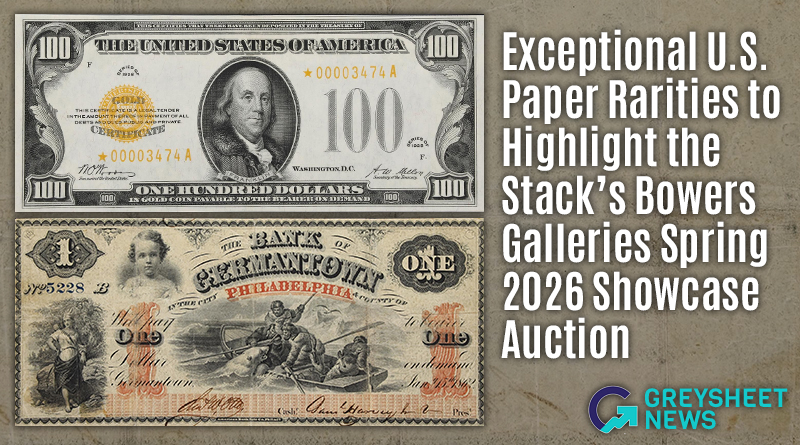
Stack's Bowers Galleries is delighted to offer a diverse selection of paper rarities in the U.S. Currency sessions of the Spring 2026 Global Showcase Auction.
1911-D $10 Sets New Record for the Indian $10 Series. 1798 Small Eagle $5 Brings $2.82 Million. 1850 Baldwin Horseman $10 Nets $840K.
Please sign in or register to leave a comment.
Your identity will be restricted to first name/last initial, or a user ID you create.
Comment
Comments