




 Whitman Expo
Liberty Gets a Classic Makeover: The Half Eagles of 1834-1838
These coins were struck for five years—between 1834 and 1838—and they were struck every year at the Philadelphia Mint.
by Michael Garofalo |
Published on May 18, 2026

Download the Greysheet app for access to pricing, news, events and your subscriptions.
Subscribe to RQ: Red Book Quarterly for the industry's most respected pricing and to read more articles just like this.
The 19th century had a stormy start in Europe, as France was engaged in the so-called “Napoleonic Wars" between 1810-1815. These hostilities saw France battling Spain, Portugal and England, France invading Russia, France being defeated by Austria, Russia, Prussia, Sweden and England and the capture of Paris. Napoleon was ultimately defeated by England at the Battle of Waterloo.
But once Napoleon was contained, the instability did not immediately end. The Greeks battled the Ottoman Empire for their independence, Spain fought an internal civil war, and Russia battled both Persia and the Ottoman Empire in a series of wars. These on-going battles led to inflation, currency devaluations, and uncertainty. Those who could afford it sought refuge in the universal currency—gold!
Additionally, the fledgling United States was not the picture of stability and peace as we fought the War of 1812 with England and then engaged in a long series of conflicts against a half dozen different Native American tribes across the country. One of the by-products of all these conflicts was the hoarding and shipping of American gold coins to Europe where they were melted for their gold content.
The Coinage Act of 1792 established an American Mint and coin denominations. It also established the price of gold in America to a 15:1 ratio to silver. As the price of gold rose across the world, it became financially feasible to send American gold coins to Europe to be melted and many of these coins met that fate.
In order to stabilize this trade imbalance, on June 28, 1834, the Congress of the United States implemented the Coinage Act of 1834. This act reduced the amount of actual gold in the coins, and it created an even greater shortage of the pre-1834 quarter eagle ($2.50) gold coins and the pre-1834 half eagle ($5.00) gold coins that were already in circulation. No other denominations of gold coins were being struck at that time.
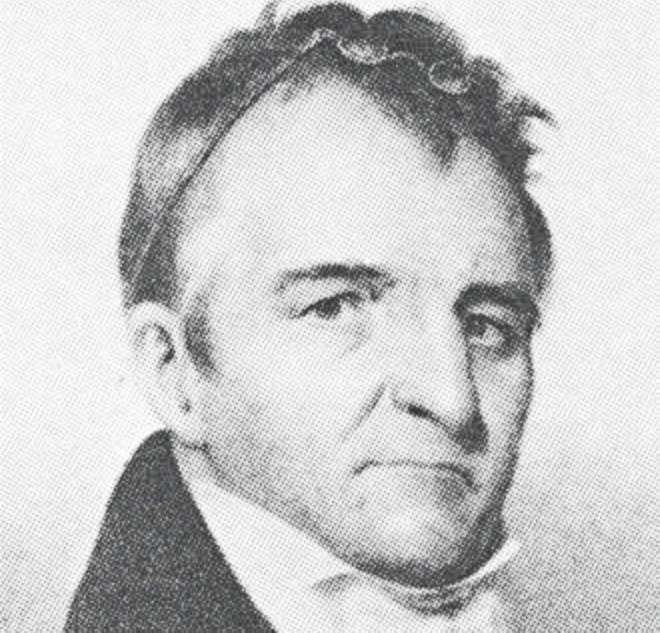
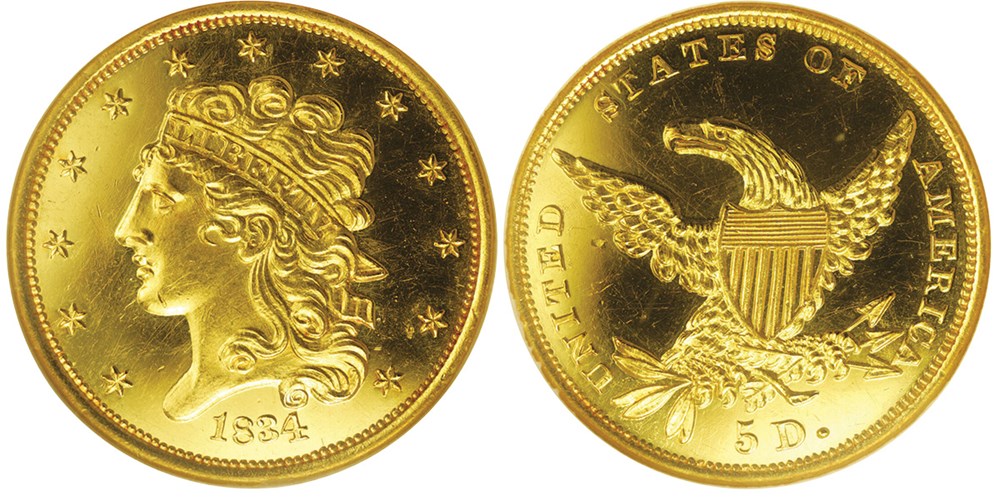
The Chief Engraver of the U.S. Mint, William Kneass, was assigned the task of re-engraving the new quarter eagle and half eagle gold coins. Like on the previous series, Miss Liberty adorned the obverse of the coin, but now she was younger, thinner, and more stylish compared to the earlier design. She still faced to the left, surrounded by 13 six-pointed stars, and still displayed the date below.
The reverse, much like the obverse, now had a thinner and sleeker-looking eagle. The eagle’s wings were continued to be spread wide and continued to hold arrows in one set of talons and an olive branch in the other. The motto, “UNITED STATES OF AMERICA," and the denomination “5 D," were still surrounding the eagle. The edge of these coins was reeded, which was intended to reduce the number of counterfeit examples as it was difficult to mimic.
To make it easier for the public to identify these newer half eagles that contained less gold, the eagle no longer held a ribbon in its beak upon which was inscribed “E PLURIBUS UNUM." This missing ribbon ensured that fewer of these coins would be melted. The reduction in the amount of gold amounted to about 5% of the total weight.
These coins were struck for five years—between 1834 and 1838—and they were struck every year at the Philadelphia Mint. In 1838, coins were also struck at the Charlotte Mint, which had opened in 1837 and at the Dahlonega Mint, which opened in 1838.
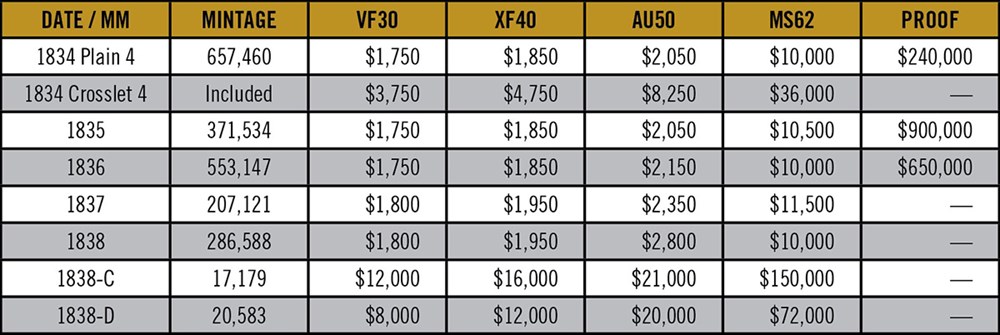
During the inaugural year, 1834, two varieties of that date were struck—a Plain 4 and a Crosslet 4. Of the 657,460 coins struck that year, we have no idea of how many of each variety have been struck. The Crosslet 4 is easily identified by having a vertical tail bar off of the end of the horizontal crossbar. The Crosslet 4 values generally run between 2.5 to 4.5 times higher than the Plain 4 variety, depending on grade.
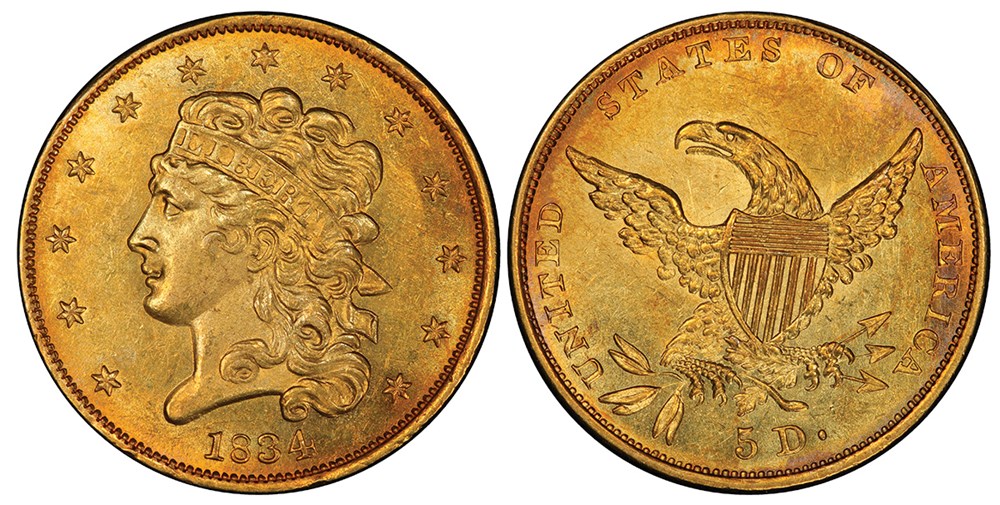
In 1835 the Philadelphia Mint struck 371,534 half eagle coins that have only very minor differences in whether the “8" in the date uses a block “8" style or a script “8" style. Neither style is significantly rarer than the other.
During 1836 the Philadelphia Mint struck 553,147 half eagles with similar differences in the “8". Again, neither style is significantly rarer than the other. It has been reported that Christian Gobrecht became not an assistant but a "second" engraver in September 1835. William Kneass suffered a major stroke in 1835 and, from that point forward, Gobrecht did all of the pattern designs and coin die modifications. Gobrecht became the Chief Engraver in 1840, shortly after the death of Kneass.
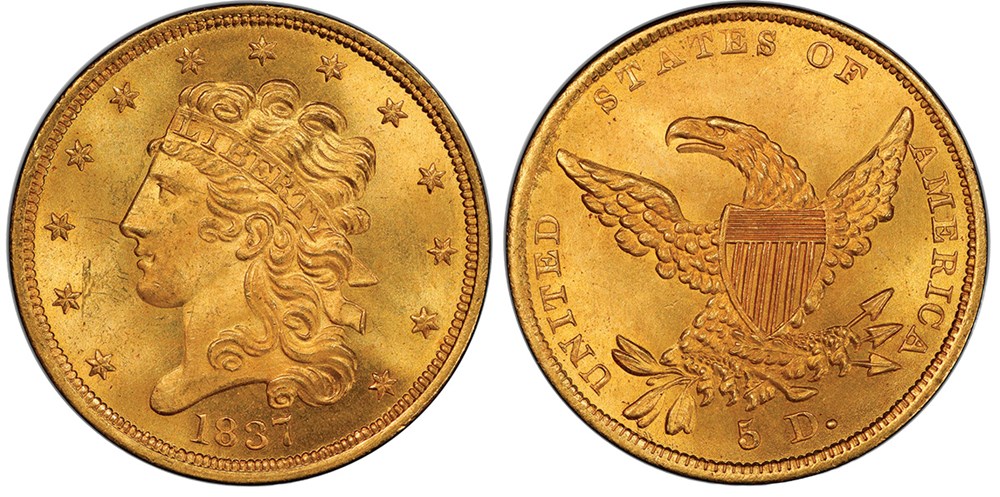
The mintage during 1837 was considerably less than half of the number struck in the prior year (1836). Only 207,121 half eagles were struck in Philadelphia that year. The 1837 date is considerably scarcer to find in any grade than previous years. Like the 1835 and 1836 dated coins, the 1837 coins also come in both block "8" and script “8" varieties.
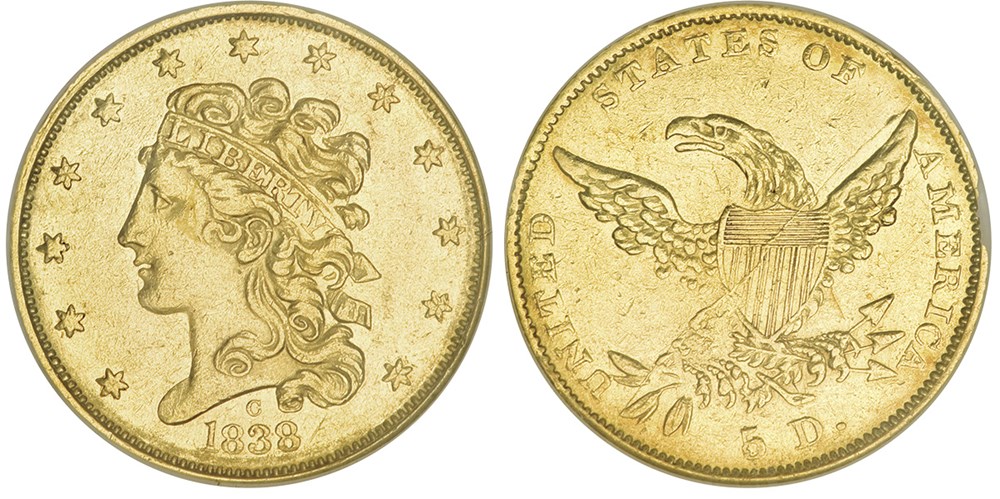
The final year of striking occurred in 1838 and, unlike in prior years when all coins were struck at the Philadelphia Mint, coins were also struck at the newly opened mints in Charlotte, North Carolina and Dahlonega, Georgia. Philadelphia struck 286,588 Classic Head $5 gold half eagles, Charlotte struck 17,179 coins and Dahlonega struck 20,583 of these coins. Examples from Charlotte and Dahlonega are extremely scarce in virtually all grades and are highly desirable. The Charlotte coins are the rare issues of the brief Classic Head series. It is scarcer than the 1838 Dahlonega five, especially in high grades. It is even rarer than the 1834 Crosslet 4 in all grades.
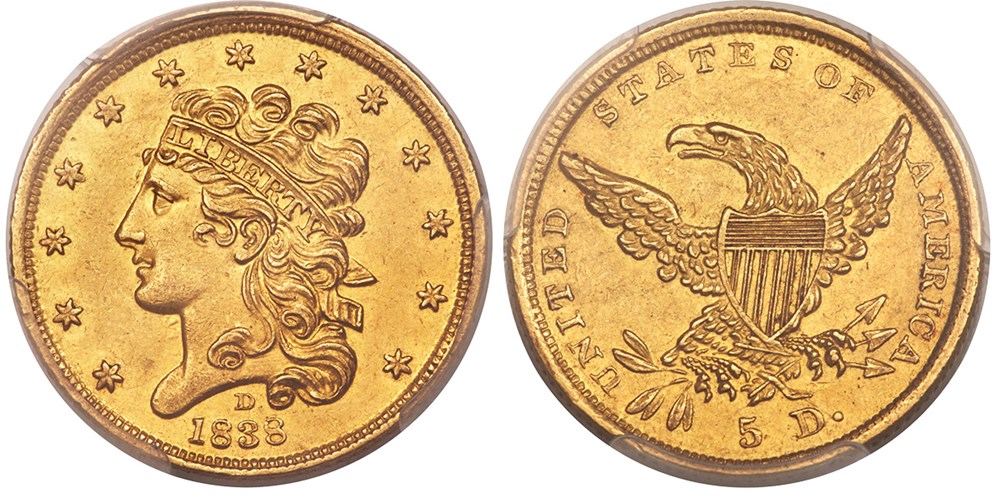
The 1838-D (Dahlonega) half eagle was the first issue of the new Dahlonega Mint, with the first pieces struck on April 21 of that year. The survivors are usually found in VF to AU grades, while any fully Mint State coins are extremely rare.
Below is a chart for both the Charlotte and Dahlonega minted coins. This chart lists the currently highest graded coins, from the population reports of the Certified Acceptance Corporation (CAC), the Numismatic Guaranty Company (NGC), and the Professional Coin Grading Service (PCGS). These ‘top population’ coins, of course, are subject to change and the coins displayed on the chart may reflect coins submitted more than once or to more than one grading service.
| Date | MS62 | MS63 | MS63* |
| 1838-C | 1 NGC | 1 PCGS, 1 CAC | — |
| 1838-D | 3 CAC | 1 NGC, 2 PCGS | 1 NGC |
For collectors and investors contemplating acquiring a set of these Classic Head half eagles, completing a set of all of the Philadelphia coins can be accomplished fairly easily in Very Fine to Extremely Fine grades.
Attempting to locate all of these Philadelphia coins in About Uncirculated (AU) condition is difficult. Finding any truly Uncirculated pieces is extremely difficult. Higher graded Mint State coins are very rare. Even in Uncirculated grades, most examples are not sharply struck on the higher parts of the bust on the obverse. For this scarce series, a weak strike is much more acceptable than numerous marks or cleaning or damage of any kind. Weak strikes are the rule rather than the exception with Classic Head gold half eagles.
There are also proof versions of these $5 Classic Head half eagles, but they are extremely rare, difficult to find, and extremely expensive if you are lucky enough to encounter them in a major auction or elsewhere.
Finding problem-free examples with a decent strike are definitely worth a premium so don’t hesitate if coins meeting this description are offered to you. You should consider assembling a set of these rare, historic, and beautiful coins.
Current Retail Pricing is as follows:
Images courtesy of Heritage Auctions and Wikimedia.

Related Stories (powered by Greysheet News)
View all news
If you decide to put together a collection of shield nickels, none of these circulation dates are prohibitively rare.

As dealers, collectors and investors all know, Morgan and Peace silver dollars are extremely popular American coins because of their history, legends, and silver content.
It is imperative that you research any Proof set before purchasing in order to determine the number of silver coins, the fineness, and the total weight of the silver content as they vary from year to year and from type of Proof set.
Please sign in or register to leave a comment.
Your identity will be restricted to first name/last initial, or a user ID you create.
Comment
Comments