

 USD
USD
 EUR
EUR
 GBP
GBP
 CAD
CAD
 AUD
AUD



 Whitman Expo
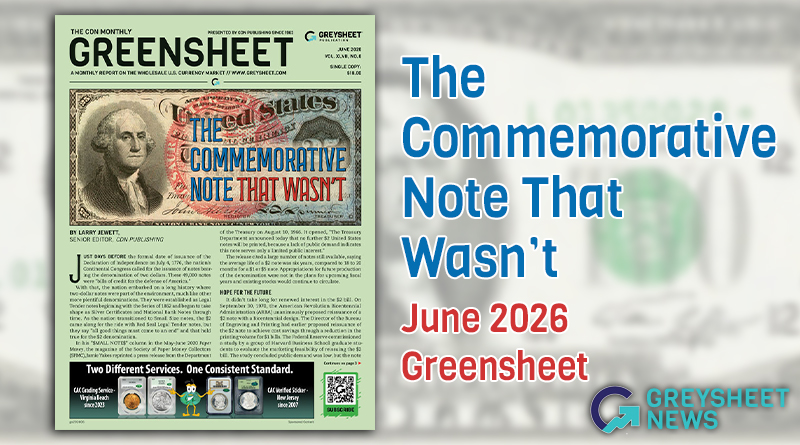
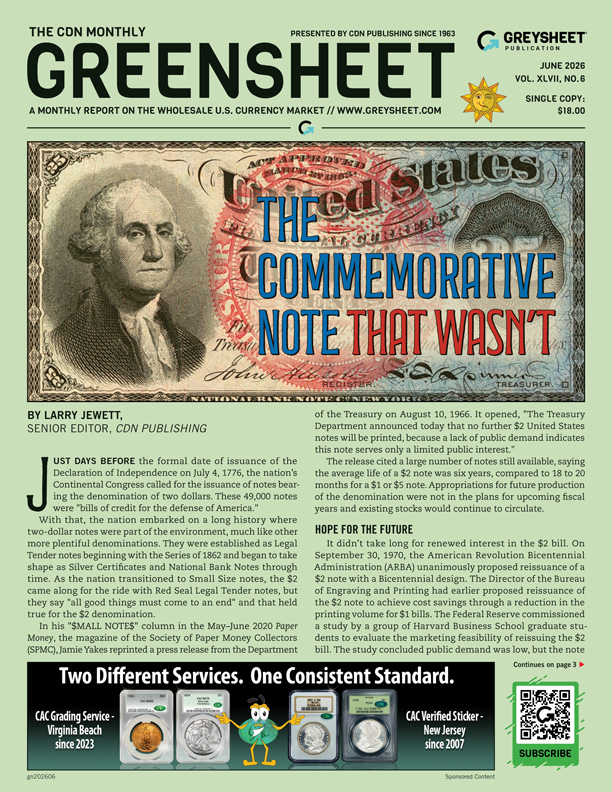
June 2026 Greensheet Market Analysis: The Commemorative Note That Wasn't
A Brief History of the $2 Note
by Larry Jewett |
Published on June 2, 2026

Download the Greysheet app for access to pricing, news, events and your subscriptions.
Subscribe to Greensheet for the industry's most respected pricing and to read more articles just like this.
Advertisement
Just days before the formal date of issuance of the Declaration of Independence on July 4, 1776, the nation’s Continental Congress called for the issuance of notes bearing the denomination of two dollars. These 49,000 notes were "bills of credit for the defense of America."
With that, the nation embarked on a long history where two-dollar notes were part of the environment, much like other more plentiful denominations. They were established as Legal Tender notes beginning with the Series of 1862 and began to take shape as Silver Certificates and National Bank Notes through time. As the nation transitioned to Small Size notes, the $2 came along for the ride with Red Seal Legal Tender notes, but they say "all good things must come to an end" and that held true for the $2 denomination.
In his "$MALL NOTE$" column in the May–June 2020 Paper Money, the magazine of the Society of Paper Money Collectors (SPMC), Jamie Yakes reprinted a press release from the Department of the Treasury on August 10, 1966. It opened, "The Treasury Department announced today that no further $2 United States notes will be printed, because a lack of public demand indicates this note serves only a limited public interest."
The release cited a large number of notes still available, saying the average life of a $2 note was six years, compared to 18 to 20 months for a $1 or $5 note. Appropriations for future production of the denomination were not in the plans for upcoming fiscal years and existing stocks would continue to circulate.
Hope for the Future
It didn’t take long for renewed interest in the $2 bill. On September 30, 1970, the American Revolution Bicentennial Administration (ARBA) unanimously proposed reissuance of a $2 note with a Bicentennial design. The Director of the Bureau of Engraving and Printing had earlier proposed reissuance of the $2 note to achieve cost savings through a reduction in the printing volume for $1 bills. The Federal Reserve commissioned a study by a group of Harvard Business School graduate students to evaluate the marketing feasibility of reissuing the $2 bill. The study concluded public demand was low, but the note would be used. With all of the information and consideration of savings through manufacturing gains, the Secretary of the Treasury advanced the plan and decided the upcoming United States Bicentennial would be the right time.
While designed as a note of circulation and not construed to be commemorative, having the Bicentennial theme on the note was considered crucial to enhance public acceptance. It would be the back of the new note that would drive home the relationship.
The face of the Series of 1976 $2 note would exhibit slight changes from the previous issues of the Series of 1963, including the color of the seal changing from red to green. The nation had changed to Federal Reserve Notes in the interim, so the addition of the Federal Reserve Bank seal and a change in wording above Jefferson’s portrait were also among the changes. To the general public, the changes would be barely noticeable.
Officials chose the John Trumbull painting "The Declaration of Independence, July 4th, 1776" as the full canvas for the back, with slight differences. The painting hangs in the rotunda of the United States Capitol. Trumbull was commissioned for the work in 1817. It was presented for placement in the Capitol on the occasion of the nation’s 50th birthday in 1826.
It was not the first time that Trumbull’s work had appeared on U.S. currency. A smaller version appeared on the back of $100 National Bank notes issued during the First Charter Period.
According to United States Paper Money by Arthur L. and Ira S. Friedberg, there were 590,720,000 Series of 1976 $2 notes produced, including 15,360,000 star notes. The Series was issued between 1976 and 1978.
Underwhelming Impact
History shows the return of the $2 note did not encourage consumer use as superstition and other factors weighed heavily on the general public. Collectors find value in the Series of 1976 $2 note as the first $2 Federal Reserve note.
As of April 1, 2026, the Bureau of Engraving and Printing has not produced a $2 in 2026, but the $2 notes were made in each of the last five months of 2025. It is not uncommon for the BEP to suspend printing as there have been many years in the past that no new notes were produced, only to see them issued again.
When asked during an event in New Orleans, U.S. Treasurer Brandon Beach confirmed that the $2 note is not going away despite a lack of production in the current year. Like the recent elimination of the cent, many believe the $2 note’s days are numbered. It’s been there before and continues to be a part of the paper money environment, thanks to the Series of 1976 note and the Bicentennial.

Related Stories (powered by Greysheet News)
View all news
A proposal has been introduced in both houses of the U.S. Congress for a commemorative coin program that would recognize fallen firefighters.


When the next SpaceX Dragon 2 rocket lifts off from Florida, it will be carrying some special cargo.
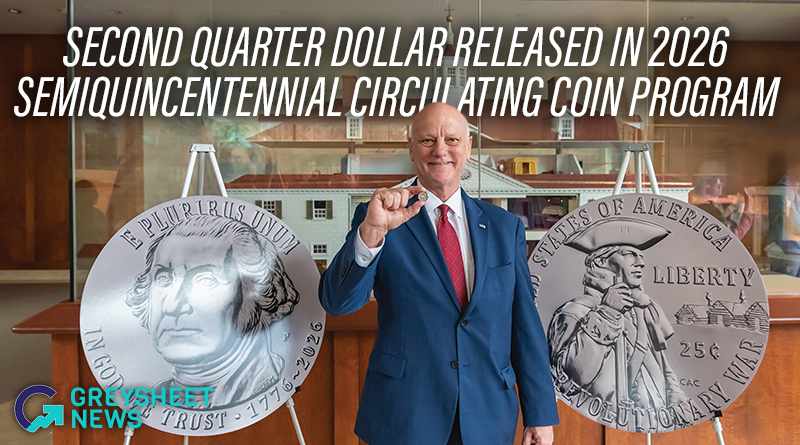
The second quarter dollar in the 2026 Semiquincentennial Circulating Coin Program was released on March 23 at Mount Vernon, the Virginia estate of President George Washington.
Please sign in or register to leave a comment.
Your identity will be restricted to first name/last initial, or a user ID you create.
Comment
Comments