




 Whitman Expo
July 2026 Greensheet Market Analysis: New Banknote for America - Fact or Fiction?
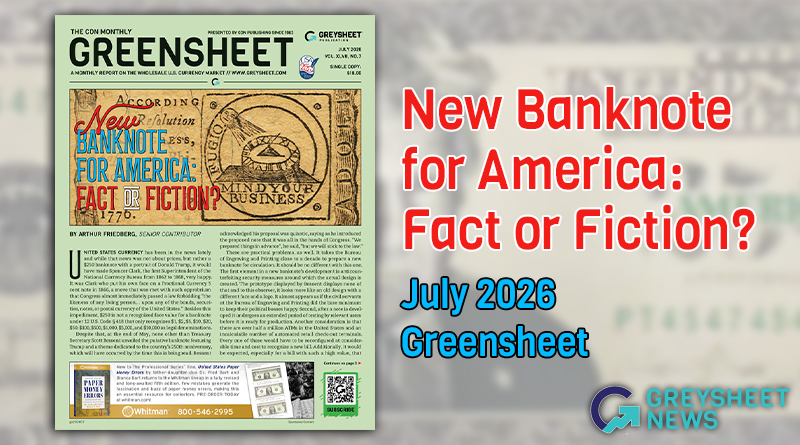
At the end of May, Treasury Secretary Scott Bessent unveiled a $250 banknote featuring Trump and a theme dedicated to the country’s 250th anniversary.
by Arthur Friedberg |
Published on July 6, 2026

Download the Greysheet app for access to pricing, news, events and your subscriptions.
Subscribe to Greensheet for the industry's most respected pricing and to read more articles just like this.
United States Currency has been in the news lately and while that news was not about prices, but rather a $250 banknote with a portrait of Donald Trump, it would have made Spencer Clark, the first Superintendent of the National Currency Bureau from 1862 to 1868, very happy. It was Clark who put his own face on a Fractional Currency 5 cent note in 1866, a move that was met with such opprobrium that Congress almost immediately passed a law forbidding "the likeness of any living person… upon any of the bonds, securities, notes, or postal currency of the United States." Besides this impediment, $250 is not a recognized face value for a banknote under 12 U.S. Code § 418 that only recognizes $1, $2, $5, $10, $20, $50, $100, $500, $1,000, $5,000, and $10,000 as legal denominations.
Despite that, at the end of May, none other than Treasury Secretary Scott Bessent unveiled the putative banknote featuring Trump and a theme dedicated to the country’s 250th anniversary, which will have occurred by the time this is being read. Bessent acknowledged his proposal was quixotic, saying as he introduced the proposed note that it was all in the hands of Congress. "We prepared things in advance", he said, "but we will stick to the law."
There are practical problems, as well. It takes the Bureau of Engraving and Printing close to a decade to prepare a new banknote for circulation. It should be no different with this one. The first element in a new banknote’s development is anticounterfeiting security measures around which the actual design is created. The prototype displayed by Bessent displays none of that and to this observer, it looks more like an old design with a different face and a logo. It almost appears as if the civil servants at the Bureau of Engraving and Printing did the bare minimum to keep their political bosses happy. Second, after a note is developed it undergoes an extended period of testing by relevant users before it is ready for production. Another consideration is that there are over half a million ATMs in the United States and an incalculable number of automated retail check-out terminals. Every one of these would have to be reconfigured at considerable time and cost to recognize a new bill. Additionally, it would be expected, especially for a bill with such a high value, that another Treasury department, the Financial Crimes Enforcement Network (FINCEN), would have comments about the impact of the introduction of such a note on its anti-money laundering activities. A week after it was asked, the BEP had not yet responded to our request for comments on these factors.
According to reports in The Washington Post, the New York Post and other media, Treasurer Brandon Beach and his adviser, Michael Brown, were behind the idea. BEP director Patricia Solimene protested, citing legal and technical factors. The New York Post wrote, "She had told them we’re not authorized to do this. We can’t progress any further, and all the stakeholders have not even met to discuss the next steps… Currency often takes six to eight years to produce a new bill, particularly one of such high value."
On April 27, Solimene was reassigned against her wishes to another government position. The Acting Director of the BEP is now listed as Michael Brown. Brown was Kansas State director of the Trump 2024 campaign and joined the Treasury Department in October as a senior adviser. According to mikebrownforkansas.com, he started his own homebuilding company in 1990 and has been "a general contractor focusing on commercial construction."
Turning to the commercial side of the paper money market, over $2.6 million in world paper money sold in Stack’s Bowers Galleries’ 640-lot Spring 2026 Maastricht auction. Over a million of that was for sixty-three lots from Palestine, including $219,600 for a perforation cancelled 100 Pounds of 1927 (BNB B106a) graded Fine 15 by PMG, and $140,300 for a 50 Pounds 1927 Specimen (BNB B105as) in Choice Uncirculated 63. The highest price paid for an issued note was $96,600 for a Very Fine 30 50 Pounds of 1929 (BNB B105b).
A group of Ceylon specimens realized over $200,000, led by a King George VI 1947 10,000 Rupees (BNB B233bs) in Choice About Uncirculated 58 at $56,100. A possibly unique, undated (1948) French Indo-China, Banque de l'Indochine 1,000 Piastres Specimen (BNB B168as3), but with a regular serial number instead of zeroes went for $37,820 in About Uncirculated 55.
A presentation album dated to the 1960s, from the now-closed Bradbury, Wilkinson & Company sold for $37,820. It contained color trial specimens from British Honduras, Brunei, Burundi, Cyprus, Gambia, Guernsey, Hong Kong, Iceland, Iran, Iraq, Isle of Man, Kenya, Kuwait, Libya, Luxembourg, Malawi, Malaysia, Malta, Nepal, Northern Ireland, Oman, Qatar & Dubai, Scotland, Seychelles, Singapore, Sri Lanka, Syria, Trinidad & Tobago, Uganda, Western Samoa, and Yemen.

Related Stories (powered by Greysheet News)
View all news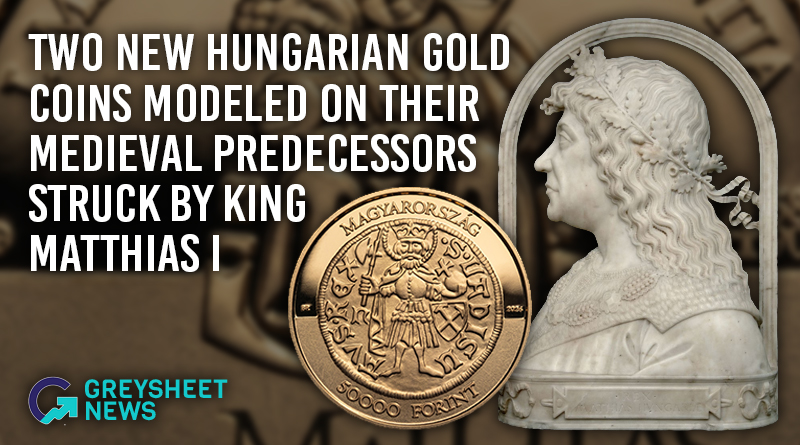
In 2026, The Hungarian Mint is issuing a gold collector coin called “The Gold Florin of Matthias I”, in single-ducat weight and quadruple-ducat weight (piedfort) versions, as well as a base metal version in a copper-nickel-zinc alloy.


Two Month Ordering Window Open Until June 30. After That Date, Mintage Will Be Set. Reservations Can No Longer Be Guaranteed.
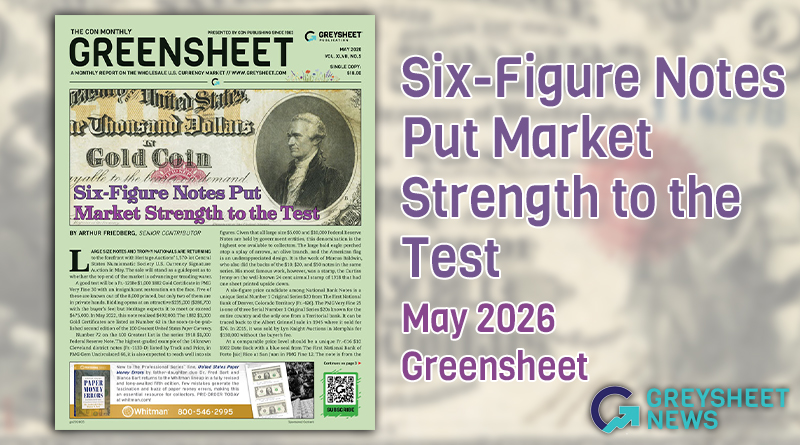
Large size notes and trophy nationals are returning to the forefront with Heritage Auctions' 1,570-lot Central States Numismatic Society U.S. Currency Signature Auction in May.
Please sign in or register to leave a comment.
Your identity will be restricted to first name/last initial, or a user ID you create.
Comment
Comments