




 Whitman Expo
Italy. Latest Silver Proof Mega-Coin Features Rome’s Iconic Coliseum and Amphitheatre
The Istituto Poligrafico -IPZS release new silver proof one-kilo commemorative coins.
by Michael Alexander |
Published on March 10, 2026

Download the Greysheet app for access to pricing, news, events and your subscriptions.
Subscribe to RQ Red Book Quarterly for the industry's most respected pricing and to read more articles just like this.
Advertisement
The Amphitheatrum Flavium, known around the world as the Coliseum of Rome is the largest ancient amphitheatre ever built and located in central Rome. Commissioned around 70 to 72 AD by Emperor Vespasian of the Flavian dynasty and completed by Titus in 80 AD, this iconic, freestanding structure of concrete and stone seated 50,000 to 80,000 spectators to attend the gladiatorial games, mock sea battles, and animal hunts. The impressive structure likely gained the name Coliseum from a nearby colossal statue of the Emperor Nero.
The elliptical, four-story arena with specifications of 83 meters by 48 meters or, 272 feet by 157 feet was constructed using the most modern materials and techniques. The primary materials used were travertine - a natural, durable, and porous form of limestone, tuff - a lightweight, porous rock formed from compacted volcanic ash and debris and concrete consisting of limestone and clay. Due to the ability to mould the building components, the design was able to incorporate arches which provided strength and stability. Eighty arches were designed and included on each of the four levels. Another unique feature to this magnificent structure included the Hypogeum, a complex underground, two-story network of tunnels used by gladiators and animals, and the Velarium, a massive, retractable awning for shade – an exceptional feat of design for the time. In 80 AD, a silver Sestertius coin authorised during the rule of Emperor Titus was minted in celebration for the inauguration of the Coliseum, depicting the four-storied building in detail. During its most prevalent era, Roman spectators gathered at the Coliseum for some of the City’s most unforgettable spectacles, such as damnatio ad bestias or, condemnation to beasts, a form of Roman execution that included the sacrifice of Christians to the lions. This form of punishment lasted from the first edict by Emperor Nero in 64 AD until 313 AD when religious freedom was established.
Roman spectacles lasted until the early half of the medieval era, after that, the Coliseum rapidly fell into decline and disrepair. Over its long history, the structure suffered from many fires, earthquakes, and looting over the centuries and was also used as housing for indigent Romans, workshops, a fortress, and ultimately a quarry. In 1349, severe damage was inflicted on the Coliseum by a deadly earthquake which caused the outer south side, lying on a less stable softer terrain to collapse. The damage which is still visible as the damage was never repaired and much of the fallen stone was reused to build palaces, churches and buildings in Rome.
It wasn’t until 1749, when the Papal States who governed Rome from the year 756, and on the orders of Pope Benedict XIV, declared the Roman Coliseum a site of Christian martyrdom, and which preventing further looting of materials. Due to general deterioration over time prompted the Italian Government and city of Rome to initiate a major restoration programme carried out between 1993 and 2000 and equal to the cost of $19.3 million dollars. The structure was recognised as one of the new Seven Wonders of the World in 2001 and remains one of the most popular tourist sites worldwide. In tribute to Italian heritage and ingenuity, the coliseum is depicted on the obverse side of Italy’s 5 euro-cent coin since 1999.
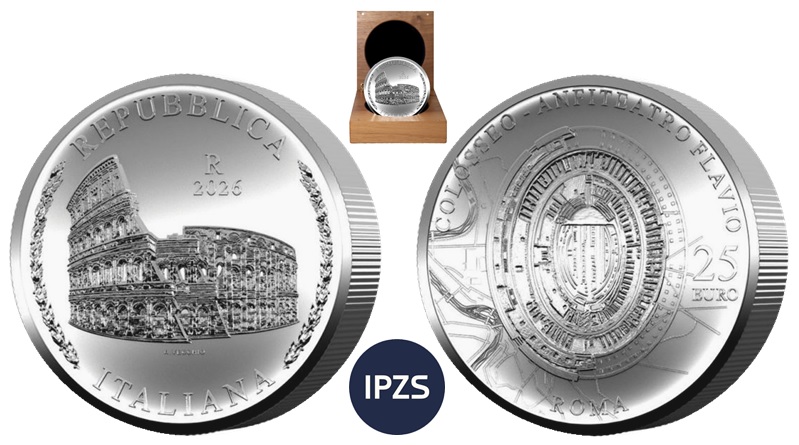
The large-size one kilogram silver coin is designed by Antonio Vecchio and depicts in detail the present and most familiar view of the Coliseum from the south facing side and centred. Along both the upper and lower rim above and below the primary design is the text REPUBBLICA and ITALIANA with depictions of laurel wreath branches on the right and left edges. To the upper right of the image of the Coliseum is the letter R identifying the Mint of Rome and year of issue, 2026. Just under the coliseum in small print is the name of the designer, A.Vecchio. The reverse side features a bird's-eye view of the Colosseum centred and with a reconstruction of its original layout. In the background is a map of ancient Rome, highlighting the consular roads. The inscription COLOSSEO – ANFITEATRO FLAVIO is placed above the primary design with ROMA appearing below. The denomination 25 EURO is shown just to the right of the Coliseum.
| Denomination | Metal | Weight | Diameter | Quality | Mintage limit |
| 25 Euro | .999 Silver | 1000 g. | 80 mm. | UHR Proof | 400 |
Available to pre-order from the 11th March, the coin is released on the 17th March online and in the Rome retail shop location. Each coin is encapsulated to accommodate its large diameter and presented in a hardwood polished custom case accompanied with a certificate of authenticity. For additional information, please visit the e-webshop of the Istituto Poligrafico e Zecca dello Stato – IPZS.
Related Stories (powered by Greysheet News)
View all news
The Central Bank of Malta release silver proof coins marking 50 years of National Housing Services.

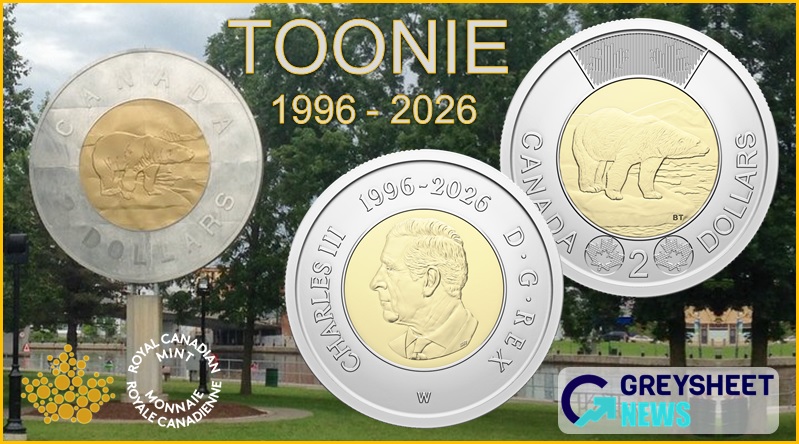
The Royal Canadian Mint release commemorative $2 coins marking their first release in 1996.

The Royal Australian Mint release new collector coins with a special denomination.
Please sign in or register to leave a comment.
Your identity will be restricted to first name/last initial, or a user ID you create.
Comment
Comments