




 Whitman Expo
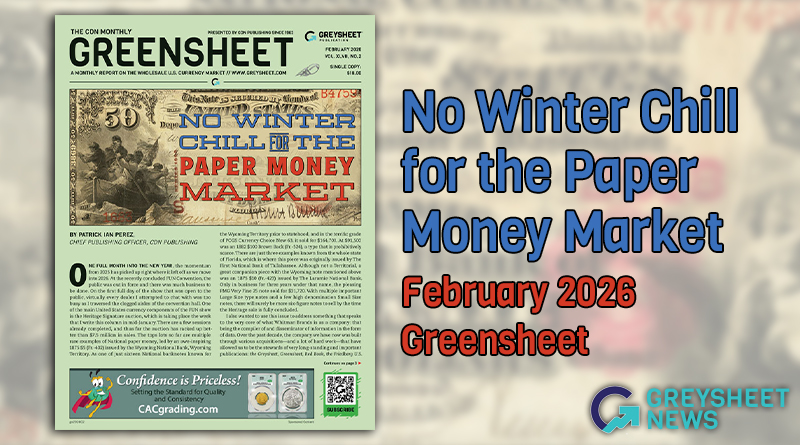
February 2026 Greensheet Market Analysis: No Winter Chill for the Paper Money Market
One full month into the new year, the momentum from 2025 has picked up right where it left off as we move into 2026.
by Patrick Ian Perez |
Published on February 16, 2026

Download the Greysheet app for access to pricing, news, events and your subscriptions.
Subscribe to The Greensheet for the industry's most respected pricing and to read more articles just like this.
Advertisement
At the recently concluded FUN Convention, the public was out in force and there was much business to be done. On the first full day of the show that was open to the public, virtually every dealer I attempted to chat with was too busy as I traversed the clogged aisles of the convention hall. One of the main United States currency components of the FUN show is the Heritage Signature auction, which is taking place the week that I write this column in mid-January. There are a few sessions already completed, and thus far the auction has racked up better than $7.5 million in sales. The tops lots so far are multiple rare examples of National paper money, led by an awe-inspiring 1875 $5 (Fr.-402) issued by the Wyoming National Bank, Wyoming Territory. As one of just sixteen National banknotes known for the Wyoming Territory prior to statehood, and in the terrific grade of PCGS Currency Choice New 63, it sold for $164,700. At $91,500 was an 1882 $100 Brown Back (Fr.-524), a type that is prohibitively scarce. There are just three examples known from the whole state of Florida, which is where this piece was originally issued by The First National Bank of Tallahassee. Although not a Territorial, a great companion piece with the Wyoming note mentioned above was an 1875 $10 (Fr.-423) issued by The Laramie National Bank. Only in business for three years under that name, the pleasing PMG Very Fine 25 note sold for $31,720. With multiple important Large Size type notes and a few high denomination Small Size notes, there will surely be more six-figure notes to sell by the time the Heritage sale is fully concluded.
I also wanted to use this issue to address something that speaks to the very core of what Whitman Brands is as a company: that being the compiler of and disseminator of information in the form of data. Over the past decade, the company we have now was built through various acquisitions—and a lot of hard work—that have allowed us to be the stewards of very long-standing and important publications: the Greysheet, Greensheet, Red Book, the Friedberg U.S. Paper Money book, The Banknote Book, and others. Although these publications are important parts of the industry, when we think of ourselves, we tend to think more about the data side of things. Publications and data have one critical component in common: the catalog. In the English language the term catalog can mean multiple things, but in this specific context it means the gathering and organization of all—or as many as possible—parameters of a numismatic item. The catalog underpins everything we are able to provide to our subscribers. All the lines one sees in a price chart in a printed publication, all the hundreds of thousands of prices that can been viewed on our website, all the information that is available in the app would not be possible without a catalog. Few prior numismatic firms understood the importance of a digital, all-encompassing catalog of U.S. and world coins and paper money. The third-party grading services were really the first to build such a thing, as they needed a catalog to identify the items they were accepting to grading. This allowed them to record every grading event, which led to population data and even allowed them to create the slab tags we are so used to today. Outside of this, there has not been a company that has been able to create and maintain an authoritative numismatic catalog. This is our goal. We have invested significant resources, both human and financial, to this end. We have built custom software to manage this humongous database, and continually work to add to it. As this pertains to paper money, we have a near-complete catalog of United States paper money, including Colonial and Confederate issues, and are working to build out an Obsolete currency catalog. We acquired the Banknote Book and have worked to digitize each chapter so that every single entry in that catalog has a corresponding digital record, which is always expanding. Recently I have seen some articles promoting past catalogs and numbering systems that have already proven themselves inadequate for the modern market. Clinging to catalog systems that were appropriate for their time—pre-internet and when paper money collecting was many times smaller than it is today—does not help to advance the field and perpetuates errors. We have always welcomed a collaborative approach to cataloging, and we have always made our catalog available to professional dealers, auction houses, and grading companies. In many of our publications we are now including our GSID, which is a unique identification number for every item that can be cross-referenced with other popular numbering systems. As we continue to build out the catalog, we are committed to accomplish the most comprehensive numismatic database ever built.

Related Stories (powered by Greysheet News)
View all news
We have recently published multiple new chapters of the Banknote Book, including the pre-1871 Germany complex, Costa Rica, and Mexico.

The rare coin market has continued its strong performance unabated despite unpredictable volatility in the precious metals space.
We are only one month into 2026 and the rare coin market's momentum has continued to surge.
Please sign in or register to leave a comment.
Your identity will be restricted to first name/last initial, or a user ID you create.
Comment
Comments