




 Whitman Expo
Engraving a Nation: How Robert Scot’s Draped Bust Design Defined America’s Coinage
Draped Bust Half Cents are a great series to collect as there are only eight different dates and the common varieties are very affordable.
by Michael Garofalo |
Published on October 6, 2025

Download the Greysheet app for access to pricing, news, events and your subscriptions.
Subscribe to RQ Red Book Quarterly for the industry's most respected pricing and to read more articles just like this.
Advertisement
After the American Revolutionary War had ended, the new fledgling government didn’t have an army, a navy, or even its own money to spend. The Coinage Act of 1792 established that the United States should create its own minting facility and to create America’s own coinage.
When the Philadelphia Mint opened for business in 1793, it first struck copper coins—Half Cents and Large Cents. Coinage in America at that time was a hodgepodge of foreign coins, each with its own unique value, so buying food priced in British Pounds with Dutch Guilders became a complicated transaction. Standardized American coins would make commerce much easier to conduct.
In 1793, the Mint struck only 35,534 Half Cents, all of which bore the Liberty Cap and Pole obverse with a Wreath reverse. All of these coins were designed by the first Chief Engraver of the United States Mint, Robert Scot. He was a Scottish-American engraver who was born in 1745 in Cannongate, Scotland. He moved to Fredericksburg, Virgina in 1775 and he changed the spelling of his last name from 'Scott' to 'Scot,' to make himself seem more American. One of his earliest jobs in America was engraving plates for Virginia’s colonial banknotes. Ironically, the banknotes he engraved were adorned with the Coat of Arms of Great Britain. But a year later, as the Colonies declared their independence, the British Coat of Arms was replaced with a new design representing the Commonwealth of Virginia.
The British Army attacked and destroyed Richmond, Virgina, in 1781, near the end of the Revolutionary War, so Scot moved to Philadelphia and engraved currency for Robert Morris, who was the Superintendent of the Office of Finance. His work was so well respected that he was selected to engrave the Great Seal of the United States of America. The Great Seal depicted an American bald eagle, with a shield protecting its chest and arrows and an olive branch in its talons. This symbolism represented the strength of the new country and demonstrated that America was ready for peace or war.
As the first Chief Engraver of the United States Mint, Scot worked with a number of different coin designers. Henry Voigt designed the first Half Cent, the 1793 Liberty Cap Half Cent, with Liberty facing to the left. But just a year later in 1794, Scot both designed and engraved the Liberty Cap Half Cent, with Liberty facing to the right. This style was struck through 1797. No Half Cents were struck or dated 1798 or 1799.
In the year 1800, Scot created his most important and well-known of all of his work. He created the Draped Bust design, which was used on Half Cents, but also the Large Cent, Half Dime, Dime, Quarter, Half Dollar, and Silver Dollar. He also designed the first American gold coins ever struck as his Capped Bust design was used on the $2.50 Quarter Eagle, the $5 Half Eagle and the $10 Eagle starting in 1795.
Robert Scot died in 1823, a month before his 78th birthday, but his legacy as the Chief Engraver of the United States Mint is unparalleled. His treatment of the design elements that he depicted on coins in the late 18th Century are still followed on coins now in the 21st Century.
The Draped Bust Half Cent series was short lived, starting in 1800 and ending in 1808. The only year that no coins were struck was in 1801. In this short-lived series there are 8 different years and 19 major varieties. All of the varieties are available and readily affordable, depending on the grade, with one glaring exception.
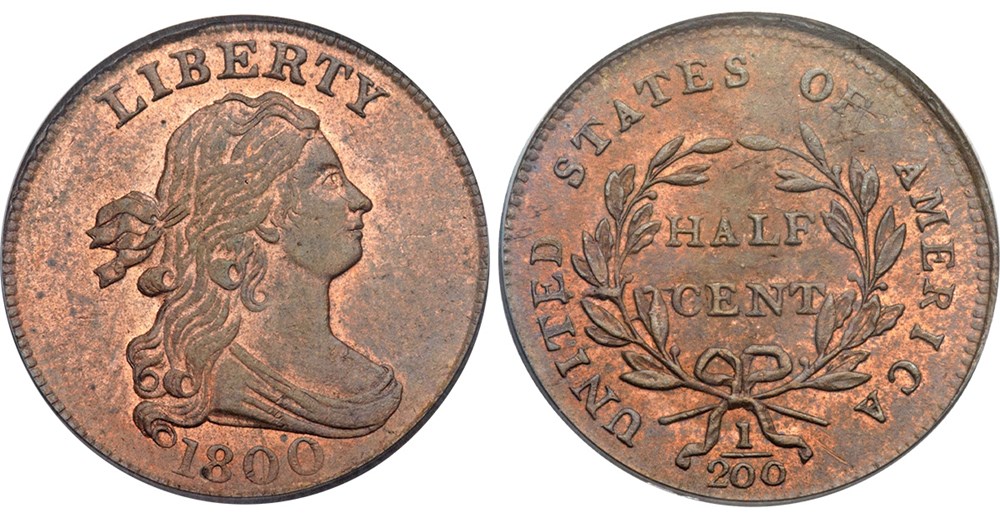
First-Year Draped Bust Half Cent
In 1800, there are no major varieties as only one obverse and one reverse dies are known. There were 202,980 1800-dated coins struck. His depiction of Miss Liberty was based on the design of Miss Liberty by American portraitist Gilbert Stuart. Born in Rhode Island colony, Stuart is best known for his unfinished portrait of George Washington, referred to as the Athenaeum Portrait. He was a prolific artist and painted over 1,000 portraits including those of the first six Presidents of the United States and a number of their wives.
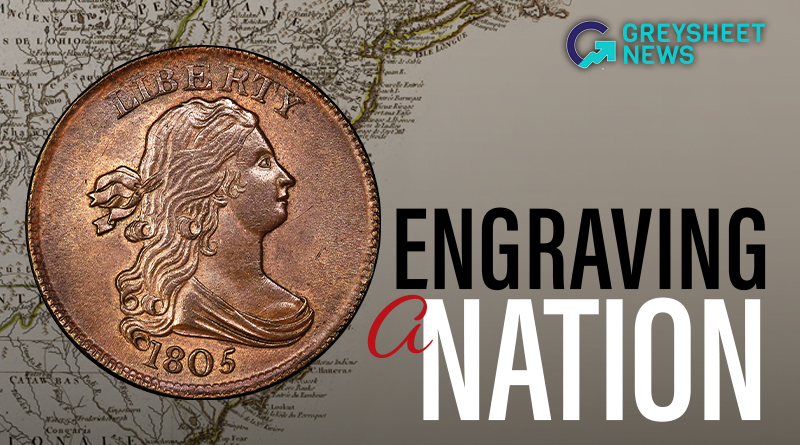
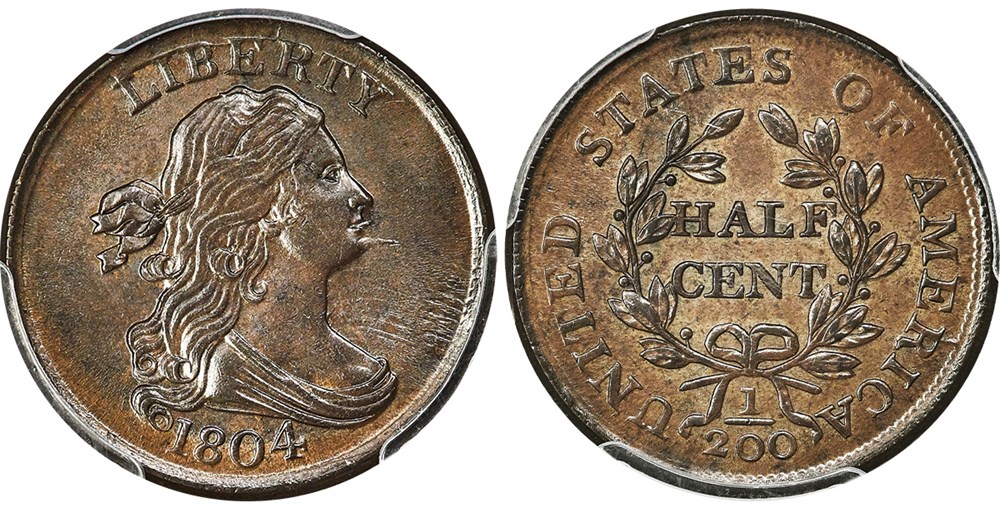
This Draped Bust design depicts more than the simple portrait of Miss Liberty. For the first time, she was depicted from her head down to her shoulders and down to her bust. Miss Liberty is facing to the right, her flowing hair tied in a ribbon behind her head. She is clothed in a flowing drapery and the word "LIBERTY," adorns the upper periphery. The date is positioned below her body.
The reverse of these Draped Bust Half Cents depicts an open wreath, of two branches tied at the bottom with a long ribbon. Enclosed within the wreath, on two lines, is the denomination "HALF CENT." Around most of the periphery is "UNITED STATES OF AMERICA," and below the ribbon is the numerical denomination "1/200."
This particular date is abundantly available in Good through Very Fine grades, less so in Extremely Fine condition. About Uncirculated specimens are scarce and Uncirculated coins are very scarce and the price is significantly higher than even high grade circulated coins.
No Half Cents were struck in 1801 due to the lack of demand and also due to the limited number of copper planchets that were available. But in 1802 the Mint cut down a number of spoiled Large Cent planchets and the Mint wound up striking 20,266 1802-dated coins.
This is the rarest date of the Draped Bust Half Cent series. There were two varieties of this date—the 1802/0 with the Reverse of 1800 and the 1802/0 with the Reverse of 1802. The reverse varieties are based on the positioning of the leaves in the wreath.
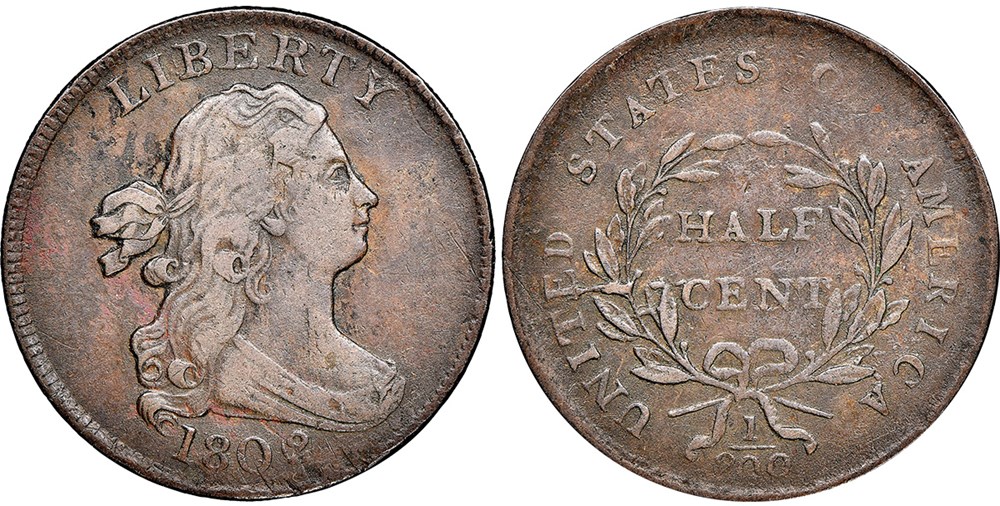
Likely the Finest Known Reverse of 1800
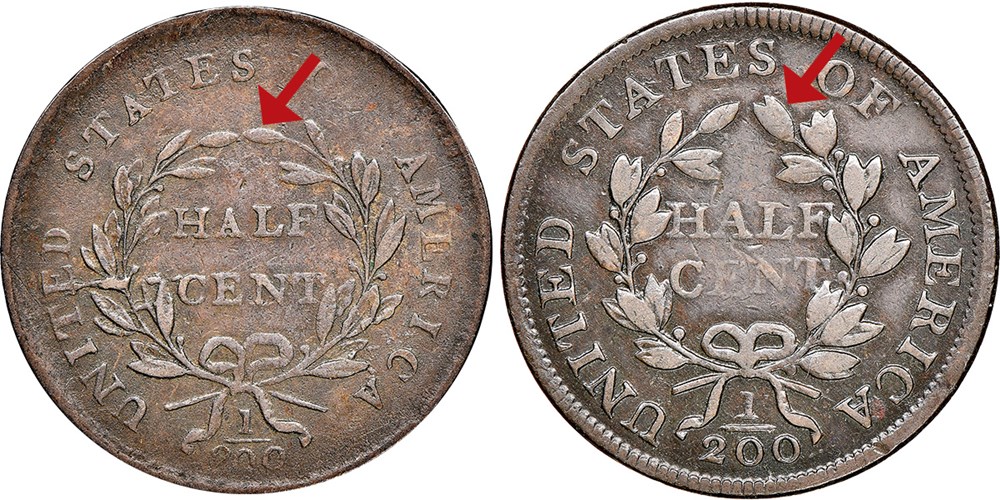
Right: Reverse of 1802. Double Leaf at Top-Right, Large Letters
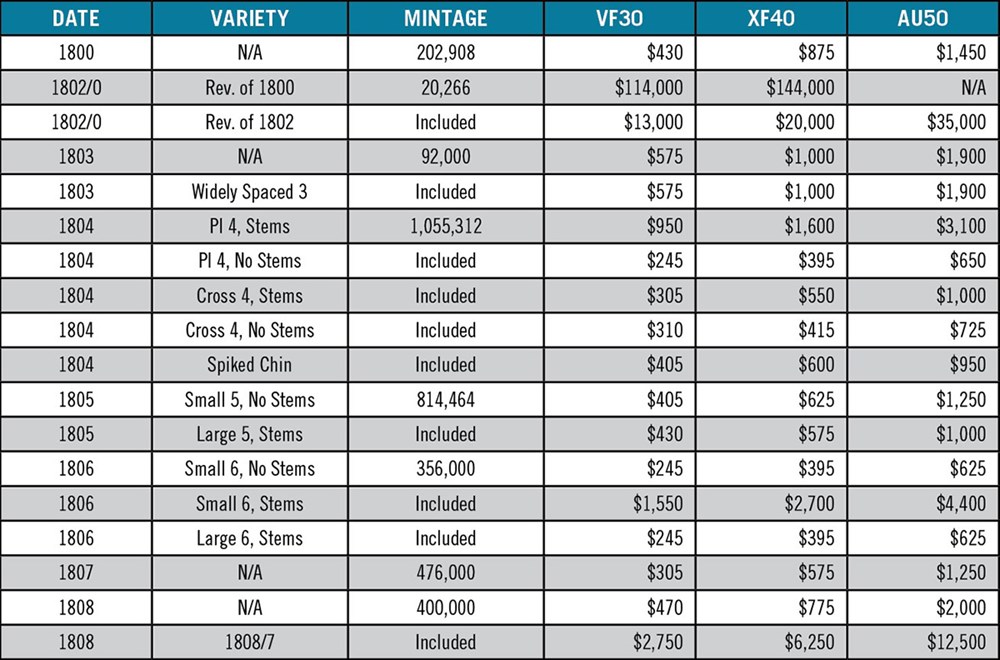
This is a true rarity and Stack’s Bowers stated in their auction catalog of the Harrington Collection in 2020 that the Reverse of 1800, Cohen-1 (C-1) variety has "an estimated population of only 30 to 50 coins." In 2021, Heritage auctioned an NGC-graded VF30 example of this C-1 rarity for $114,000. The 1802/0 with the Reverse of 1802 is still a very scarce coin but significantly overshadowed by the 1800 Reverse rarity.
In 1803, the US Mint struck 92,000 coins and there is one minor variety, a "Widely Spaced 3," but neither coin is scarce and they seem to be equally divided between varieties.
1804-dated coins have, by far, the highest mintages, (1,055,312) and there are 5 known varieties. There is an 1804 with a Plain 4 on the obverse and stems coming off the wreath on the reverse as well as an 1804 with a Plain 4 obverse and no stems coming off the wreath. Additionally, there is a Crosslet 4, with Stems and a Crosslet 4 without Stems. All four of these varieties are fairly common in mintage and price. The fifth and final variety is an 1804 called the "Spiked Chin" as it looks like there is a "Spike" coming out of Miss Liberty’s chin due to an anomaly in the die. While the variety is unusual, it is not a rare coin.
In 1805, the Mint struck 814,464 coins and there are three varieties, due to using various size numeral punches. There is a Medium (size) 5, that has a Stemless reverse, as well as a Small 5 with Stems and a Large 5 with Stems. The Small 5 with Stems is a scarce variety worth approximately 10 times the price of the other two varieties in low grade.
1806 saw 356,000 coins struck and again there are three varieties of 1806-dated Half Cents. There is a Small 6, with Stems, a Small 6, stemless and a Large 6 with Stems. The Small 6 with Stems is the scarcest of the 3 varieties , worth 2 times the value of the other two varieties.
In 1807 there is only one die variety for all of the 476,000 coins that were struck. Finally, in 1808, there is a Normal Date and an 1808 Over 7 variety. This overdate is about twice as valuable as the Normal Date in low grade.
This is a great series to collect as there are only 8 different dates and the common varieties are very affordable. For the more seasoned numismatist there are 19 total varieties with only one coin over $10,000 in low grade.

Related Stories (powered by Greysheet News)
View all news
The 1796 Draped Bust quarter dollar is a very important first-year of issue, one-year type coin and the only American quarter struck during the 18th century.

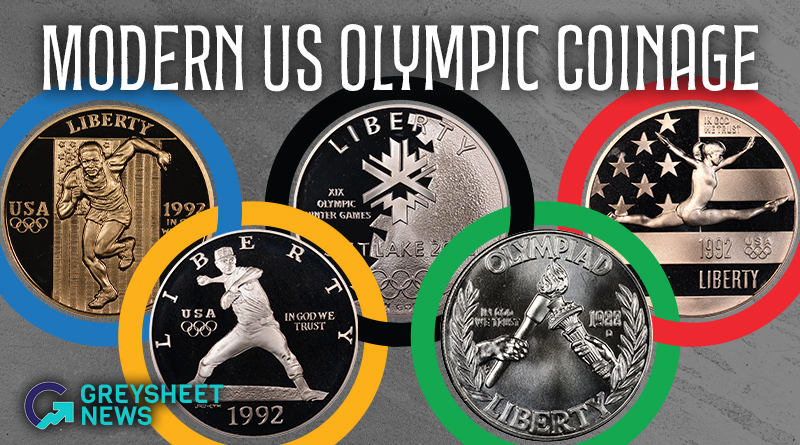
The Olympics as we know them began in 1896, but it took until 1952 for the first modern Olympic coin to be struck.
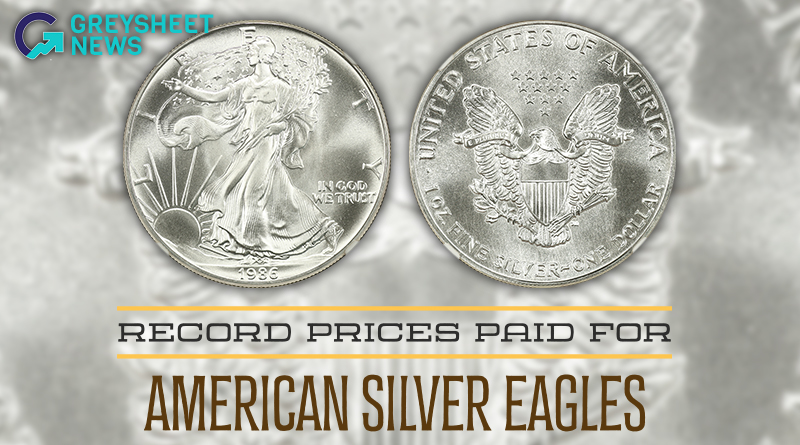
These coins typically have mintages in the tens of millions, but not all of these coins are common or sell for modest premiums.
Please sign in or register to leave a comment.
Your identity will be restricted to first name/last initial, or a user ID you create.
Comment
Comments