




 Whitman Expo
Atocha Silver Ingot Leads Heritage’s Shipwreck & Treasures World Coins Auction to $459,498
Atocha, 1715 Fleet and Whydah treasures among top highlights in Aug. 9 event.
by Heritage Auctions |
Published on August 12, 2026

Download the Greysheet app for access to pricing, news, events and your subscriptions.
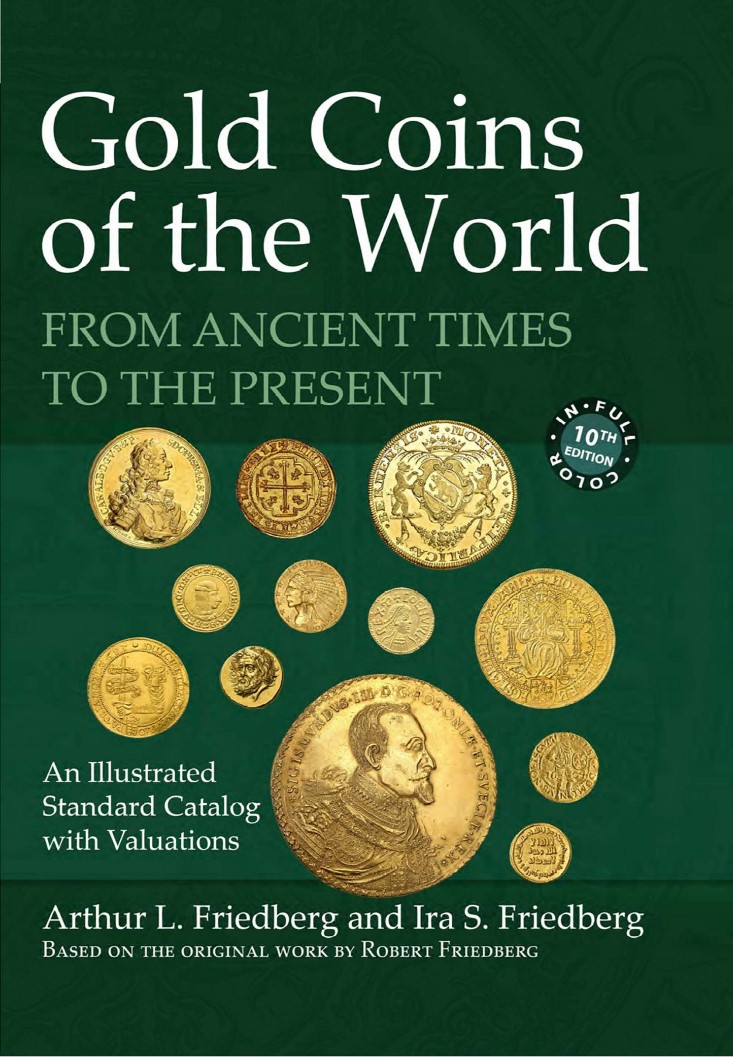
A massive silver ingot recovered from the legendary Nuestra Señora de Atocha shipwreck sold for $56,120 to lead Heritage’s Aug. 9 Spotlight: Shipwreck & Treasures World Coins Showcase Auction to $459,498.
The auction achieved a 100% sell-through rate by both value and lots sold, as collectors pursued historic shipwreck coins, precious-metal ingots and other maritime treasures recovered from some of the most celebrated wrecks in numismatic history.
Leading the event was a Philip IV silver “Atocha” Ingot of 36 lb (518 troy oz) ND (1622), salvaged from the Nuestra Señora de Atocha, which sank in 1622 off Key West, Florida. The hefty silver bar, weighing 16,125.21 grams, bears nine total stamps that provide clues to its original purpose and journey, including a manifest number, assayer’s bite, purity stamp, Quinto Tax seals, an owner/shipper monogram and a silver master mark. Originally destined for Spain, the ingot instead spent centuries beneath the sea before its recovery. It brought the auction’s top result at $56,120.
Gold associated with another legendary maritime disaster also drew significant interest. A Philip V gold “1715 Fleet” Cob 8 Escudos ND (1714) Mo-J MS62 NGC realized $31,720. Struck at the Mexico City Mint and salvaged from the 1715 Fleet shipwrecks off Florida’s Treasure Coast, the coin is an example of the desirable, short-lived “date on reverse” type, which is confirmed by its specific design. Its MS62 grade complements sharply struck designs and notable remaining sheen, combining preservation with a direct connection to one of the best-known shipwreck events in American waters.
A Philip V gold Cob 8 Escudos 1711 MXo-J AU Details (Mount Removed) PCGS, reached $20,740. The Mexico City issue displays the MXo-J mintmark and assayer clearly to the left of the shield and represents the rare “bar end cross” variety, distinguished by “ears” visible in the corners of the reverse cross. Struck only in 1711 and 1712, the variety offers collectors a narrowly defined issue within the broader Spanish colonial gold series.
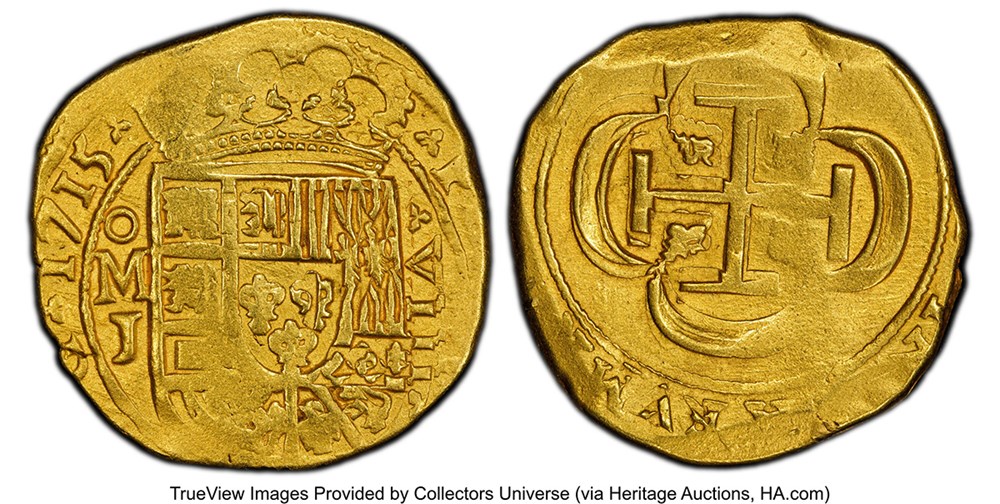
Also finishing at $20,740 was a Philip V gold Cob 8 Escudos 1715 Mo-J AU Details (Mount Removed) PCGS. The date appears clearly to the left of the shield, linking the coin to the year of the famed 1715 Fleet disaster off Florida’s Treasure Coast. Listed as Extremely Rare in the supplied catalog references, the 26.87-gram 8 Escudos retains sharp, clear features despite its noted mount removal.
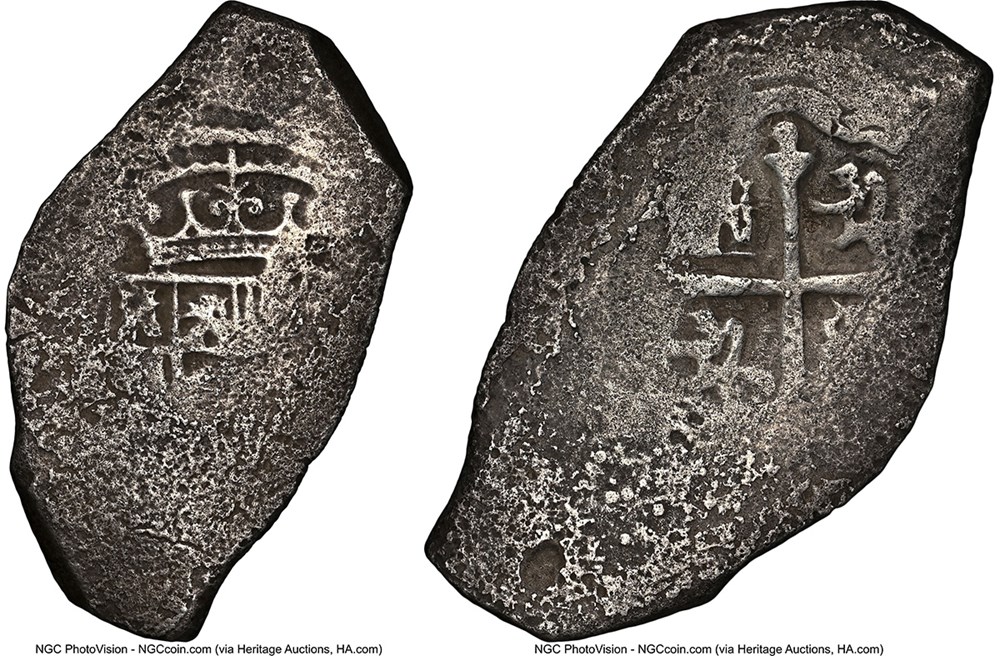
A coin connected to perhaps the most evocative name in pirate shipwreck history also ranked among the auction’s leading results. A Philip V “Whydah” Cob 8 Reales ND (1701-1717)-Mo Fine Details (Sea Salvaged) NGC sold for $18,300. The coin was recovered from the Whydah, which sank in 1717 off Cape Cod, Massachusetts.
The Whydah’s story gives the piece a distinctive place among shipwreck coins. After Barry Clifford located the lost pirate ship, investors who had funded the project received coins from the wreck as tokens of their contribution to the recovery. Artifacts and treasure from the wreck ultimately became part of the Whydah Pirate Museum in Massachusetts, making coins from the wreck a tangible connection to the ship’s history.
Another 1714 Mexico City 8 Escudos added $16,470 to the auction total. The Philip V gold Cob 8 Escudos ND (1714) Mo-J AU Details (Removed From Jewelry) NGC represents the “date on reverse” type struck only in 1714. Although its reverse date is no longer visible, the arrangement of the Jerusalem cross allows the variety to be attributed and dated even with incomplete legends.
Earlier Spanish colonial maritime history was represented by a Charles & Johanna gold “Golden Fleece Shipwreck” Splash (Oro Corriente) of 15.50 grams ND (c. 1550), which realized $14,640. Marked with a fineness stamp and formed as a flattened piece of gold with clear markings, the piece illustrates an early form of precious metal in circulation during the period of colonization. Such oro corriente could take the form of pieces chopped from larger ingots or bars or pieces of smelter splatter collected during the assaying process.
Rounding out the auction’s notable ingot results was a Dutch Colony United East India Company “Rooswijk” silver bar of 1,973 grams ND (1700s), which sold for $12,200. Salvaged from the Rooswijk, which sank in 1739 off the Goodwin Sands in southeast England, the well-preserved bar bears three stamps, including the famous VOC monogram with an “A” identifying the Chamber of Amsterdam, along with a billy goat assayer/foundry mark. An assayer’s bite remains visible on one corner.
Complete results can be found at HA.com/61643.

Related Stories (powered by Greysheet News)
View all news
Casascius Bitcoin, BTCC “Poker Chip” and elite modern gold Proof issues bring strong results in Heritage's July 26 event.

Ancient Islamic gold, Alexander the Great staters and exceptional Sasanian rarities highlight strong demand in Heritage's July 20-21 event.
Demand for eye-appealing and premium quality coins pushes Heritage Auctions' July 20 event over $237,000.
Please sign in or register to leave a comment.
Your identity will be restricted to first name/last initial, or a user ID you create.
Comment
Comments