




 Whitman Expo
Albania. New Silver Proof Coins Honour Prominent Educator and Women’s Rights Advocate
The Bank of Albania release new silver proof coins to observe Teachers' Day and Women's Day.
by Michael Alexander |
Published on March 17, 2026

Download the Greysheet app for access to pricing, news, events and your subscriptions.
Subscribe to RQ Red Book Quarterly for the industry's most respected pricing and to read more articles just like this.
Advertisement
The 7th and 8th March are celebrated jointly as Albanians remember with gratitude the extraordinary contribution of all Albanian teachers and the women who have helped build the country’s education system. Known as the first Albanian teacher, Sevasti Qiriazi Dako (1871 – 1949) – (also known as Sevasti D. Kyrias) together with her family, made an extraordinary contribution to the development of national education at a time when illiteracy prevailed in the country and teaching was conducted mainly in foreign languages. Qiriazi is also remembered as the initiator of the organization of national education for women. It was on the 7th March 1887, the first Albanian Teacher's School was opened in the town of Korça, a historic moment that marked the beginning of education in the Albanian language.
Born into the patriotic Qiriazi family in the town of Tërnovë, Monastir, a part of the Ottoman Empire – in present-day Northern Macedonia, she was the sixth of ten children. As her family’s religious background was Greek Orthodox, and she began attending a Greek-language primary school organised by the Church as was customary from age of four. She was also able to attend the American College for Girls at Constantinople from 1888 to 1891 which was arranged by her brother Gjerasim Qiriazi. She was admitted as a sophomore and graduated with a class of eight other women and received a Bachelor of Arts degree. Sevasti became the first Albanian woman to complete a University education and receive a degree. After her studies, she returned to her home town of Korça and in October 1891, with the help of her brother Gjerasim, she opened the first-ever national Albanian Girls' School. The school would go on to serve as a model of Albanian schools based on a secular model and not based on a religious curriculum.
After the closure of the Boy’s school in Korça, the Girl’s school remained the only faculty in Southern Albania where reading and writing could be taught in the Albanian language. Although attending the Qiriazi’s school brought the risk of girls and their parents being persecuted by the Ottoman authorities, the classes remained full. Both Christian and Moslem girls learned to read and write in Albanian and would teach their lessons to their brothers. Sevasti Qiriazi-Dako wrote, edited and published a grammar curriculum for primary schools in 1912 and also edited a series of history textbooks, she remains the only Albanian woman to have done so.
Sevasti Qiriazi married in Kristo Dako (1880 – 1941) in 1910, he became a prominent journalist, the couple welcomed two sons Aleksandër (1910–1995) and Gjergj (1913–1949). In 1914, due to hostilities with Greek forces in Korça, Sevasti, her husband and their two children were forced to flee Albania, and the Girls School was closed. The family were able to emigrate to the United States, settling in Southbridge, Massachusetts, home to a thriving Albanian community, particularly during the early part of the 20th century. Sevasti assisted her sister Parashqevi who also emigrated to the US in publishing the semi-monthly periodical Yll'i Mëngjezit (Morning Star) aimed at ex-patriot Albanians from 1917 to 1920.
At the end of 1921 Qiriazi, her husband and children returned to Albania, where her husband had previously returned to work with the Albanian government. As a second initiative, soon after their return, Sevasti together with her husband Kristo and sister Parashqevi founded a new institution of female education in Tirana. Though privately funded, it was considered a national school, open to all districts, classes and religious beliefs. The family began construction of another facility in Kamëz which provisionally opened in 1927 and fully completed in 1929. It was King Zog I, head of the newly independent country of Albania and whose two sisters had attended the school in Tirana, visited and inaugurated the new campus. In 1931 the school in Tirana celebrated the 40th anniversary of its founding, viewing itself as a continuation of the Girls School founded in Korçë in 1891. Many dignitaries, Albanian and foreign, attended the ceremony.
The arrival of hostilities in 1939 also brought personal danger to members of the Qiriazi family and with the outbreak of war, Sevasti and her family were imprisoned and deported to the Banjica concentration camp near Belgrade. At the conclusion of the war, she and family were returned to Albania where a hostile communist government took over the family’s schools and evicted the Qiriazi’s from their home. In 1946 Sevasti's sons Aleksandër and Gjergj were arrested and imprisoned with her youngest son dying in prison in 1949. Sevasti died the same year in Tirana, having lost the family’s properties to confiscation and over the death of her son. It wasn’t until 1959 that members of the Qiriazi family and Sevasti specifically began to regain recognition in Albania for their contributions to the country’s education system as well as for the emancipation of women. She was posthumously decorated with the Order of Freedom in 1960, the Medal for Patriotic Activity in 1962 and named a Teacher of the People in 1987.
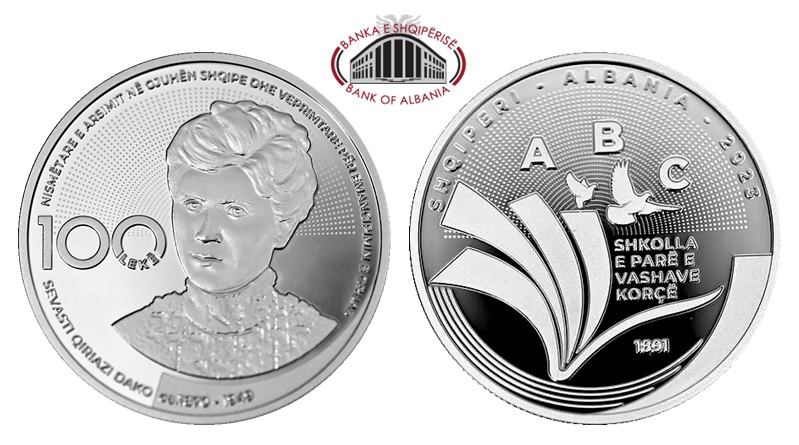
Originally minted in 2023, the silver proof coins have now been officially released by the Bank of Albania. The obverse side features an image of Sevasti Qiriazi-Dako positioned to the right and based on a composite of photos. In the background and in the shape of a semi-circle is a pattern of dots placed to the upper half. To the left of Qiriazi-Dako’s image is the face value of 100 LEKE which incorporates the numeral 100 and name of the Albanian currency. Along the upper rim and above the primary design is the inscription NISMËTARE E ARSIMIT NË GJUHËN SHQIPE DHE VEPRIMTARE PËR EMANCIPIMIN E GRUAS. (Pioneer of education in the Albanian language and activist for the emancipation of women) Along the lower rim is the additional text SEVASTI QIRIAZI-DAKO ca. 1870 – 1949. The reverse side features a stylised open book centred, from which two doves emerge, symbolising freedom and the spread of knowledge. Above the book and doves are the letters A B C representing the study of the alphabet. Beneath one dove and in between an open book page is the inscription SHKOLLA E PARË E VASHAVE KORÇË (First Girls' School in Korça) and its year of foundation, 1891. Above the primary design and along the upper rim is the name of the issuing country and the year of minting SHQIPËRI - ALBANIA - 2023.
| Denomination | Metal | Weight | Diameter | Quality | Maximum Mintage |
| 100 Leke | .925 Silver | 30 g. | 38 mm. | Proof | n/a |
Available from the 9th March, the coin is encapsulated and accompanied with a certificate of authenticity. For additional information, please visit the retail page of the Bank of Albania Museum shop.
Related Stories (powered by Greysheet News)
View all news
The Perth Mint release new silver proof coins highlighting the DUNE Trilogy.

The Royal Mint release this year's sought-after Britannia range of proof quality gold and silver coins.
The Bank of Greece release new silver proof collector coins honouring a pioneer in Astronomy.
Please sign in or register to leave a comment.
Your identity will be restricted to first name/last initial, or a user ID you create.
Comment
Comments